
Identifying Work Patterns That Lead to Gradual Burnout

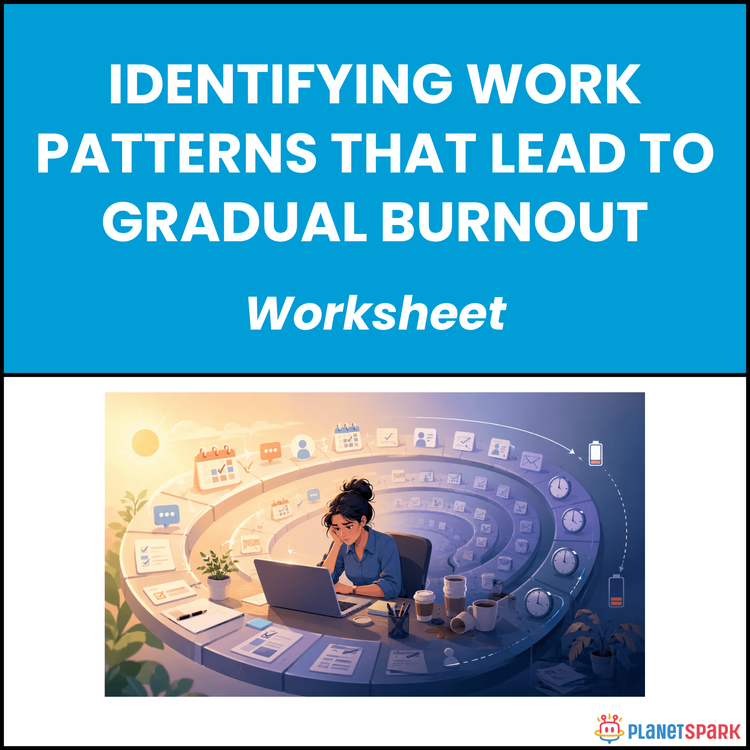
Identifying Work Patterns That Lead to Gradual Burnout
Identifying Work Patterns That Lead to Gradual Burnout: A Practical Worksheet to Catch Burnout Early
Introduction
Burnout does not usually happen overnight.
For many working professionals, it starts with small habits that feel harmless at first. You answer one late-night message. You skip one break to finish a task. You say yes to extra work because saying no feels uncomfortable. You keep telling yourself that things will calm down soon.
But over time, those repeated patterns begin to drain your energy, focus, and motivation.
The worksheet Identifying Work Patterns That Lead to Gradual Burnout helps professionals notice these patterns early. It is designed to help you understand what is happening in your daily work life before exhaustion becomes a serious problem.
Instead of giving general advice like “rest more” or “set boundaries,” this resource helps you identify your specific burnout patterns, understand your warning signs, and choose small practical changes that are easier to apply.
Who Is This Resource For?
This resource is useful for working professionals who want to stay productive without ignoring their wellbeing.
It is especially helpful for:
Early-to-mid career professionals who are managing growing responsibilities
Career switchers who feel pressure to prove themselves
Job seekers dealing with uncertainty, rejection, and emotional fatigue
Consultants who manage client demands and shifting expectations
Managers who carry team pressure, emotional labour, and decision fatigue
High-performing professionals who often overcommit or stay constantly available
Busy professionals who want a practical self-reflection tool instead of theory
If you often feel tired, disconnected, resentful, or mentally overloaded, this worksheet gives you a structured way to understand what may be driving those feelings.
What Does This Resource Contain?
The resource includes a clear burnout pattern-recognition framework that helps you move from vague stress to specific insight.
1. Introduction to Gradual Burnout
The worksheet explains how burnout builds slowly through repeated work habits. These habits may include checking messages after hours, skipping meals, taking on extra work, or pushing through fatigue for too long.
It also makes clear that this is not a diagnostic tool. It is a practical self-awareness worksheet that helps you recognise patterns before they become harder to manage.
2. The Slow Erosion Model
The worksheet explains burnout as a process with three stages:
Engagement: You have energy, motivation, and a strong sense of purpose.
Erosion: You begin to feel overextended, tired, resentful, or disconnected.
Depletion: You experience emotional numbness, low energy, and reduced effectiveness.
The worksheet focuses mainly on the erosion stage because this is where early action can make the biggest difference.
It also explains three common dimensions of burnout:
Exhaustion: Feeling physically and emotionally drained
Cynicism: Becoming emotionally distant from work or people
Inefficacy: Feeling that your effort is not making a meaningful difference
This helps you understand which part of burnout may be showing up first in your own work life.
3. The Five Work Patterns That Fuel Burnout
The worksheet identifies five common work patterns that often lead to gradual burnout.
The Always-On Availability Trap
This happens when you feel the need to stay reachable all the time. You respond to messages outside work hours, check your phone during personal time, and struggle to fully disconnect.
Over time, this removes the recovery time your mind and body need.
The Invisible Overcommitment Loop
This pattern appears when you keep accepting work outside your role or capacity because you want to be helpful, avoid conflict, or prove your value.
Each task may seem small, but the total load becomes exhausting.
The Perfectionism-Delay Spiral
This happens when you spend too much time improving work that is already good enough. You keep revising, reviewing, and comparing your output to others.
The pressure does not always come from the workload itself. Sometimes it comes from the standards you keep raising for yourself.
The Emotional Labour Accumulation
This pattern is common among managers, consultants, and people-facing professionals.
It includes managing other people’s stress, suppressing your own frustration, performing enthusiasm, or absorbing tension without support.
Emotional labour is real work, even when it does not appear on a task list.
The Purpose-Drift Disconnect
This happens when your daily work starts feeling disconnected from the reason you cared about it in the first place.
You may still be performing well, but the work begins to feel less meaningful or personally fulfilling.
4. Pattern Recognition Checklist
The worksheet includes a checklist to help you identify which burnout patterns are active for you.
You review statements related to availability, overcommitment, perfectionism, emotional labour, and purpose drift.
If several statements have been true for the past four to six weeks, it may be a sign that you are in the erosion stage and need to take action.
5. Burnout Signals: Language, Behaviour, and Body
The worksheet helps you notice burnout signals in three areas.
Language signals include phrases like:
“I’m fine, just tired.”
“I just need to push through.”
“No one else will do it if I don’t.”
Behavioural signals include:
Skipping breaks or meals
Withdrawing from colleagues
Procrastinating on work you used to enjoy
Becoming irritated in small situations
Producing lower-quality work despite trying harder
Body signals include:
Persistent fatigue
Headaches or neck tension
Poor sleep
Feeling physically heavy at the start of the workday
Getting sick more often
This section is useful because many professionals ignore early warning signs until they become serious.
6. Reflection Prompts
The worksheet includes reflection questions to help you build your personal burnout pattern map.
You are guided to:
Identify your primary pattern
Name the trigger behind it
Track what the pattern has cost you
Understand what the pattern gives you
Choose one small change you can make this week
This is one of the most practical parts of the resource because it helps you understand why a pattern continues, not just that it exists.
7. Real-World Case Example
The worksheet includes the example of Priya, a product manager who looked successful from the outside but was slowly moving toward burnout.
Her main pattern was overcommitment. She kept taking on tasks outside her official goals because she feared being seen as unhelpful.
Her micro-shift was simple: before accepting any task outside her goals, she gave herself a 24-hour decision window.
This small change helped her create space, reduce automatic yeses, and think more clearly.
8. Common Mistakes and Fixes
The resource also explains common mistakes professionals make when dealing with burnout.
These include:
Waiting for a big warning sign before acting
Treating rest as a reward instead of a requirement
Calling yourself lazy instead of naming the pattern
Trying to change everything at once
Keeping your struggles private
Each mistake is paired with a practical fix, making the advice easy to apply.
9. The 4-Week Burnout Pattern Audit
The worksheet ends with a simple four-week early warning system.
Week 1: Set your baseline by rating your energy, purpose, and effectiveness.
Week 2: Check whether your main pattern is becoming stronger or weaker.
Week 3: Review your language, behaviour, and body signals.
Week 4: Review your micro-shift and decide what to adjust next.
This weekly audit takes less than 10 minutes and helps you stay aware before burnout becomes more serious.
Summary of the Resource
Identifying Work Patterns That Lead to Gradual Burnout is a practical worksheet for professionals who want to catch burnout early.
Its main message is clear: burnout often follows patterns.
When you can name those patterns, you can respond to them more effectively.
The worksheet helps you identify what is draining your energy, what triggers your behaviour, what the pattern is costing you, and what small change you can make next.
It is not about blaming yourself. It is about understanding your habits and making better choices before exhaustion becomes your normal way of working.
How Will This Resource Be Useful?
This resource is useful because it gives you clarity.
Many professionals know they feel tired or disconnected, but they do not know exactly why. This worksheet helps you identify the specific work patterns behind those feelings.
It helps you spot burnout early.
By reviewing your habits, language, behaviour, and body signals, you can notice warning signs before they become a crisis.
It helps you understand your personal pattern.
Instead of treating burnout as one big problem, the worksheet breaks it into five clear patterns. This makes the issue easier to understand and act on.
It reduces self-blame.
The worksheet explains that these patterns are not personal failures. They are often strategies that once helped you succeed but have become unsustainable.
It supports better boundaries.
Once you know your triggers and costs, it becomes easier to decide where you need to pause, say no, ask for support, or adjust expectations.
It encourages small, realistic change.
The worksheet focuses on micro-shifts instead of major life overhauls. This makes the process manageable for busy professionals.
It builds long-term self-awareness.
The four-week audit helps you create a habit of checking in with yourself regularly, instead of waiting until you feel completely drained.
How Should You Use This Resource?
Use this worksheet slowly and honestly. Do not treat it like a quick form to complete and forget.
Step 1: Read the full worksheet once.
Start by reading the entire resource from beginning to end. This will help you understand the framework before you begin reflecting.
Step 2: Complete the checklist.
Go through the pattern recognition checklist based on your real experience over the past four to six weeks.
Do not answer based on what you think you should feel. Answer based on what has actually been happening.
Step 3: Identify your main pattern.
Look at your checklist responses and choose the pattern that seems most active right now.
It may be always-on availability, overcommitment, perfectionism, emotional labour, or purpose drift.
Step 4: Complete the reflection prompts.
Set aside 20 to 30 minutes to answer the worksheet questions properly.
Write down your pattern, trigger, cost, payoff, and one small change you can make.
Step 5: Choose one micro-shift.
Do not try to fix everything at once.
Choose one small action that is specific and realistic.
For example:
I will not respond to non-urgent messages after 8 PM.
I will wait 24 hours before accepting work outside my scope.
I will submit completed work without doing unnecessary extra revisions.
I will take a short reset break after emotionally demanding meetings.
I will reconnect one weekly task to a larger career goal.
Step 6: Start the 4-week audit.
Use the weekly audit to track your energy, purpose, effectiveness, warning signals, and progress.
This helps you notice changes before they become serious.
Step 7: Revisit the worksheet monthly.
Your burnout patterns may change as your role, workload, or goals change.
Return to the worksheet regularly so you can keep your self-awareness current.
Action Steps
After using this resource, take these next steps:
Read the full worksheet carefully.
Complete the pattern recognition checklist.
Identify your primary burnout pattern.
Write down one trigger that activates this pattern.
Complete the reflection prompts honestly.
Choose one small micro-shift for this week.
Set a weekly 10-minute reminder for your burnout audit.
Share one insight with a trusted colleague, friend, mentor, or coach.
Review your progress after one month and choose your next small change.
Burnout prevention is not about doing less because you are less capable.
It is about working in a way that protects your energy, focus, and long-term performance.
This worksheet gives you a practical system to notice your patterns early, understand what they are costing you, and take small actions before burnout becomes a crisis.
For ambitious professionals, protecting your energy is not a luxury. It is a professional skill.
Use this resource honestly. Revisit it regularly. Let it help you build a healthier and more sustainable way of working.