
Improving Verbal Communication Skills Guide

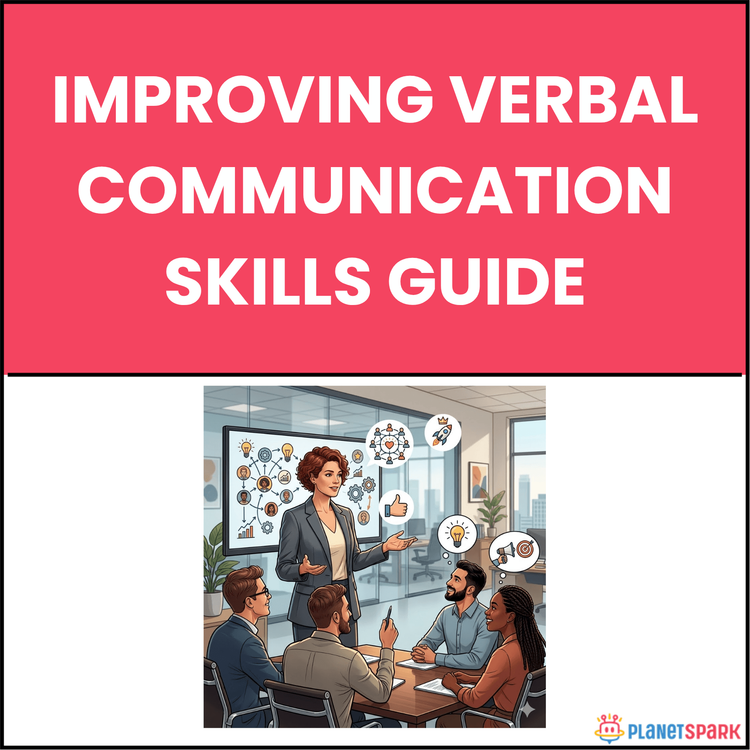
Improving Verbal Communication Skills Guide
Verbal Communication Mastery at Work and Practical Techniques to Speak Clearly and Confidently
You’ve likely experienced this before — you have a strong idea, you understand the problem deeply, but when it’s time to speak, something doesn’t land. You over-explain, lose your train of thought, or feel your confidence drop mid-sentence. And in that moment, it’s not your capability that’s being judged — it’s your communication.
For most working professionals, this gap between thinking and speaking becomes a silent career limiter. Despite years of experience, very few people receive structured, practical guidance on how to communicate effectively in real-world situations.
This is exactly where the Improving Verbal Communication Skills Guide steps in. It is not a theoretical resource. It is a practical, action-driven guide designed to help you think clearly, speak confidently, and communicate with impact in every professional setting. :contentReference[oaicite:0]{index=0}
Who Is This Resource For?
This guide is designed for working professionals who want to improve how they communicate in high-impact situations. It is especially valuable for:
- Early-career professionals trying to build credibility in meetings
- Managers handling team discussions, feedback, and difficult conversations
- Consultants and client-facing professionals presenting ideas to stakeholders
- Job seekers and career switchers preparing for interviews
- Professionals who feel unheard, misunderstood, or lacking confidence while speaking
If you’ve ever struggled to articulate your thoughts clearly or felt overlooked despite having strong ideas, this resource is built for your reality.
What Does This Resource Contain?
The guide is structured as a complete, practical system for improving verbal communication, built around clear frameworks, tools, and exercises.
Here’s what you’ll find inside:
- A Three-Pillar Framework for communication mastery:
- Clarity (organising your thinking before speaking)
- Delivery (how you say what you say)
- Adaptability (adjusting based on your audience)
- Practical frameworks like:
- PREP (Point → Reason → Example → Point) for structured communication
- SBI (Situation → Behaviour → Impact) for difficult conversations
- Actionable worksheets and tools:
- Message Clarity Worksheet to prepare for important conversations
- Pre-Conversation Confidence Checklist for quick mental preparation
- Post-Conversation Debrief Framework to improve consistently
- Real-world communication scenarios:
- Speaking up in meetings
- High-stakes presentations
- Difficult conversations
- Handling unexpected questions
- A 30-day practice plan designed for busy professionals
- A self-assessment tool to track improvement and identify gaps
- Advanced techniques like storytelling and strategic listening
Every section is built for immediate application, not passive reading. :contentReference[oaicite:1]{index=1}
Summary of the Resource
This guide provides a structured, step-by-step system to help you:
- Think clearly before you speak
- Communicate ideas in a concise and structured way
- Deliver messages with confidence and authority
- Adapt your communication based on different audiences
- Handle high-pressure situations with control and clarity
Instead of generic tips, it gives you repeatable frameworks and tools that you can use daily to improve how you communicate at work.
How Will This Resource Be Useful?
The real value of this guide lies in how directly it translates into real-world outcomes.
By applying this resource, you will:
- Speak with clarity instead of rambling or over-explaining
- Build confidence in meetings, presentations, and conversations
- Be taken more seriously and heard more often
- Reduce anxiety in high-stakes situations
- Handle objections and questions more effectively
- Communicate your ideas in a way that influences decisions
Over time, these improvements compound into stronger professional presence, better relationships, and faster career growth.
How Should You Use This Resource?
This guide is designed to be flexible and practical for time-poor professionals. You can use it in multiple ways depending on your needs:
1. Read it end-to-end
Start with the full framework to understand how clarity, delivery, and adaptability work together.
2. Use it situationally
Jump to specific sections based on your immediate challenge — meetings, presentations, or difficult conversations.
3. Apply the worksheets and checklists
Use the Message Clarity Worksheet before important conversations and the Pre-Conversation Checklist for quick preparation.
4. Build a daily habit
Follow the 30-day practice plan with small, consistent improvements.
5. Reflect and improve
Use the Post-Conversation Debrief Framework to learn from every interaction.
The goal is not to consume the guide once, but to use it repeatedly until the frameworks become second nature.
Action Steps
If you want to start seeing results immediately, follow these simple steps:
1. Define your core message
Before your next conversation, write down your one key point in a single sentence.
2. Use the PREP framework
Structure your response clearly using Point → Reason → Example → Point.
3. Run the pre-conversation checklist
Spend 5–10 minutes preparing before any important interaction.
4. Replace filler words with pauses
Start noticing and reducing words like “um,” “like,” and “basically.”
5. Reflect after one conversation today
Identify one thing you did well and one thing to improve.
6. Commit to consistency
Follow the 30-day plan with small daily actions rather than occasional effort.
The difference between knowing and improving is action — and this guide is built to help you take that action consistently.
Strong communication is not about personality or natural talent. It is a skill that can be developed with the right structure and practice. The professionals who stand out are not the ones who speak the most — they are the ones who speak with clarity, purpose, and impact.
This guide gives you that structure. The next step is yours — to apply it in your next meeting, your next presentation, and your next conversation.