
Influence Tactics Comparison Worksheet

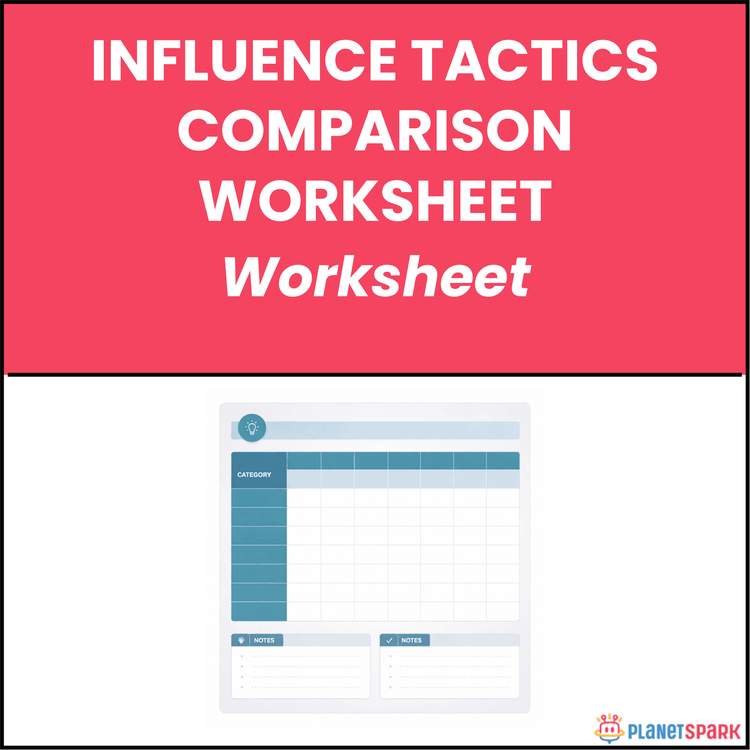
Influence Tactics Comparison Worksheet
Influence Tactics Comparison Worksheet: A Practical Guide to Mastering Workplace Influence and Persuasion
You’ve been there before. You had a strong idea, solid logic, and clear intent—but the meeting ended with no decision, no buy-in, and no movement. It’s not that your idea lacked merit. It’s that it didn’t land the way it needed to.
In today’s workplace, success is not just about what you know—it’s about how effectively you influence others. Whether you’re trying to align a team, manage upward, or gain stakeholder approval, your ability to influence determines how fast and how far your ideas go.
The Influence Tactics Comparison Worksheet is designed to solve this exact problem. Instead of leaving influence to instinct or personality, this resource gives you a structured, practical system to choose the right approach for every situation—so your ideas don’t just exist, they get implemented.
Who Is This Resource For?
This resource is especially valuable for:
- Early to mid-career professionals (0–15 years experience) who want to increase their impact
- Career switchers looking to build credibility quickly in new environments
- Managers who need to lead without relying solely on authority
- Consultants who depend on client buy-in for success
- Professionals who feel their ideas are often overlooked or not taken seriously
- Anyone who wants to communicate more persuasively in high-stakes situations
If your role requires influencing decisions, aligning people, or driving action—this resource is built for you.
What Does This Resource Contain?
This worksheet is not just a guide—it’s a complete influence system. It includes:
- A breakdown of six core influence tactics:
Rational Persuasion, Inspirational Appeal, Consultation, Exchange, Coalition Building, and Legitimating
- A detailed comparison matrix:
Shows when to use each tactic, who it works best with, expected outcomes, common mistakes, and risks of overuse
- A situational decision framework:
Helps you analyze audience, relationship, and context before choosing your approach
- A Situation Planner Worksheet:
A structured tool to prepare for real conversations, presentations, and negotiations
- A self-assessment tool:
Helps you identify your default influence style and uncover blind spots
- Real-world case studies:
Demonstrates how professionals successfully applied these tactics in actual workplace scenarios
- A mistakes and fixes guide:
Highlights common influence errors and shows how to correct them immediately
- A reflection checklist:
Builds a habit of continuous improvement after every important interaction
- A quick reference guide:
A condensed version of all tactics for fast decision-making before high-stakes moments
Summary of the Resource
This worksheet equips you with a practical, repeatable system to influence effectively at work. Instead of relying on one default style, you learn how to adapt your approach based on the situation, audience, and desired outcome.
It transforms influence from guesswork into a deliberate skill—helping you plan conversations, choose the right tactic, and refine your approach through reflection.
How Will This Resource Be Useful?
Using this resource consistently can lead to tangible professional outcomes:
- Improved decision-making influence in meetings and discussions
- Stronger stakeholder and client buy-in
- Increased confidence in high-stakes conversations
- Better alignment across teams and functions
- Faster execution of ideas and initiatives
- Enhanced credibility as a strategic thinker and communicator
Most importantly, it helps you move from “having good ideas” to “getting those ideas accepted and acted upon.”
How Should You Use This Resource?
To get the most value, approach this resource as a system—not a one-time read.
Step 1: Read Through the Entire Resource
Understand all six influence tactics and how they differ.
Step 2: Identify Your Default Style
Complete the self-assessment to see which tactics you naturally rely on.
Step 3: Use the Comparison Table
Before any important interaction, match your situation to the most suitable tactic.
Step 4: Plan with the Situation Planner
Write down your objective, audience insights, and chosen tactics before entering the conversation.
Step 5: Apply in Real Conversations
Use the planned approach in meetings, presentations, or negotiations.
Step 6: Reflect and Improve
After the interaction, use the reflection checklist to evaluate what worked and what didn’t.
Step 7: Build a Pattern Over Time
Track multiple situations to identify patterns in your behavior and outcomes. This is where true expertise develops.
Action Steps
Start applying the worksheet immediately with these simple steps:
1. Identify one upcoming conversation where you need to influence an outcome
2. Define clearly what success looks like for that situation
3. Analyze your audience—what do they care about most?
4. Choose one primary influence tactic and one backup
5. Plan your opening statement intentionally
6. Use the Situation Planner Worksheet before the conversation
7. After the interaction, complete the reflection checklist
8. Repeat this process consistently for the next 5–10 interactions
Even a five-minute preparation using this framework can significantly improve your results.
The professionals who grow fastest are not the ones who communicate more—they are the ones who communicate more strategically. Influence is not about being louder, more forceful, or more persuasive by default. It is about being intentional, adaptable, and aligned with what others need to say yes.
This resource gives you a structured way to build that capability. The more you use it, the more natural it becomes. Over time, you will stop guessing what works and start knowing what works—before you even enter the room.
Your next conversation is your next opportunity to apply this system. Use it deliberately, reflect on it honestly, and improve with every interaction. That is how influence becomes a career-defining skill.
Book your free session today!