
Interview Storytelling Storyboard

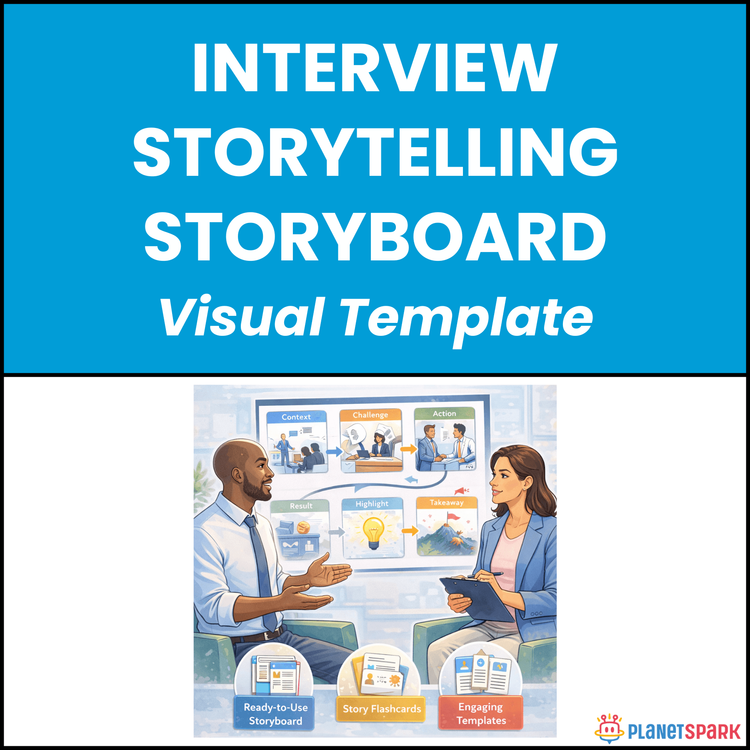
Interview Storytelling Storyboard
Master Interview Storytelling: Build Powerful STAR+ Stories That Impress Hiring Managers
You’ve done meaningful work in your career — solved problems, handled pressure, delivered results. But when an interviewer says, “Tell me about a time you handled a difficult situation,” something strange happens.
You either go blank… or you start talking without structure — and lose the interviewer halfway through.
This isn’t a lack of experience. It’s a lack of storytelling structure.
Most professionals are never taught how to turn their work into compelling narratives. And that’s exactly what interviews demand. Hiring managers aren’t just evaluating your skills — they’re asking, “Can I picture this person solving problems in my team?”
The Interview Storytelling Storyboard is designed to solve this. It gives you a repeatable system to craft, structure, and deliver interview stories that are clear, memorable, and impactful.
Who Is This Resource For?
This resource is ideal for professionals who want to improve their interview performance through structured storytelling:
- Job seekers preparing for interviews across industries
- Career switchers who need to reposition their experience
- Managers and professionals stepping into leadership roles
- Candidates struggling with behavioral interview questions
- Professionals who tend to ramble or lack clarity in answers
If you’ve ever felt “I know the answer, but I don’t know how to say it,” this resource is built for you.
What Does This Resource Contain?
The Interview Storytelling Storyboard is a practical, visual toolkit that helps you build a bank of strong interview stories.
Here’s what it includes:
- STAR+ Framework
An advanced storytelling structure:
- Situation
- Task
- Action
- Result
- Reflection (the key differentiator)
- Story Mining System
Helps you extract stories from:
- Wins (achievements)
- Struggles (failures or challenges)
- Pivots (adaptability and change)
- Storyboard Template
A one-page structured planner for each story, including:
- Hook line (attention-grabbing opener)
- Core actions and decisions
- Quantified results
- Reflection and learning
- Competency Mapping Framework
Aligns your stories with key interview skills like leadership, communication, and problem-solving
- Question Mapping Matrix
Helps you match stories to common interview questions (behavioral, situational, leadership, etc.)
- Real-World Example
A fully filled storyboard showing how one story can demonstrate multiple competencies and deliver measurable impact
- Common Mistakes Guide
Covers critical errors like:
- Over-explaining context
- Using “we” instead of showing ownership
- Giving vague results
- Skipping reflection
- 48-Hour Interview Checklist
A step-by-step preparation plan covering what to do 48 hours, 24 hours, and right before the interview
- Story Quality Scorecard
A self-evaluation tool to assess clarity, impact, structure, and delivery
Summary of the Resource
This resource helps you move from “thinking on the spot” to “performing with structure.”
In one focused session, you will:
- Build a bank of 5–7 interview-ready stories
- Structure each story using the STAR+ framework
- Learn how to deliver stories in 90 seconds to 2.5 minutes
- Map stories to multiple interview question types
- Rehearse with clarity and confidence
The end result is simple but powerful: you walk into interviews with prepared, structured stories instead of uncertain, improvised answers.
How Will This Resource Be Useful?
This resource directly improves your interview outcomes by strengthening how you communicate your experience.
Here’s how it helps:
- Improves clarity under pressure
You’ll know exactly how to structure every answer
- Eliminates rambling
The STAR+ structure keeps your answers focused and impactful
- Builds confidence
You walk in with prepared stories instead of hoping for the best
- Enhances credibility
Structured stories with results and reflection make you memorable
- Increases versatility
One story can answer multiple interview questions effectively
- Demonstrates self-awareness
The Reflection component shows growth — something top employers value highly
How Should You Use This Resource?
To get maximum value, use this resource in a structured way:
Step 1: Understand the STAR+ framework
Focus on Action and Reflection — these are where most candidates fail
Step 2: Mine your experiences
List stories from wins, failures, and moments of change
Step 3: Build your story bank
Create at least 5–7 stories before any interview
Step 4: Fill the storyboard template
For each story, define:
- Situation (brief context)
- Task (your responsibility)
- Action (specific decisions you made)
- Result (quantified outcome)
- Reflection (what you learned)
Step 5: Add a strong hook
Start each story with a line that creates curiosity and engagement
Step 6: Map stories to interview questions
Ensure each competency (leadership, problem-solving, etc.) has at least one story
Step 7: Rehearse out loud
Time yourself — keep each story between 90 seconds and 2.5 minutes
Step 8: Refine after every interview
Update your stories based on what worked and what didn’t
Action Steps
If you’re preparing for an upcoming interview, take these immediate steps:
1. List 7 stories from your career (wins, failures, pivots)
2. Pick your top 5 stories and build full STAR+ structures
3. Add one quantified result to each story
4. Write a compelling hook for each story
5. Practice delivering each story out loud (record yourself)
6. Map each story to at least 2 interview question types
7. Review the 48-hour checklist before your next interview
Even one round of structured preparation can dramatically improve your interview performance.
Most professionals don’t fail interviews because they lack experience — they fail because they cannot communicate that experience effectively.
Storytelling is the bridge between what you’ve done and what the interviewer understands.
When you structure your stories well, you don’t just answer questions — you make the interviewer remember you.
Use this resource consistently. Build your story bank. Refine it after every interview. And over time, you’ll notice a shift — not just in your performance, but in the confidence you bring into every professional conversation.