
Job Search KPI Tracker

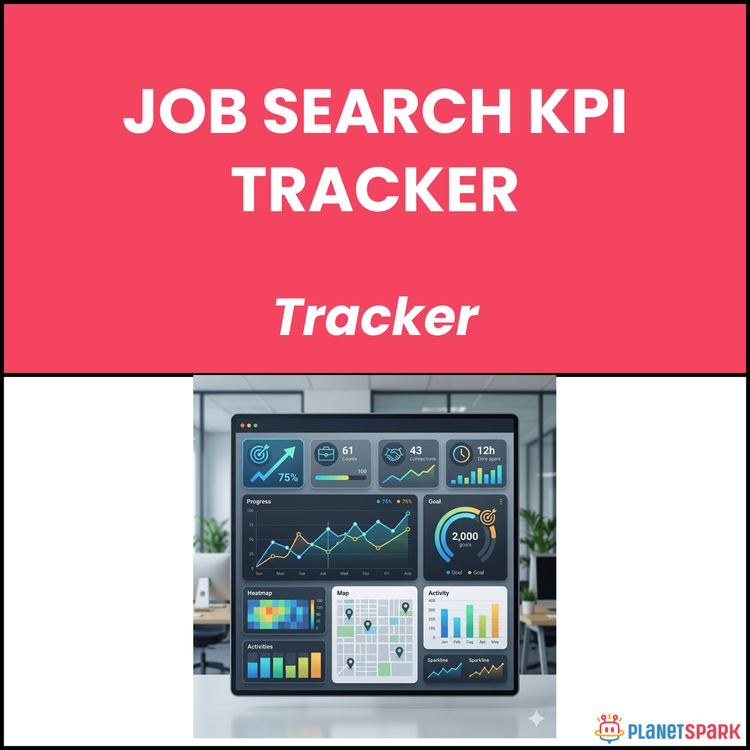
Job Search KPI Tracker
Job Search KPI Tracker: How to Measure, Improve, and Accelerate Your Job Search Results
If your job search feels busy but unproductive, you’re not alone.
Many working professionals spend hours applying to roles, updating resumes, and scrolling job boards—yet see little progress in terms of interviews or offers. The problem isn’t effort. It’s lack of visibility.
Without a clear system to track what’s working and what isn’t, your job search becomes guesswork.
That’s exactly why the “Job Search KPI Tracker” exists.
This resource helps you treat your job search like a structured, data-driven process—so you can measure performance, identify bottlenecks, and improve outcomes consistently. Instead of hoping for results, you start managing them.
Who Is This Resource For?
This resource is especially valuable if you are:
- A working professional with 0–15 years of experience
- A job seeker who feels stuck despite consistent effort
- A career switcher trying to improve response rates and traction
- A consultant or specialist managing multiple opportunities
- A mid-career professional aiming for faster and better job outcomes
- Someone who wants clarity, structure, and measurable progress in their job search
If you’re outcome-focused and want to stop guessing what works, this tracker is built for you.
What Does This Resource Contain?
This is not just a tracking sheet—it’s a complete system to run your job search like a high-performance pipeline.
Inside the resource, you’ll find:
- A clear explanation of the job search funnel (from applications to offers)
- A structured framework to understand where most job searches fail
- The 8 core KPIs that directly impact job search success
- Benchmark ranges to evaluate your performance at each stage
- A weekly tracking worksheet to monitor progress consistently
- A detailed application pipeline log to track every opportunity
- A networking tracker to manage outreach and relationship-building
- An interview performance tracker to improve with each conversation
- A monthly funnel audit framework to diagnose and fix weak points
- Conversion benchmarks to measure health across your pipeline
- Common job search mistakes—and how to fix them using data
- A self-evaluation scorecard to assess overall job search effectiveness
Everything is designed to help you move from activity to results.
Summary of the Resource
The “Job Search KPI Tracker” is a practical system that helps you measure, manage, and optimise your job search like a professional project.
Instead of relying on assumptions, you use data to understand your funnel—how many applications turn into interviews, how interviews convert into offers, and where improvements are needed.
It transforms your job search from a reactive process into a structured, strategic system.
How Will This Resource Be Useful?
This resource gives you clarity and control over your job search.
You’ll gain:
- Clear visibility into your job search pipeline at any moment
- The ability to identify exactly where your process is breaking down
- Better decision-making based on real data—not assumptions
- Improved response rates through targeted adjustments
- Stronger interview performance through structured reflection
- Consistent momentum with weekly tracking habits
- Higher chances of offers through a healthier pipeline
Most importantly, it helps you stop taking rejection personally—and start interpreting it strategically.
How Should You Use This Resource?
To get the best results, follow a structured approach:
Start by reading the guide once to understand the job search funnel and the role of each KPI.
Next, set up your tracking system—this can be a spreadsheet or tool like Google Sheets or Notion.
Begin with weekly tracking. Record your applications, responses, outreach efforts, interviews, and follow-ups. This builds consistency.
At the same time, maintain your application pipeline log. Update it regularly so you always know the status of every opportunity.
Track your networking efforts separately to ensure you’re building relationships—not just applying to jobs.
After each interview, use the reflection framework to identify strengths and improvement areas.
At the end of every month, conduct a funnel audit. Identify your weakest conversion stage and focus on improving just that one area.
Over time, these small, targeted improvements compound into significantly better results.
Action Steps
After accessing this resource, take these steps immediately:
1. Set up your job search tracker (spreadsheet or tool)
2. List all your current applications and their statuses
3. Define your weekly KPI targets (applications, outreach, interviews)
4. Track your activities daily for the next 7 days
5. Identify your weakest metric (e.g., low response rate or no interviews)
6. Make one focused improvement to address that gap
7. Schedule a weekly review and a monthly audit in your calendar
Consistency with these steps can dramatically accelerate your job search.
A successful job search is not about doing more—it’s about doing the right things, consistently, and improving based on feedback.
When you start tracking your efforts like a system, you gain clarity, confidence, and control. You stop wondering what’s wrong—and start fixing it.
Use this resource to turn your job search into a measurable, optimisable process that delivers real results.
Book your free session today!