
Leveraging Internal Visibility To Build External Career Assets

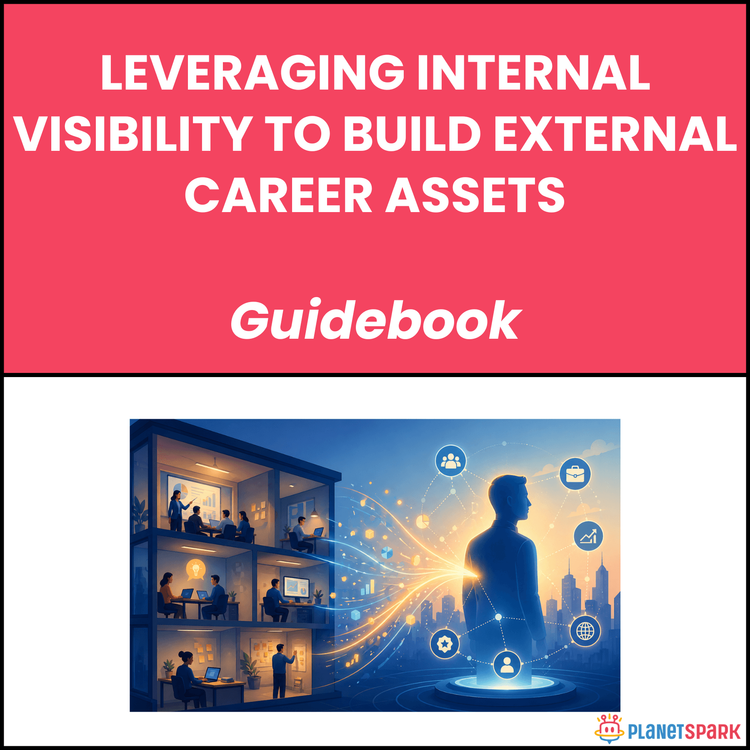
Leveraging Internal Visibility To Build External Career Assets
How to Turn Your Everyday Work Into a Powerful Career Brand
If you’re doing good work—but still feel overlooked for opportunities, promotions, or better roles—you’re not alone.
Most professionals assume that consistent performance will naturally lead to recognition. But in reality, what often gets rewarded is not just the work you do—but how visible, documented, and shareable that work is.
You might be solving complex problems, influencing decisions, and delivering results every week. But if none of that is captured or translated into something others can see and understand, it stays locked inside your current workplace.
That’s exactly the gap this resource is designed to solve.
This practical guide helps you systematically convert your internal contributions into external career assets—so your work continues to create opportunities for you, even outside your organisation.
Who Is This Resource For?
This resource is especially valuable if you are:
- A working professional with 0–15 years of experience
- Someone who feels their work is not getting the recognition it deserves
- A career switcher trying to build credibility in a new field
- A consultant or freelancer looking to attract better clients
- A manager aiming to position themselves for leadership roles
- A professional who wants stronger visibility without spending hours on personal branding
If you’ve ever struggled to explain your impact clearly in interviews, LinkedIn, or performance reviews—this guide is built for you.
What Does This Resource Contain?
This is not a motivational guide. It is a structured, execution-focused system.
At its core is a step-by-step framework that helps you move from “doing good work” to “being known for it.”
Inside the resource, you’ll find:
- A clear breakdown of the “visibility gap” and why it slows career growth
- The V.I.S.I.B.L.E. framework—a 7-step system for building career visibility (explained visually on page 4)
- A “Career Wins” tracking system to capture your achievements consistently
- A worksheet to document your contributions with context, action, and results (page 6)
- A method to define your professional identity beyond your job title
- A storytelling structure (Stakes–Problem–Action–Result–Insight) to communicate your work effectively
- An audience mapping strategy to identify who needs to see your work
- Guidance on building key assets like LinkedIn profiles, case studies, and thought leadership content
- A platform strategy to distribute your expertise consistently
- A 30-day action checklist to implement everything step by step (page 13)
- Reflection exercises and ready-to-use templates for immediate application
- A 90-day roadmap to build long-term visibility (page 19)
- A real-world case study showing how visibility leads to opportunities
Everything is designed to be actionable—even if you only have 15–30 minutes a week.
Summary of the Resource
This resource is a practical playbook that helps you stop relying on memory and start building evidence of your work.
It shows you how to:
- Capture your contributions consistently
- Turn them into structured stories
- Build assets that represent your expertise
- Share them with the right audience
- Create a system that compounds over time
Instead of starting from scratch every time you apply for a job or opportunity, you build a portfolio of proof that works for you continuously.
How Will This Resource Be Useful?
This guide helps you shift from invisible effort to visible impact.
You’ll gain:
- Clarity on what you actually contribute professionally
- Confidence in interviews, networking, and career conversations
- Stronger positioning in the job market
- Better salary negotiation leverage
- More inbound opportunities instead of constant job searching
- A long-term career asset system that grows with you
As explained in the guide, the difference between two equally skilled professionals is often visibility—not capability.
This resource ensures your work doesn’t go unnoticed.
How Should You Use This Resource?
To get real results, don’t just read—apply.
Here’s the most effective way to use it:
Start by reading the full guide once
This gives you a complete understanding of the system and how each step connects.
Then begin with Value Capture
Use the worksheet to log your recent contributions (start with the last 90 days). This becomes your foundation.
Define your professional identity
Clarify what you want to be known for—not just your job title, but your unique value.
Build your story library
Convert your experiences into structured, repeatable stories you can use anywhere.
Identify your audience
Be specific about who needs to see your work—this makes your efforts targeted and effective.
Create your first set of assets
Update your LinkedIn, write one post, or build a simple case study from your existing work.
Focus on consistency, not intensity
As the guide emphasizes, small, repeatable actions over time create stronger results than short bursts of effort.
Revisit regularly
Use the worksheets, templates, and checklist every few weeks to refine and expand your visibility.
Action Steps
After accessing this resource, take these steps immediately:
1. Create a simple “Career Wins” document today
2. Write down at least 5 contributions from the past month
3. Identify one strong story using the structured framework
4. Rewrite your LinkedIn headline based on your value, not your title
5. Publish one small insight or experience as a post
6. List 5 people or roles who should know about your work
7. Block 15 minutes weekly to update your progress
These small actions will start building momentum quickly.
Your career is not just built on what you do—it’s built on what others can see, understand, and trust about what you do.
The professionals who grow faster are not always the most talented—they are the ones who make their work visible, structured, and accessible to the right audience.
You don’t need more time. You need a system.
This resource gives you that system—step by step, in a way that fits into your existing work.
Start small. Stay consistent. Let your work speak—clearly, confidently, and beyond your current organization.