
Managing Asynchronous Communication Systems

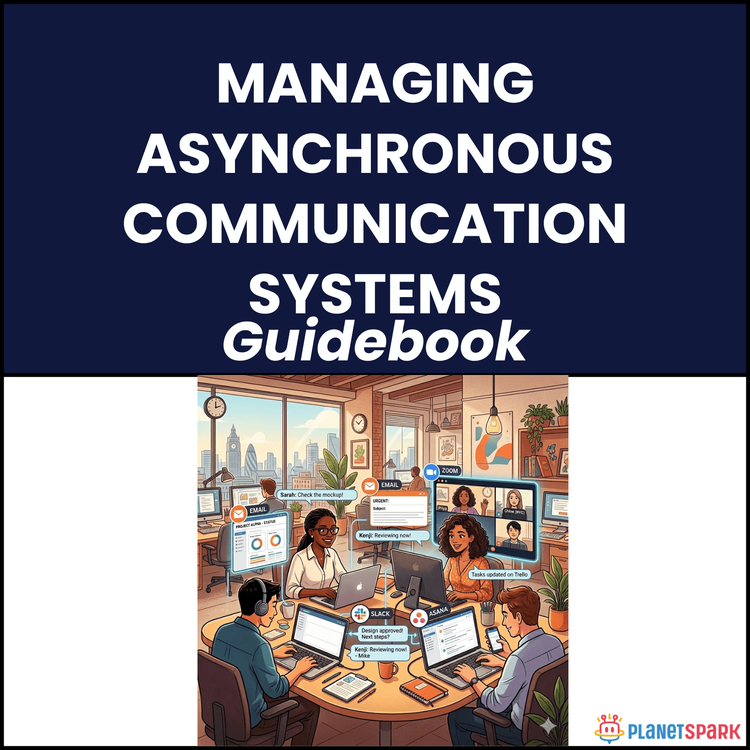
Managing Asynchronous Communication Systems
How to Master Asynchronous Communication Systems for Working Professionals: A Practical Guide
If your day is filled with back-to-back meetings, constant pings, and never-ending email threads, you’re not alone. Most professionals today are stuck in a reactive communication loop—responding instantly, switching contexts constantly, and struggling to find time for deep, meaningful work.
The problem isn’t a lack of communication. It’s inefficient communication.
That’s exactly where asynchronous communication comes in. The resource “Managing Asynchronous Communication Systems” is designed to help you break free from real-time overload and build a more structured, intentional, and productive way of working.
This guide gives you the systems, frameworks, and practical tools to communicate clearly—without needing everyone to be online at the same time.
Who Is This Resource For?
This resource is especially valuable if you are:
- A working professional collaborating across teams, tools, or time zones
- A manager or team lead trying to reduce unnecessary meetings
- A remote or hybrid worker dealing with communication overload
- A professional struggling with constant interruptions and lack of focus time
- A consultant or cross-functional contributor managing multiple stakeholders
- Anyone who wants to communicate more effectively without being always “online”
If you want to work smarter, not just faster, this guide is built for you.
What Does This Resource Contain?
This is not just a theory-heavy guide—it’s a practical system you can implement immediately.
Inside the resource, you’ll find:
- A clear explanation of what asynchronous communication is and why it matters
- Real-world data on productivity gains, time savings, and meeting reduction
- Core principles like context over brevity, clarity of action, and channel selection
- The Async Communication Spectrum to help you choose the right tool for every situation
- Ready-to-use email scripts for decisions, follow-ups, and status updates
- Before-and-after message transformations to improve clarity instantly
- Structured templates for chat tools like Slack and Teams
- The 5-step async communication framework (channel, structure, anticipate, expectations, follow-up)
- The CAD formula (Context, Ask, Deadline) for writing clear messages
- Guidelines for building team-level async communication norms
- Common mistakes professionals make—and how to avoid them
- Advanced strategies like BLUF (Bottom Line Up Front) and async video communication
- Practice exercises and real-world scenarios for skill-building
- A 30-day improvement plan to build consistent habits
- A quick-reference cheat sheet for everyday use
Everything is designed to help you reduce back-and-forth communication and increase clarity.
Summary of the Resource
“Managing Asynchronous Communication Systems” is a practical, action-oriented guide that helps professionals communicate more effectively without relying on real-time interactions.
It teaches you how to structure messages clearly, choose the right communication channel, and create systems that reduce meetings, save time, and improve team alignment.
If you want to reclaim your time and improve the quality of your work, this resource gives you a clear path to do it.
How Will This Resource Be Useful?
This resource helps you move from reactive communication to intentional communication.
You’ll gain:
- More uninterrupted time for deep work
- Reduced dependence on meetings and instant replies
- Clear, structured communication that gets faster responses
- Better collaboration across time zones and teams
- Fewer follow-ups and miscommunications
- Stronger professional reputation as a clear and effective communicator
Most importantly, it helps you create a work style that is sustainable, focused, and high-impact.
How Should You Use This Resource?
To get the most value, follow a phased approach:
Start by reading the entire guide once to understand the key principles, especially the async mindset, channel selection, and the CAD formula.
Next, begin applying the CAD format (Context, Ask, Deadline) to your daily emails and messages. This alone can significantly improve clarity.
Use the ready-made scripts and templates for emails and chat tools. These help you communicate faster without overthinking every message.
Then, implement the 5-step async communication framework to ensure every message you send is complete and actionable.
Work through the practice exercises to identify your current communication gaps and improve them systematically.
Finally, follow the 30-day improvement plan to build consistent habits and integrate async communication into your workflow.
You can also revisit this resource when:
- Your workload increases
- You start working with distributed teams
- You want to reduce meetings
- You take on leadership or coordination roles
Action Steps
After accessing this resource, take these steps immediately:
1. Audit your last 10–20 messages across email and chat
2. Rewrite 2–3 messages using the CAD format
3. Replace one unnecessary meeting with an async update
4. Use a structured email script for your next important communication
5. Set clear response expectations in your messages
6. Block 2–3 focused time slots daily for async responses instead of reacting instantly
Small improvements in how you communicate can unlock hours of productive time every week.
In today’s workplace, being available all the time is not a strength—being clear and intentional is.
Asynchronous communication is not about slowing down. It’s about working smarter, thinking better, and respecting everyone’s time—including your own.
When you master this skill, you don’t just become more productive—you become more effective, more reliable, and more trusted in your professional environment.
Use this resource to build that edge. Start small, stay consistent, and watch how your work—and your impact—transforms.