
Managing Multitasking vs Single-Tasking Decisions

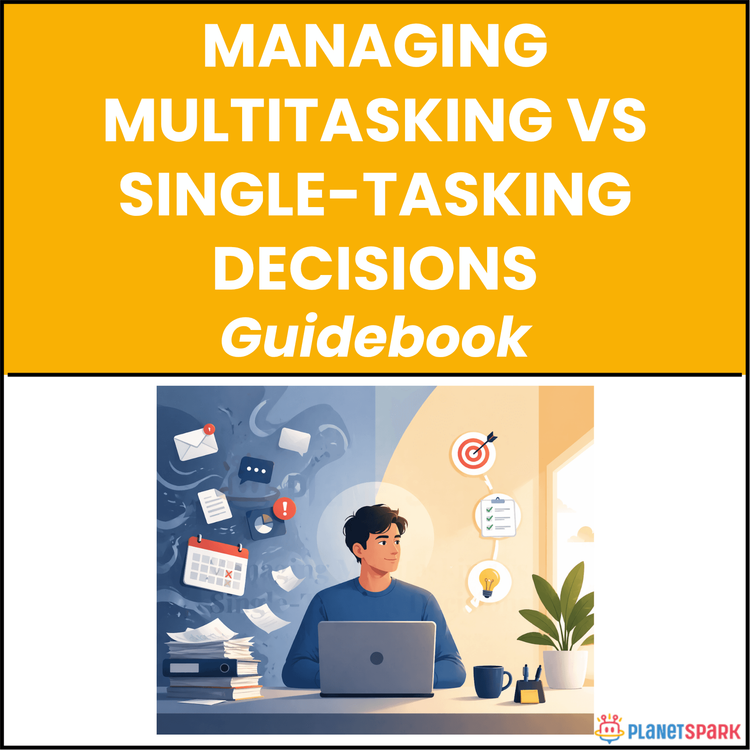
Managing Multitasking vs Single-Tasking Decisions
Deciding When to Multitask or Focus Deeply for Better Productivity
If your workdays feel busy but not productive, you’re not imagining it. Many professionals spend their days jumping between emails, meetings, messages, and deliverables—only to end the day feeling mentally drained with little meaningful progress to show for it.
The real issue isn’t workload—it’s how work is approached.
This is exactly where the resource “Managing Multitasking vs Single-Tasking Decisions” comes in. It helps you move beyond the confusion of “should I multitask or focus?” and gives you a clear, practical system to decide how to work—based on task type, cognitive load, and real-world demands.
Instead of relying on guesswork or willpower, this guide shows you how to structure your workday, protect your focus, and deliver better results without burning out.
Who Is This Resource For?
This guide is designed for working professionals who want to work smarter—not just harder. It is especially valuable if you are:
- A professional with 0–15 years of experience navigating increasing responsibilities
- A consultant or manager juggling multiple tasks, clients, or stakeholders
- An early-career professional trying to build strong productivity habits
- Someone who feels constantly busy but struggles to complete high-impact work
- A professional dealing with frequent interruptions, meetings, and context switching
- Anyone looking to improve focus, reduce stress, and deliver higher-quality output
If you often wonder when to focus deeply versus when to handle multiple tasks, this resource gives you a clear answer.
What Does This Resource Contain?
This is not a generic productivity guide—it’s a structured, actionable system built for real work environments.
Inside the resource, you’ll find:
- A clear explanation of why multitasking is often a productivity myth
- The Cognitive Load Matrix to classify tasks based on complexity and effort
- A practical decision-making framework to choose between multitasking and single-tasking
- The Three-Zone Workday model to structure your day for maximum efficiency
- The Switch Cost Protocol to reduce the hidden cost of constant task switching
- Daily, weekly, and reflection checklists to build consistent habits
- A task-mode planning worksheet for structured weekly execution
- A 30-day roadmap to gradually build focus and productivity habits
- Common multitasking myths and the reality behind them
- Real-world case studies showing how professionals improved outcomes with better focus
- Communication strategies to manage expectations and reduce interruptions
- A curated list of tools to support focus, time-blocking, and tracking
Everything is designed to be practical, repeatable, and easy to integrate into your daily workflow.
Summary of the Resource
“Managing Multitasking vs Single-Tasking Decisions” is a practical guide that helps you make smarter decisions about how you work.
Instead of trying to eliminate multitasking completely, it teaches you when to multitask, when to focus deeply, and how to structure your day accordingly. The result is better output, less stress, and a more controlled workday.
If you apply even a few frameworks from this guide, you’ll see immediate improvements in how efficiently and effectively you work.
How Will This Resource Be Useful?
This resource helps you move from reactive work habits to intentional productivity.
You’ll gain:
- Clarity on which tasks require deep focus and which can be batched or combined
- Reduced decision fatigue about how to approach your workday
- Better time management through structured workday design
- Improved output quality by minimizing context-switching
- Increased efficiency by aligning tasks with your energy levels
- Stronger focus and ability to enter deep work states
- Lower stress and mental fatigue from constant switching
- Greater control over your schedule and priorities
Most importantly, it helps you stop confusing activity with productivity—and start delivering meaningful results.
How Should You Use This Resource?
To get the best results, use this guide in a structured, phased way.
Start by reading through the entire guide once to understand the core concepts and frameworks. This gives you a clear mental model of how everything connects.
Next, begin applying the Cognitive Load Matrix to classify your daily tasks. This step alone will change how you approach your work.
Then, implement the Three-Zone Workday structure. Identify your peak energy window and protect it for deep, single-task work.
As you progress, start using the decision framework before beginning any task. This builds consistency and reduces hesitation.
Finally, integrate the checklists, worksheets, and weekly reflection system. These tools help you turn one-time insights into long-term habits.
You can revisit this resource regularly when:
- Your workload increases
- You feel overwhelmed or unfocused
- You want to improve productivity and output quality
- You are planning your week or restructuring your schedule
Action Steps
After accessing this resource, take these steps immediately:
1. Block 2–3 hours this week to review and apply the guide
2. List your top 10 tasks and classify them using the Cognitive Load Matrix
3. Identify your peak energy window and block it as “Deep Focus Time”
4. Set 2–3 fixed time slots for emails and messages (batch windows)
5. Apply the decision framework before starting each major task
6. Use the daily checklist to structure your workday
7. Complete the weekly reflection to identify improvement areas
Small structural changes in how you work can lead to significant gains in productivity and clarity.
The ability to focus deeply in a distracted world is becoming a rare and valuable skill. This guide helps you build that skill intentionally—so you can think more clearly, work more effectively, and deliver results that truly stand out.
Use it not just as a one-time read, but as a system you return to and refine over time. Because better work doesn’t come from doing more things at once—it comes from doing the right things, in the right way.
Book your free session today!