
Managing Passive-Aggressive Behaviour Guide

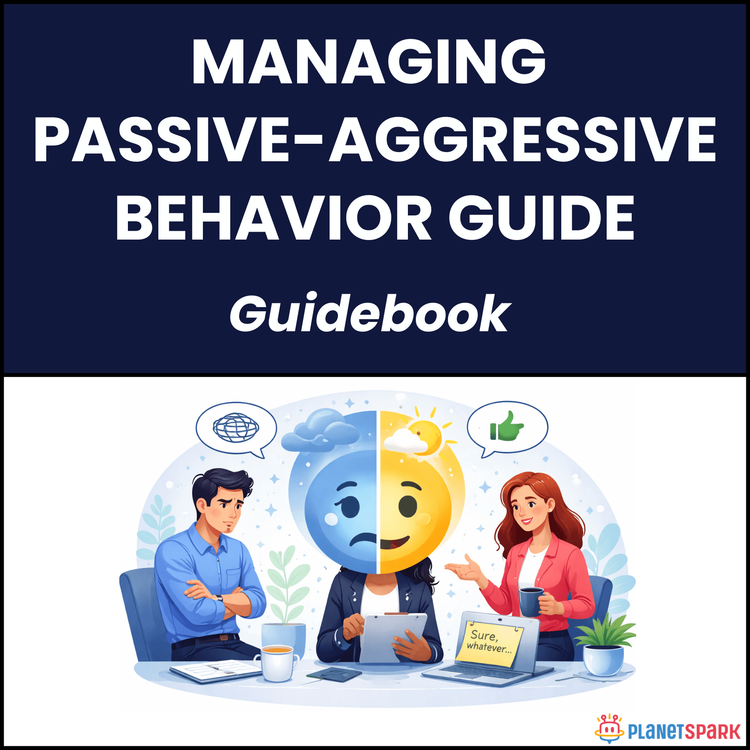
Managing Passive-Aggressive Behaviour Guide
Managing Passive-Aggressive Behaviour at Work: A Practical Guide to Recognise, Respond, and Resolve with Confidence
If you’ve ever walked out of a meeting feeling confused, frustrated, or subtly undermined—but couldn’t quite explain why—you’ve likely encountered passive-aggressive behaviour at work.
It’s the colleague who agrees in meetings but never follows through. The manager who “forgets” to include you in key decisions. The team member whose silence carries more resistance than words ever could.
The real challenge? It’s rarely direct. There’s no open conflict to address—just ambiguity, second-guessing, and a slow drain on your energy and productivity.
That’s exactly why the resource “Managing Passive-Aggressive Behaviour” exists. It gives working professionals a clear, structured, and practical playbook to handle these situations without overreacting, avoiding, or escalating unnecessarily.
Who Is This Resource For?
This guide is especially valuable if you are:
- A working professional (0–15 years experience) dealing with difficult workplace dynamics
- A manager handling resistant or non-communicative team members
- A consultant or client-facing professional navigating indirect conflict
- A mid-career professional trying to assert boundaries without damaging relationships
- A career switcher adapting to new workplace cultures
- Someone who often feels confused or drained by unclear interpersonal behaviour at work
If you want clarity, control, and professional composure in complex situations, this resource is built for you.
What Does This Resource Contain?
This is not a generic communication guide. It’s a structured, step-by-step system designed for real workplace scenarios.
Inside the resource, you’ll find:
- A clear breakdown of what passive-aggressive behaviour looks like (visible signs + subtle patterns)
- The psychology behind why people behave this way
- A behavioural spectrum to help you assess severity and respond appropriately
- A pattern-recognition framework to distinguish isolated incidents from real issues
- A practical worksheet to document behaviour objectively
- A complete pre-conversation preparation system (emotional, strategic, logistical)
- The CLEAR Model for structured, effective conversations
- Examples of language that works vs language that escalates situations
- Boundary-setting frameworks with real templates you can use immediately
- In-the-moment response strategies for live situations
- Role-based guidance (peer, manager, direct report, consultant)
- Real-world case study to see the framework in action
- Common mistakes professionals make—and how to fix them
- A self-evaluation tool to assess your readiness and improve over time
- A quick reference guide for fast recall during real situations
Everything is designed for practical application—not theory.
Summary of the Resource
“Managing Passive-Aggressive Behaviour” is a hands-on, outcome-driven guide that helps you identify hidden workplace friction, respond with clarity instead of emotion, and create structured solutions that actually change behaviour.
It equips you with repeatable frameworks so you can handle difficult dynamics professionally—without damaging relationships or your own credibility.
If you invest a few focused hours, you’ll walk away with tools you can apply immediately in real conversations.
How Will This Resource Be Useful?
This resource helps you move from confusion to control.
You’ll gain:
- Clarity in identifying passive-aggressive patterns (not just reacting to incidents)
- Confidence in handling difficult conversations without escalation
- Structured communication skills that reduce defensiveness
- Strong boundary-setting ability with clear, enforceable expectations
- Better documentation habits for professional protection
- The ability to respond calmly in high-pressure, real-time situations
- Reduced emotional drain and improved workplace confidence
Most importantly, it helps you stop second-guessing yourself—and start responding with precision and authority.
How Should You Use This Resource?
To get the best results, follow a phased approach:
First, read the entire guide end-to-end to understand the full framework and how each step connects.
Next, begin applying the recognition tools. Use the pattern-tracking worksheet to observe behaviour objectively over time instead of reacting immediately.
Once a pattern is clear, move to the preparation phase. Work through the pre-conversation checklist to clarify your intent, examples, and desired outcome.
Then, use the CLEAR model to structure your conversation. Stick to observation-based language and focus on future outcomes.
If behaviour persists, apply the boundary-setting templates to create clear expectations and consequences.
Finally, use the quick reference guide whenever you face real-time situations or need a fast reminder.
You can revisit this resource whenever you:
- Face repeated communication breakdowns
- Prepare for a difficult conversation
- Step into a new team or leadership role
- Handle client or stakeholder resistance
- Feel emotionally drained by workplace dynamics
Action Steps
After accessing this resource, take these steps immediately:
1. Identify one current situation where passive-aggressive behaviour may be present
2. Spend 30–45 minutes documenting observable patterns using the worksheet
3. Validate whether it’s a pattern or isolated incidents
4. Complete the pre-conversation checklist for that situation
5. Schedule a structured conversation using the CLEAR model
6. Follow up with written clarity to remove ambiguity
Taking action on just one situation can significantly improve your confidence and control at work.
Passive-aggressive behaviour thrives in ambiguity. The more structure, clarity, and consistency you bring into your interactions, the less space it has to operate.
This resource is not about confrontation—it’s about professional precision. When you recognise patterns, communicate clearly, and set boundaries that stick, you shift the dynamic without unnecessary conflict.
Use this guide not just to handle difficult people, but to strengthen your own communication, leadership, and emotional discipline in the workplace.