
Managing Team Workload Distribution Worksheet

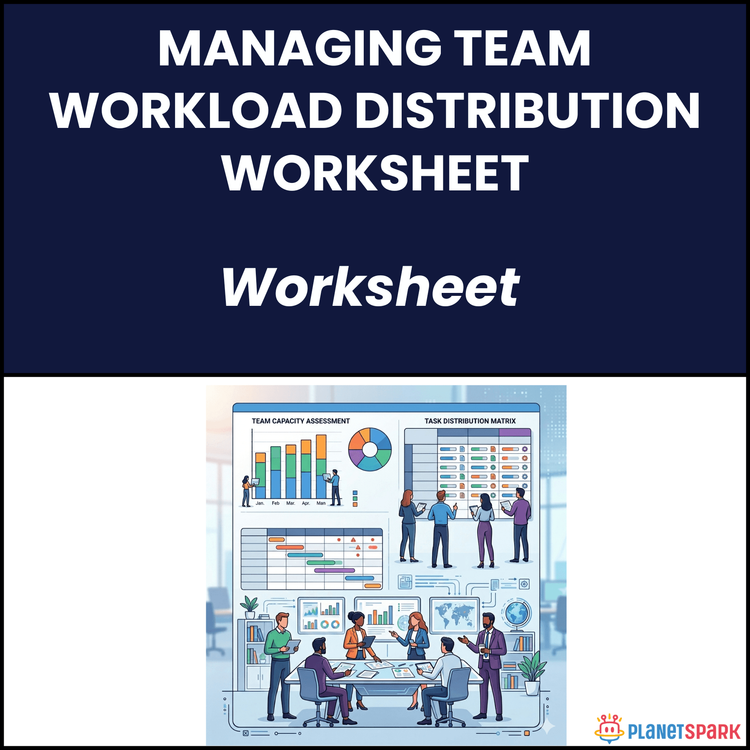
Managing Team Workload Distribution Worksheet
How to Manage Team Workload Distribution Effectively: A Practical Worksheet for Balanced Teams and Better Delivery
If your team constantly feels busy but deadlines still slip, the problem may not be effort—it’s workload distribution. In many teams, a few individuals end up handling the most critical work while others remain underutilised. This creates bottlenecks, slows down delivery, and eventually leads to burnout and disengagement.
The “Managing Team Workload Distribution” worksheet is designed to solve exactly this problem. It provides a structured, repeatable system to help managers and professionals bring clarity to workload, align tasks with real capacity, and distribute work in a way that improves both performance and team well-being.
Instead of relying on assumptions or reactive task assignment, this resource helps you make informed, intentional decisions about how work gets distributed across your team.
Who Is This Resource For?
This resource is especially useful if you are:
- A manager or team lead responsible for planning and assigning work
- A consultant working on improving team efficiency and delivery
- A professional transitioning into a leadership or managerial role
- A startup team dealing with rapid growth and shifting priorities
- Someone managing hybrid or distributed teams with limited visibility
- A team experiencing burnout, bottlenecks, or uneven workload
If you want a clear, structured way to manage workload without overcomplicating the process, this worksheet is built for you.
What Does This Resource Contain?
This is a practical, execution-focused worksheet—not a theoretical guide. It walks you through workload planning step by step.
Inside the resource, you’ll find:
- A clear explanation of why workload imbalance happens and its impact on teams
- A structured framework to map all work into planned, unplanned, and overhead categories
- A method to estimate effort consistently using hours, story points, or sizing models
- A realistic capacity calculation approach using focus factors (60–75%)
- A skill-based task assignment framework (must-match, should-match, stretch)
- Guidance on balancing workload and sequencing tasks for better throughput
- A built-in capacity calculator to determine assignable hours per team member
- A work assignment matrix to visualise ownership, effort, and skill fit
- A risk radar checklist to identify bottlenecks, dependencies, and overload early
- Common workload planning mistakes and practical fixes
- A one-page printable worksheet for quick weekly planning
Everything is designed to help you move from reactive planning to structured execution.
Summary of the Resource
The “Managing Team Workload Distribution” worksheet is a hands-on planning tool that helps you make work visible, align it with actual capacity, and assign it intentionally across your team.
It replaces guesswork with clarity, helping you avoid overload, reduce bottlenecks, and improve delivery outcomes—without needing additional resources.
How Will This Resource Be Useful?
This resource helps you bring structure and predictability to your team’s work.
You’ll gain:
- Clear visibility into total workload, including hidden tasks
- Realistic understanding of team capacity
- Better prioritisation and decision-making
- Balanced workload across team members
- Reduced dependency on a few individuals
- Improved delivery timelines and output quality
- Lower burnout and higher team morale
Most importantly, it helps you move from firefighting mode to proactive planning.
How Should You Use This Resource?
To get the best results, follow a structured approach:
Start by reviewing the entire worksheet to understand the workflow. This gives you a clear picture of how each step connects.
Next, begin with mapping all work. Capture everything your team is handling—not just planned deliverables, but also unplanned requests and overhead like meetings.
Then calculate true capacity. Subtract meetings, admin work, and leave from total hours, and apply a focus factor to arrive at realistic working time.
Once capacity is clear, assign work based on skill fit and growth opportunities. Use the must-match, should-match, and stretch framework to balance delivery and development.
After assignment, review workload balance using the matrix. Ensure no one is overloaded and buffers are preserved.
Finally, use the risk radar checklist to identify potential issues early and define countermeasures.
Revisit and update this worksheet weekly to reflect changes in priorities and workload.
Action Steps
After accessing this resource, take these steps immediately:
1. List all current work across your team, including hidden and unplanned tasks
2. Categorise work into planned, unplanned, and overhead
3. Calculate realistic capacity for each team member
4. Assign tasks using skill fit and workload balance principles
5. Use the work assignment matrix to review distribution
6. Run the risk radar checklist to identify gaps
7. Schedule a weekly review to adjust workload as needed
Small improvements in how you distribute work can lead to significant gains in productivity and team satisfaction.
When workload is balanced and visible, teams perform better, decisions become easier, and outcomes improve naturally. This resource gives you a practical system to make that happen consistently.
Use it not just as a one-time tool, but as an ongoing planning habit that strengthens your team’s performance over time.
Book your free session today!