
Mapping Activities That Drain vs Restore Your Energy

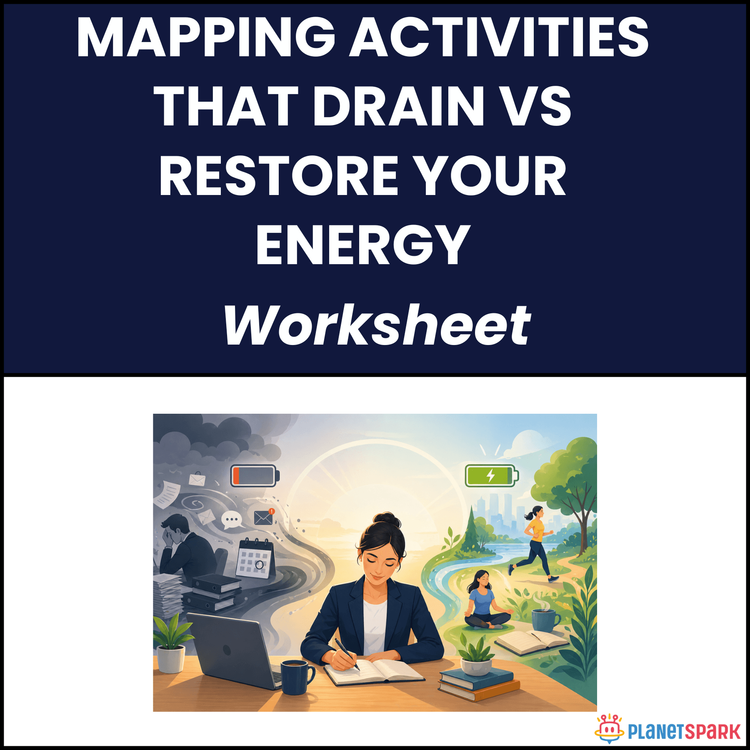
Mapping Activities That Drain vs Restore Your Energy
A Map of Energy-Draining and Energy-Restoring Activities: A Practical Worksheet to Improve Focus, Productivity, and Prevent Burnout
Most professionals don’t struggle with time management—they struggle with energy mismanagement.
You can have a perfectly planned calendar, a full to-do list, and still end the day feeling exhausted, unfocused, and strangely unproductive. Meetings blur together, deep work feels harder than it should, and by mid-afternoon, your mental clarity starts to drop.
The problem isn’t that you’re doing too little. It’s that you don’t have visibility into what your work is actually doing to your energy.
That’s exactly why the resource “Mapping Activities That Drain vs Restore Your Energy” exists. It’s designed to help you move from operating on autopilot to making intentional, high-impact decisions about how you spend your time and energy at work.
This is not just a reflection exercise—it’s a structured system to help you reclaim focus, reduce burnout, and perform at your best sustainably.
Who Is This Resource For?
This resource is especially valuable if you are:
- A working professional with 0–15 years of experience navigating demanding roles
- Feeling consistently busy but not genuinely productive
- Experiencing low-grade exhaustion that doesn’t go away with rest
- Struggling to identify why certain tasks or days feel more draining than others
- A manager, consultant, or individual contributor balancing multiple responsibilities
- Looking to improve focus, decision-making, and overall work satisfaction
If you want more control over your energy—not just your schedule—this worksheet is built for you.
What Does This Resource Contain?
This is a highly practical, step-by-step worksheet designed for immediate application. Inside, you’ll find:
- A clear explanation of energy management vs time management
- The core “Drain vs Restore” framework to evaluate your work activities
- A structured activity audit to capture everything you do in a typical week
- A 5-point energy scoring system (during and after each activity)
- A detailed energy mapping grid to visualise your work patterns
- Four key energy zones:
- Power Zone (high restore, high time)
- Hidden Gems (high restore, low time)
- Danger Zone (high drain, high time)
- Background Noise (low impact activities)
- Guided reflection prompts to uncover patterns and root causes
- A real-world case study showing how small changes can significantly improve energy
- Common mistakes professionals make with energy management
- A 30-day energy rebalancing action plan
- A personal commitment card to drive consistent behaviour change
Every section is designed to move you from awareness to action—quickly and practically.
Summary of the Resource
“Mapping Activities That Drain vs Restore Your Energy” is a hands-on worksheet that helps you identify exactly where your energy is being lost—and where it can be regained.
Instead of guessing why you feel exhausted or unfocused, this resource gives you a clear, visual map of your work patterns, along with a simple system to rebalance them.
In just a few focused hours, you can move from reactive work habits to intentional, energy-aligned performance.
How Will This Resource Be Useful?
This resource helps you build clarity where most professionals operate blindly.
You’ll gain:
- A clear understanding of which activities drain vs restore your energy
- Better decision-making about how to structure your day and week
- Reduced burnout risk by identifying and addressing high-drain areas
- Improved focus and productivity by protecting your peak energy periods
- Greater job satisfaction by increasing time spent on meaningful work
- A repeatable system you can use throughout your career
Most importantly, it helps you stop pushing through exhaustion—and start working in alignment with how you perform best.
How Should You Use This Resource?
To get maximum value, follow a structured, phased approach:
First, read through the entire worksheet to understand the framework and key concepts. This gives you context before you begin applying it.
Next, complete the activity audit. List all your regular work activities—big and small—without filtering or judging. The more honest and detailed you are, the better your results.
Then, rate each activity using the energy scoring system. Pay attention to how you feel during and after each task. This step is critical for accurate insights.
After that, map your activities onto the energy grid. This will visually reveal your Power Zone, Hidden Gems, Danger Zone, and Background Noise.
Once your map is complete, spend time on the reflection section. Identify patterns, root causes, and opportunities for change.
Finally, implement the 30-day action plan. Focus on small, specific shifts—such as batching draining tasks, protecting high-energy work, or adding recovery buffers.
Revisit this worksheet regularly—especially after role changes, new projects, or periods of high stress.
Action Steps
After accessing this resource, take these steps immediately:
1. Block 60–90 minutes of uninterrupted time
2. List 15–25 activities from your typical work week
3. Rate each activity honestly using the energy scoring system
4. Map your activities into the four energy zones
5. Identify your top 1–2 draining activities and 1–2 restoring activities
6. Make one small structural change (batch, delegate, or protect time)
7. Set a weekly or bi-weekly energy check-in
Small adjustments here can create a significant shift in how you experience your work.
Your performance is not just a function of how much you work—it’s a function of how well your work aligns with your energy.
When you understand what drains you and what restores you, you stop relying on willpower and start building a system that supports sustainable performance.
Use this resource not just to optimise your schedule, but to redesign how you work, how you recover, and how you grow in your career.
Book your free session today!