
Mapping Emotional Dependencies in Workplace Relationships

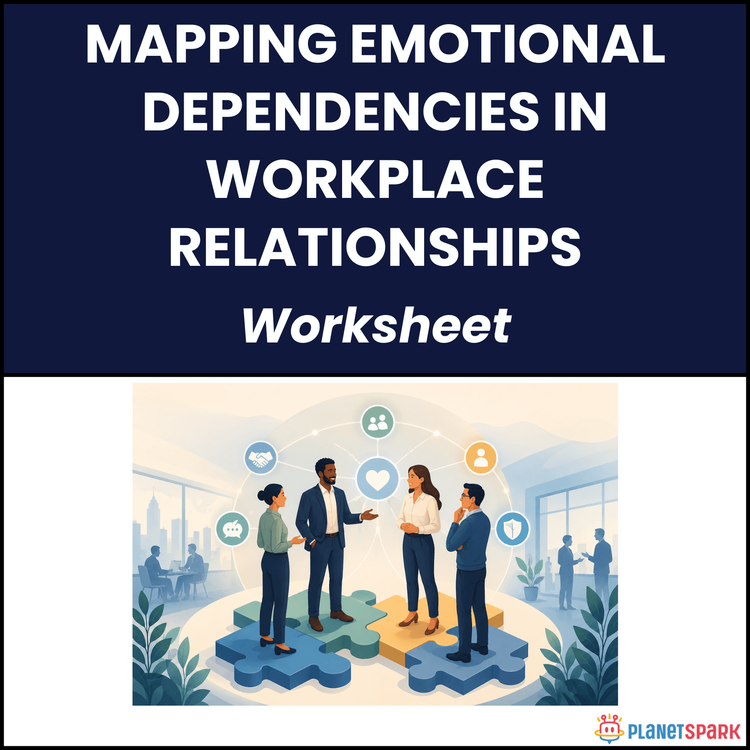
Mapping Emotional Dependencies in Workplace Relationships
Mapping Emotional Dependencies in Workplace Relationships: A Practical Guide to Building Healthier Professional Boundaries
If you’ve ever found your mood shifting based on a manager’s feedback, a colleague’s reaction, or a client’s approval—you’re not alone. Many working professionals unknowingly tie their confidence, motivation, and sense of worth to specific people at work.
This isn’t a flaw—it’s human. But when these emotional dependencies go unexamined, they can quietly shape your decisions, limit your growth, and drain your energy.
That’s exactly why the resource “Mapping Emotional Dependencies in Workplace Relationships” exists. It’s designed to help professionals understand their emotional patterns at work, identify where they may be over-relying on others, and build healthier, more balanced relationships.
This guide moves you from unconscious emotional reactions to structured awareness and intentional action—so you can perform better without losing yourself in the process.
Who Is This Resource For?
This resource is especially valuable if you are:
- A working professional with 0–15 years of experience
- A manager or team member navigating complex workplace relationships
- Someone who feels overly affected by feedback, approval, or criticism
- A professional struggling with people-pleasing, conflict avoidance, or burnout
- A mid-career individual aiming to build stronger boundaries and confidence
- Anyone who wants to improve emotional resilience and professional relationships
If you want to understand how your relationships at work impact your performance and wellbeing, this guide is built for you.
What Does This Resource Contain?
This is not a generic self-awareness worksheet. It’s a structured, actionable framework to help you map and improve your emotional dynamics at work.
Inside the resource, you’ll find:
- A clear explanation of what emotional dependency means in a professional context
- A structured relationship inventory to identify key people influencing your emotional state
- A rating system to measure the level of emotional influence across relationships
- A framework to identify triggers behind emotional dependency patterns
- The Four Dependency Archetypes (Approval Seeker, Safety Anchor, Conflict Avoider, Emotional Caretaker)
- A visual mapping model to categorise relationships based on emotional influence
- Deep-dive reflection questions to understand the origin, need, and cost of dependencies
- Practical, behaviour-based actions tailored to each dependency archetype
- A weekly emotional dependency audit checklist to track patterns over time
- A real-world case study illustrating how dependency patterns show up and can be changed
- Common mistakes professionals make—and how to correct them
- Guided reflection tools for deeper, long-term self-awareness
- A structured approach to building emotional autonomy without damaging relationships
Everything is designed to help you take immediate, practical action—not just reflect.
Summary of the Resource
“Mapping Emotional Dependencies in Workplace Relationships” is a practical, insight-driven worksheet that helps professionals understand how their emotional responses are shaped by workplace relationships—and how to rebalance them.
It enables you to identify who influences your emotional state the most, why that influence exists, and what you can do to create healthier, more independent professional dynamics.
If you invest focused time in this resource, you’ll gain clarity that directly improves both your performance and wellbeing at work.
How Will This Resource Be Useful?
This resource helps you move from unconscious patterns to intentional control.
You’ll gain:
- Clear visibility into your emotional triggers at work
- A deeper understanding of how specific relationships impact your behaviour
- The ability to identify and break unhealthy dependency patterns
- Stronger professional boundaries without damaging relationships
- Improved confidence, decision-making, and emotional stability
- Reduced burnout, people-pleasing, and internal stress
- Greater emotional autonomy while maintaining collaboration
Most importantly, it helps you stop reacting automatically—and start responding consciously.
How Should You Use This Resource?
To get the best results, follow a structured approach:
Start by completing the relationship inventory. Identify the key people in your professional environment and rate their emotional influence honestly.
Next, identify your dominant dependency archetype. This gives you a clear lens to understand your behaviour patterns.
Then, map your emotional ecosystem visually. Place relationships based on their level of influence and explore the underlying dynamics.
After that, reflect deeply on your inner-circle relationships—understanding their origin, the needs they fulfil, and the cost they carry.
Once you have clarity, move into action. Choose specific behavioural shifts based on your archetype and begin applying them in daily interactions.
Finally, use the weekly audit checklist consistently for at least four weeks to track patterns and reinforce change.
You can revisit this resource whenever you:
- Feel emotionally affected by workplace interactions
- Struggle with feedback, approval, or conflict
- Experience burnout or emotional fatigue
- Transition into new roles or teams
- Want to build stronger professional boundaries
Action Steps
After accessing this resource, take these steps immediately:
1. Block 60–90 minutes for focused reflection
2. Complete your Relationship Inventory honestly
3. Identify your dominant dependency archetype
4. Map your top 5–8 workplace relationships visually
5. Choose one high-impact relationship to focus on
6. Apply one behavioural action aligned with your archetype
7. Start the weekly emotional dependency audit for the next 4 weeks
Small, consistent shifts here can significantly improve both your professional effectiveness and emotional wellbeing.
Your professional success is not just shaped by your skills—but by how you relate to the people around you. When your emotional state depends too heavily on others, you lose control over your performance and confidence. But when you build awareness and autonomy, you create stability that no external factor can easily disrupt.
Use this resource not just to understand your relationships—but to transform how you show up in them, with clarity, confidence, and balance.