
Mapping Power vs Influence Dynamics in Your Team

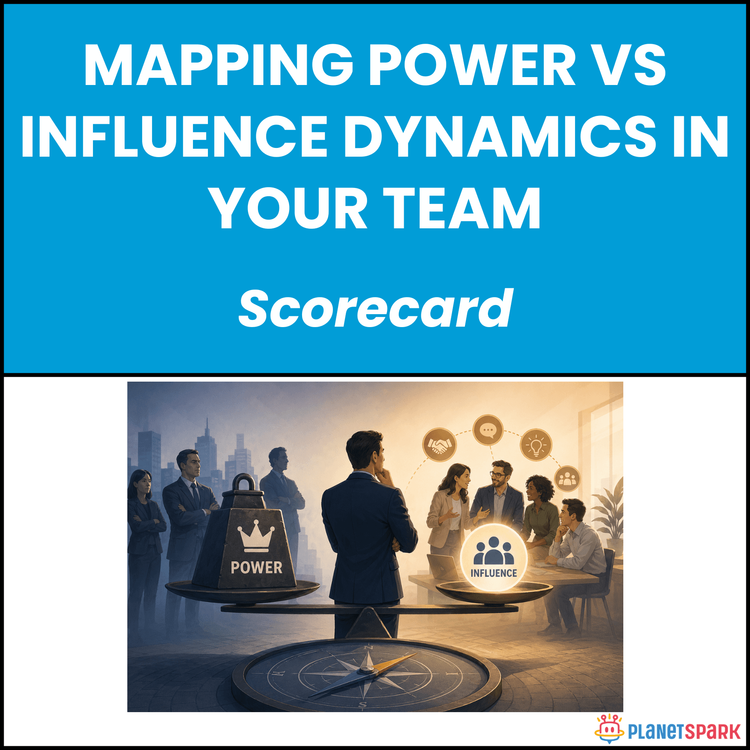
Mapping Power vs Influence Dynamics in Your Team
How to Understand Power vs Influence at Work: A Practical Guide to Navigating Team Dynamics and Driving Real Impact
You did everything right. You got approvals, followed the process, built a strong case—and yet, your idea stalled. Meanwhile, someone else with less authority but stronger relationships moved things forward effortlessly.
If this feels familiar, you’re not missing skills—you’re missing visibility into how decisions actually happen.
Most professionals assume power drives outcomes. In reality, influence often matters more.
That’s exactly why the resource “Mapping Power vs Influence Dynamics in Your Team” exists. It helps working professionals decode the invisible dynamics behind decisions, identify who truly shapes outcomes, and build strategies that work in real-world organisational environments.
Who Is This Resource For?
This resource is especially valuable if you are:
- A working professional with 0–15 years of experience navigating team dynamics
- A manager or team leader responsible for driving alignment and execution
- A consultant working across multiple stakeholders and functions
- A mid-career professional aiming for faster growth and leadership roles
- Someone frustrated by slow decision-making or hidden resistance
- A professional who wants to build influence—not just rely on authority
If you want to stop guessing how decisions are made and start navigating them strategically, this guide is built for you.
What Does This Resource Contain?
This is not a generic workplace dynamics guide. It’s a structured diagnostic system designed to help you map, analyse, and act on power and influence in your team.
Inside the resource, you’ll find:
- A clear explanation of the difference between formal power (authority) and informal influence (relational impact)
- A foundational framework explaining four key team dynamics and roles within the system
- Deep insights into the most overlooked group: Shadow Leaders (low power, high influence)
- A step-by-step method to build your own Power–Influence map in under an hour
- A structured scoring system to evaluate stakeholders on both power and influence (1–5 scale)
- A visual grid to plot individuals and identify patterns or clusters in your team
- A complete stakeholder scorecard worksheet for real-world application
- Quadrant-based playbooks with tailored engagement strategies for different profiles
- Practical guidance on how to engage Power Players, Formal Authorities, Shadow Leaders, and Peripheral Actors
- A real-time “Influence Signals Checklist” to help you read the room during meetings and conversations
- Common mistakes professionals make when interpreting team dynamics—and how to avoid them
- A real-world case study showing how misreading influence can stall execution—and how to fix it
- A personal self-assessment to evaluate your own power, influence, and network strength
- Reflection prompts to guide your long-term career strategy
- A clear action plan to apply insights immediately
Everything is designed for practical use—not passive reading.
Summary of the Resource
“Mapping Power vs Influence Dynamics in Your Team” is a practical, action-oriented guide that helps professionals understand how decisions are really made inside organisations.
It teaches you how to identify key players, map influence networks, and engage stakeholders strategically—so you can move work forward faster and more effectively.
If you want to stop being surprised by outcomes and start shaping them, this resource gives you the clarity and tools to do it.
How Will This Resource Be Useful?
This resource helps you move from frustration to control.
You’ll gain:
- A clear understanding of how power and influence operate simultaneously
- The ability to identify who actually drives decisions—not just who approves them
- A structured way to map stakeholders and predict outcomes
- Stronger relationship-building strategies with high-impact individuals
- Improved ability to handle resistance and unblock stalled initiatives
- Better timing, communication, and alignment in your work
- Increased visibility and influence in your professional environment
Most importantly, it helps you stop relying only on authority—and start leveraging influence effectively.
How Should You Use This Resource?
To get the best results, follow a structured approach:
Start by reading the full guide to understand the difference between power and influence and why both matter.
Next, choose one real team or project and list all relevant stakeholders—including cross-functional members.
Score each person on power and influence using the provided criteria. Be honest and base your scores on observable behaviour, not assumptions.
Plot individuals on the Power–Influence grid to identify key clusters—especially Shadow Leaders who may not be visible on the org chart.
Then, design your engagement strategy based on each quadrant. Adjust how you communicate, involve, and align with different stakeholders.
Use the Influence Signals Checklist in real meetings to sharpen your ability to read dynamics in real time.
Finally, complete the self-assessment to understand your own position—and identify where you need to grow.
This resource becomes more powerful when you revisit and update your map regularly.
Action Steps
After accessing this resource, take these steps immediately:
1. List 6–8 key stakeholders in your current team or project
2. Score each person on power and influence (1–5 scale)
3. Plot them on the Power–Influence grid
4. Identify 1–2 Shadow Leaders you may have overlooked
5. Plan one relationship-building conversation with each
6. Adjust your approach in your next key meeting based on your map
Small shifts in how you engage can unlock major progress.
Most professionals focus on doing the work. The most effective professionals focus on how work moves.
When you understand power and influence, you stop pushing harder—and start moving smarter. You anticipate resistance, build alignment early, and create momentum before decisions are even made.
Use this resource to build that capability. Because career growth isn’t just about execution—it’s about navigating the system you operate in with clarity, strategy, and intent.