
Mapping Psychological Safety Levels Across Teams

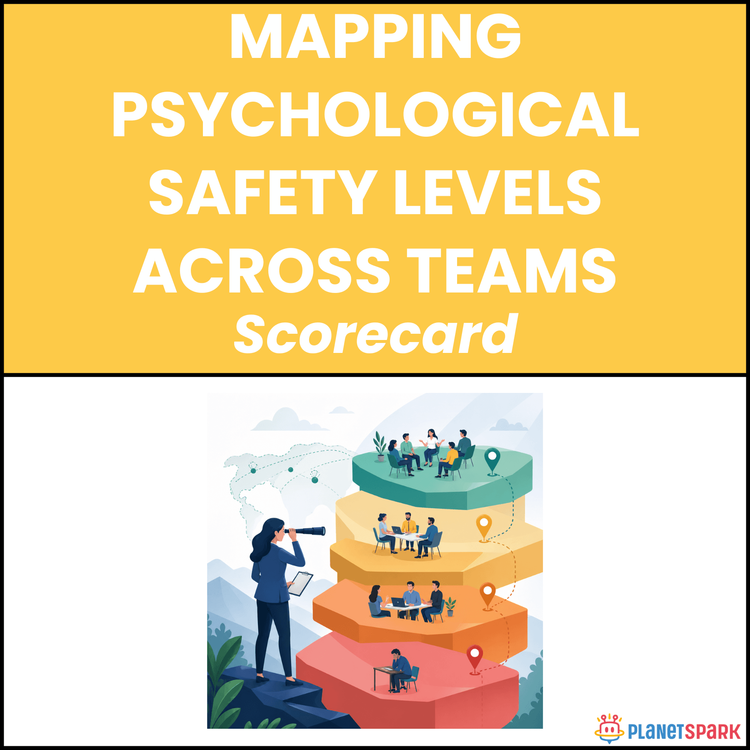
Mapping Psychological Safety Levels Across Teams
A Practical Scorecard to Diagnose and Improve Team Performance
Most teams don’t fail because of lack of talent or effort — they fail silently.
You might notice it in subtle ways: people hesitate before speaking, meetings feel unusually quiet, ideas don’t flow freely, and feedback sounds overly safe or agreeable. On the surface, everything looks “fine,” but underneath, performance is being limited by something far more fundamental — psychological safety.
This is exactly the gap the “Mapping Psychological Safety Levels Across Teams” scorecard is designed to solve. It gives managers, consultants, and team leaders a clear, structured way to diagnose team dynamics and take targeted action to improve them — without guesswork.
Who Is This Resource For?
This resource is especially valuable for:
- Team leaders and managers responsible for performance and team culture
- Consultants working with teams or organisations on transformation
- Early to mid-career professionals stepping into leadership roles
- Startup founders or project leads managing small teams
- HR professionals focused on employee engagement and retention
If you’ve ever felt that your team “could do better, but something is holding them back,” this resource is built for you.
What Does This Resource Contain?
This is not a theoretical guide — it is a hands-on diagnostic and action toolkit. Inside, you’ll find:
- A clear explanation of psychological safety and why it directly impacts performance
- The Four Levels of Psychological Safety framework:
- Inclusion Safety
- Learner Safety
- Contributor Safety
- Challenger Safety
- A 12-point team scorecard to assess current safety levels
- A scoring system that categorises your team into clear performance bands
- A detailed interpretation guide explaining what each score actually means
- A level-by-level intervention playbook with practical actions you can apply immediately
- A manager reflection worksheet for self-assessment and behaviour correction
- A real-world case example showing how a team improved safety in 90 days
- A breakdown of the most common mistakes leaders make (and how to fix them)
- A structured 30-day action plan to move from diagnosis to execution
Every section is designed to move you from awareness to action quickly.
Summary of the Resource
In simple terms, this resource helps you:
- Identify where your team truly stands on psychological safety
- Understand what that level means for performance and behaviour
- Pinpoint the exact gaps holding your team back
- Take targeted, practical steps to improve team dynamics
- Build a culture where people feel safe to speak, contribute, and challenge
It replaces vague assumptions with clear data and actionable insights.
How Will This Resource Be Useful?
The real value of this resource lies in what it enables you to do:
- Improve team communication and participation
- Unlock hidden ideas and innovation within your team
- Reduce fear-based behaviours like silence and avoidance
- Build trust without relying on expensive interventions or programs
- Make better decisions by encouraging honest input
- Strengthen leadership credibility through consistent behaviour
Instead of reacting to problems like low engagement or poor collaboration, you’ll be able to address the root cause directly.
How Should You Use This Resource?
To get the best results, use this resource in a structured way:
Step 1: Start with honest self-assessment
Go through the 12-point scorecard and rate your team based on real observations — not assumptions.
Step 2: Involve your team
Share the scorecard with team members and collect their responses. This gives you a more accurate and balanced view.
Step 3: Compare and analyse
Look for gaps between your scores and your team’s scores. These gaps often reveal blind spots.
Step 4: Identify your lowest safety level
Focus on the weakest level (inclusion, learning, contribution, or challenge). That is where improvement must begin.
Step 5: Apply targeted interventions
Use the intervention playbook to select one or two specific actions relevant to your team’s level.
Step 6: Reflect on your own behaviour
Complete the manager reflection worksheet honestly. Your behaviour is the biggest driver of team safety.
Step 7: Reassess regularly
Run the scorecard again after 30 days to track progress and adjust your approach.
Consistency matters more than intensity here.
Action Steps
If you’re ready to use this resource effectively, start with these steps:
- Complete the scorecard on your own today
- Share it with at least 2–3 team members this week
- Identify your team’s current safety level
- Choose ONE intervention to implement immediately
- Announce this change openly to your team
- Schedule a follow-up assessment in 30 days
- Reflect on one behaviour you will stop and one you will start
Small, visible actions create powerful signals within teams.
Psychological safety is not a “soft skill” — it is the foundation of high performance. The teams that succeed consistently are not the ones with the best strategies, but the ones where people feel safe to think, speak, and challenge openly.
If you want better results from your team, start by improving the environment in which those results are created. This resource gives you a practical, structured way to do exactly that — one step at a time.