
Mapping Recovery Strengths and Weaknesses for Growth

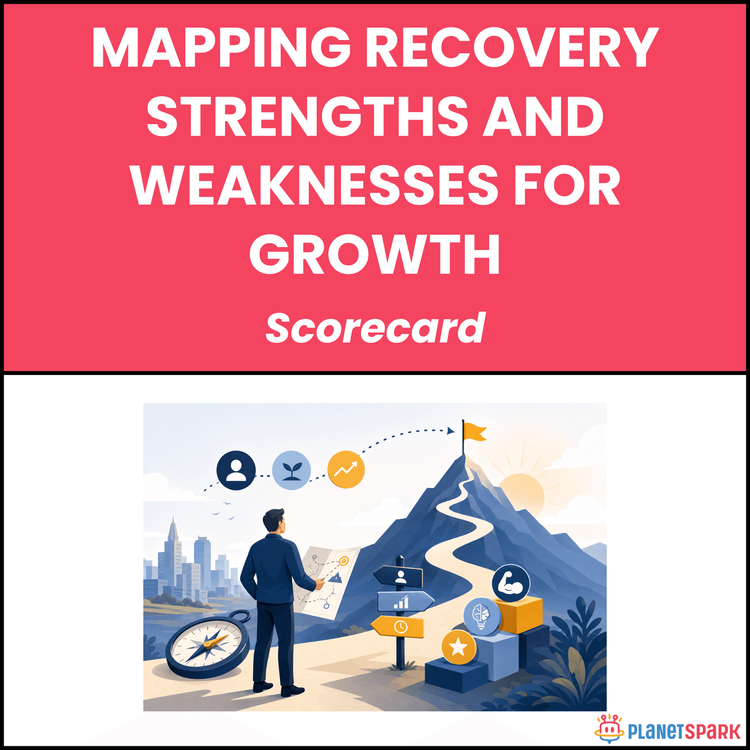
Mapping Recovery Strengths and Weaknesses for Growth
Evaluating Career Recovery: A Guide to Identifying Strengths and Weaknesses for Professional Growth
Most professionals prepare extensively for success—but very few prepare systematically for setbacks.
A missed promotion, redundancy, difficult feedback cycle, failed interview, leadership conflict, or stalled career transition can quietly impact confidence, decision-making, and momentum far longer than expected. The problem is not just the setback itself. It’s the lack of a structured recovery process afterward.
That’s why the resource “Mapping Recovery Strengths and Weaknesses for Growth” was created.
Instead of treating resilience as a vague personality trait, this practical scorecard helps working professionals understand how they actually respond under pressure—and how to improve that response strategically over time.
Through structured self-assessment, reflection exercises, recovery frameworks, and action-oriented tools, this resource helps professionals identify the hidden patterns slowing their recovery and build a smarter, more sustainable approach to career growth.
If you’ve ever felt stuck after a setback, unsure how to rebuild momentum, or frustrated by repeating the same emotional and professional patterns, this guide provides the clarity and structure needed to move forward intentionally.
Who Is This Resource For?
This resource is especially useful for:
- Working professionals with 0–15 years of experience
- Professionals recovering from layoffs, redundancy, rejection, or burnout
- Career switchers navigating uncertainty and identity shifts
- Managers and consultants operating in high-pressure environments
- Professionals struggling with confidence after setbacks
- Individuals who want to build long-term career resilience
- Professionals seeking structured self-awareness instead of generic motivational advice
It is particularly valuable for time-poor professionals who want practical frameworks they can immediately apply without spending weeks consuming theory-heavy content.
What Does This Resource Contain?
This is not a motivational workbook filled with vague advice. It is a structured professional development tool designed to help you measure, understand, and improve your recovery capability.
Inside the resource, you’ll find:
- A clear explanation of “Recovery Intelligence” and why it matters professionally
- A practical framework built around four recovery domains:
- Cognitive Flexibility
- Social Resourcefulness
- Professional Adaptability
- Strategic Reframing
- A detailed recovery strengths and weaknesses scorecard
- Guided self-assessment questions to evaluate behaviour under pressure
- A recovery map worksheet to identify:
- Leverage Zones
- Build Zones
- Repair Zones
- Domain-specific recovery-building exercises and action plans
- The Reframe Protocol for reducing catastrophic thinking
- The Recovery Triangle framework for building stronger support systems
- The Pivot Log method to strengthen adaptability confidence
- The Setback-to-Story exercise for reframing professional setbacks
- Deep reflection questions designed to uncover recovery blockers and hidden strengths
- A real-world case study showing how a professional rebuilt momentum after redundancy
- Common recovery mistakes professionals make—and how to avoid them
- A 30-day recovery sprint roadmap for structured implementation
Everything inside the resource is designed for practical application and long-term professional growth.
Summary of the Resource
“Mapping Recovery Strengths and Weaknesses for Growth” is a practical scorecard and recovery development system that helps professionals assess how effectively they recover from setbacks and where improvement is needed most.
Rather than focusing only on emotional resilience, the guide explores recovery through four interconnected professional domains: thinking, relationships, adaptability, and strategic reframing.
The resource helps professionals:
- Understand their default reactions under stress
- Identify recovery bottlenecks
- Build structured recovery habits
- Reframe setbacks more effectively
- Improve professional adaptability
- Develop stronger long-term career resilience
Most importantly, it transforms recovery from something reactive and emotional into something measurable, intentional, and improvable.
How Will This Resource Be Useful?
Many professionals unknowingly carry unresolved professional setbacks into future opportunities. Over time, this affects confidence, communication, risk-taking, networking, and career decision-making.
This resource helps interrupt that cycle.
By working through the scorecard and exercises, you’ll gain:
- Greater self-awareness about how you respond under pressure
- Clarity on which recovery behaviours are helping or hurting your growth
- Faster emotional and professional recovery after setbacks
- Improved confidence in navigating uncertainty and career transitions
- Stronger professional relationships and support systems
- Better adaptability during change and disruption
- More strategic thinking after failure or rejection
- A healthier, more resilient approach to long-term career growth
The guide also helps professionals stop viewing setbacks as isolated failures and start treating them as valuable data points for future growth.
For professionals navigating fast-changing industries, uncertain job markets, or leadership pressure, recovery capability becomes a genuine competitive advantage.
How Should You Use This Resource?
To get the maximum benefit from this resource, approach it as an active working system—not passive reading material.
Start by reading through the full guide once to understand the overall recovery framework and how the four domains connect.
Then complete the Recovery Strengths & Weaknesses Scorecard honestly based on how you actually behave during difficult situations—not how you wish you behaved.
After scoring yourself:
1. Identify your strongest and weakest recovery domains
2. Use the Recovery Map Worksheet to categorise your zones
3. Focus first on your lowest-scoring domain
4. Apply the recommended domain-specific builder exercise consistently
5. Complete the reflection questions in writing for deeper insight
6. Track your progress over the next 30 days
7. Reassess quarterly to measure long-term growth
The resource works especially well when revisited during:
- Career transitions
- Job searches
- Post-burnout recovery
- Leadership challenges
- Organisational restructuring
- Performance setbacks
- Major professional uncertainty
The more honestly and consistently you engage with the exercises, the more valuable the insights become.
Key Concepts That Make This Resource Different
Recovery Is a Skill, Not a Personality Trait
One of the strongest ideas in this resource is that resilience is not fixed.
Recovery capability can be measured, improved, strengthened, and refined through deliberate practice. This shifts professionals away from self-judgment and toward practical development.
Four Recovery Domains Work Together
Many professionals focus only on emotional resilience while ignoring other areas affecting recovery.
This resource expands recovery into four interconnected domains:
- Cognitive Flexibility
- Social Resourcefulness
- Professional Adaptability
- Strategic Reframing
Weakness in one area can quietly slow progress in others, which is why the scorecard focuses on balance and visibility.
Your Lowest Score Is Your Highest Leverage Point
The guide encourages professionals to stop trying to improve everything simultaneously.
Instead, it helps identify the single recovery bottleneck creating the most friction in career growth. Focusing deeply on one weak domain often creates faster and more sustainable improvement.
Real-World Practicality of the Resource
One of the most useful aspects of this guide is its practicality.
The exercises are intentionally designed for busy professionals and require minimal time investment.
For example:
- The Reframe Protocol takes approximately 15 minutes
- The Pivot Log can be updated in 5 minutes
- The Recovery Triangle requires simple monthly touchpoints
- The Setback-to-Story method can be drafted in under 30 minutes
This makes the resource realistic to implement even for professionals managing demanding schedules.
Action Steps
After accessing this resource, take these steps immediately:
1. Set aside 60–90 uninterrupted minutes for your first assessment
2. Complete the full Recovery Strengths & Weaknesses Scorecard honestly
3. Identify your Repair Zone domain
4. Choose one domain-specific recovery builder exercise to implement
5. Write responses to the five reflection questions
6. Create a simple 30-day recovery improvement plan
7. Reassess your progress after one month
8. Schedule quarterly recovery reviews moving forward
Small improvements in recovery speed and clarity compound significantly over time.
Professional growth is not defined by avoiding setbacks. It is defined by how effectively you recover, adapt, learn, and reposition yourself afterward.
“Mapping Recovery Strengths and Weaknesses for Growth” helps professionals move beyond vague resilience advice and build a structured recovery system that supports long-term career success.
When recovery becomes intentional, setbacks stop feeling like endpoints. They become transition points toward stronger thinking, better decisions, deeper self-awareness, and more sustainable professional growth.
Book your free session today!