
Mapping System Strengths And Weaknesses For Optimization

Mapping System Strengths And Weaknesses For Optimization
Mapping System Strengths & Weaknesses for Optimisation: A Practical Guide for Working Professionals
Most professionals know when something feels inefficient.
Projects move slower than they should.
Teams work hard but results remain inconsistent.
Processes create friction instead of momentum.
Meetings generate activity but not clarity.
Important problems keep repeating despite constant effort.
Yet even experienced professionals often struggle to answer one critical question:
“What exactly is broken — and what should we fix first?”
That uncertainty creates reactive decision-making, wasted effort, and constant firefighting.
That’s exactly why the resource “Mapping System Strengths & Weaknesses for Optimisation” was created.
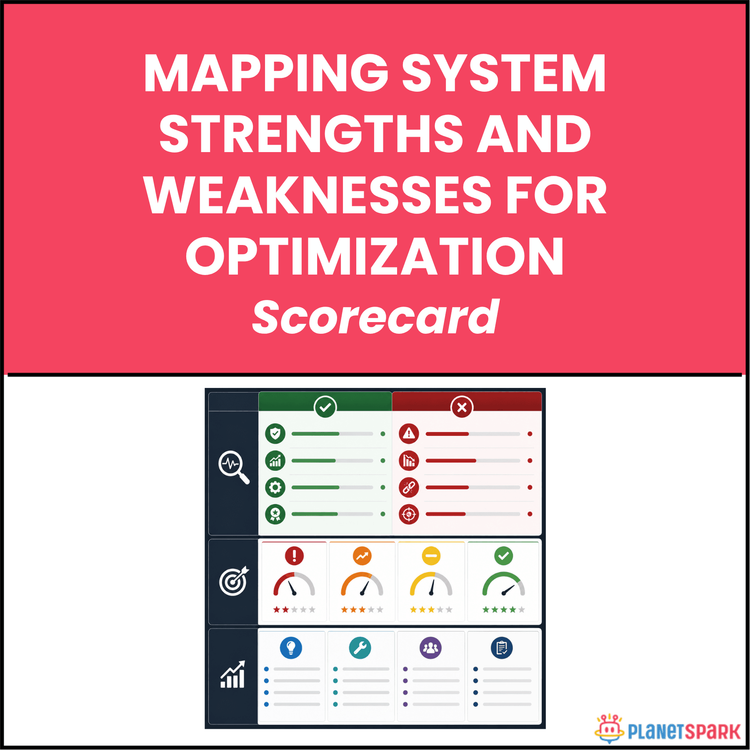
This practical scorecard gives working professionals a structured framework for diagnosing systems clearly, identifying high-leverage gaps, prioritising improvements intelligently, and building focused optimisation plans.
Instead of relying on assumptions, intuition, or vague frustration, the resource helps readers map systems objectively and make decisions based on structured analysis.
If you manage workflows, teams, projects, operations, or even your own productivity systems, this guide is designed for you.
Who Is This Resource For?
This resource is especially valuable for:
- Working professionals with 0–15 years of experience
- Managers responsible for improving team performance
- Consultants conducting operational or workflow audits
- Career switchers entering new organisational environments
- Team leads managing process improvement initiatives
- Professionals struggling with recurring workflow bottlenecks
- Individuals seeking more structured decision-making systems
- Professionals trying to optimise productivity and execution quality
It is particularly useful for professionals who need clarity before taking action.
What Does This Resource Contain?
This is not a generic productivity worksheet or business theory guide.
It is a structured diagnostic and optimisation framework designed for real-world professional systems.
Inside the resource, you’ll find:
- A practical explanation of why system mapping matters
- Frameworks for diagnosing bottlenecks and performance gaps
- Step-by-step guidance for defining system boundaries clearly
- Stakeholder mapping exercises
- Structured system-definition prompts
- The complete 6-Dimension Scoring Framework:
- Clarity of Purpose
- Process Consistency
- People & Role Fit
- Tools & Infrastructure
- Feedback & Measurement
- Adaptability
- Detailed scoring criteria for each dimension
- The System Scorecard Worksheet
- Evidence-based evaluation prompts
- Strength and gap identification frameworks
- Total score interpretation guidance
- Pattern analysis systems for identifying:
- Strength clusters
- Weakness clusters
- System anchors
- System drags
- Reflection exercises for uncovering root causes
- A Prioritisation Matrix based on:
- Impact
- Effort
- Sequencing frameworks for deciding what to fix first
- Practical optimisation planning templates
- Real-world consulting and team audit case studies
- Common optimisation mistakes and how to avoid them
- A structured 30-Day Optimisation Action Plan
- A System Optimiser Self-Evaluation framework
- Quarterly review and re-scoring guidance
Everything inside the resource is designed to help professionals move from vague awareness to structured optimisation.
Summary of the Resource
“Mapping System Strengths & Weaknesses for Optimisation” is a practical diagnostic framework for professionals who want to improve systems strategically instead of reacting emotionally.
The resource helps readers:
- Define systems clearly
- Diagnose gaps objectively
- Identify leverage points
- Prioritise improvements intelligently
- Build structured action plans
- Create repeatable optimisation practices
The core philosophy behind the guide is simple:
Most performance problems are system problems in disguise.
When professionals learn how to map systems properly, improvement becomes significantly more targeted, measurable, and sustainable.
How Will This Resource Be Useful?
This resource helps professionals move from reactive problem-solving to strategic optimisation.
You’ll gain:
- Greater clarity about how systems actually function
- Better visibility into hidden bottlenecks and weak points
- More structured approaches to diagnosis and prioritisation
- Improved ability to identify root causes instead of symptoms
- Better communication with stakeholders around system gaps
- Stronger decision-making frameworks
- More confidence in leading optimisation initiatives
- Better sequencing of improvement efforts
- Reduced wasted effort on low-impact fixes
- Improved operational thinking and systems awareness
Most importantly, this resource helps professionals stop trying to fix everything at once.
Instead, it teaches them how to identify the highest-leverage improvements that create meaningful downstream impact.
How Should You Use This Resource?
To get the best results, work through the framework sequentially rather than jumping directly to solutions.
Start by defining the system clearly:
- What is the system?
- Where does it start?
- Where does it end?
- Who are the stakeholders?
- What is the intended output?
Avoid vague definitions. Precision creates useful analysis.
Next, complete the 6-Dimension Scoring Framework honestly:
- Clarity of Purpose
- Process Consistency
- People & Role Fit
- Tools & Infrastructure
- Feedback & Measurement
- Adaptability
Use evidence, not assumptions, when scoring.
After completing the scorecard, identify patterns:
- Which dimensions reinforce each other?
- Which weaknesses are creating downstream problems?
- Which strengths are being undermined by gaps elsewhere?
Then use the Prioritisation Matrix to categorise gaps by:
- High Impact / Low Effort
- High Impact / High Effort
- Low Impact / Low Effort
- Low Impact / High Effort
Focus first on high-impact improvements that create momentum quickly.
Finally, create your 30-Day Optimisation Plan:
- Assign ownership
- Define success metrics
- Set review checkpoints
- Track measurable progress
The resource works best when revisited quarterly because systems evolve constantly as people, priorities, and environments change.
Action Steps
After accessing this resource, take these steps immediately:
1. Choose one real system to analyse
2. Define the system boundaries clearly
3. Identify all key stakeholders
4. Complete the 6-Dimension Scorecard honestly
5. Highlight your top two system drags
6. Identify one high-leverage Quick Win
7. Use the Prioritisation Matrix to sequence improvements
8. Assign ownership to one optimisation action
9. Schedule a 30-day review checkpoint
10. Re-score the system after implementation
Most professionals spend too much time reacting to symptoms.
High-performing professionals learn how to diagnose systems instead.
That shift changes everything.
When you can map strengths, identify weaknesses, understand leverage points, and prioritise intelligently, you stop operating reactively and start improving systems deliberately.
This resource helps professionals build that capability.
You do not need perfect systems to make meaningful progress.
You need structured visibility, focused action, and consistent optimisation.
That is how sustainable professional improvement actually happens.
Book your free session today!