
Mapping Your Communication Strengths and Weaknesses

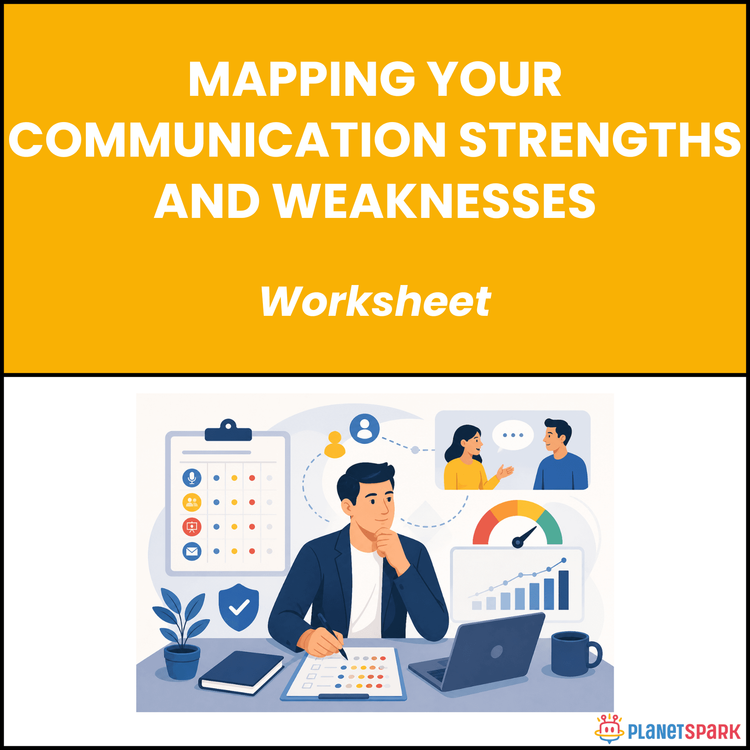
Mapping Your Communication Strengths and Weaknesses
Mapping Your Communication Strengths and Weaknesses: A Practical Guide to Improving Workplace Communication Skills
If you’ve ever received feedback like “you need to communicate better” but weren’t told exactly how, you’re not alone.
Communication is one of the most critical skills in any professional environment—yet it’s also one of the least clearly defined. Many professionals assume they are “good communicators” simply because they can speak confidently or write emails daily. But when it comes to performance reviews, promotions, or high-stakes conversations, gaps suddenly become visible—and costly.
This is exactly the problem the “Mapping Your Communication Strengths and Weaknesses” worksheet pack is designed to solve.
Who Is This Resource For?
This resource is built specifically for working professionals who want to improve communication in a structured, measurable way. It is especially useful for:
- Early to mid-career professionals (0–15 years of experience)
- Job seekers preparing for interviews or career transitions
- Managers and team leads stepping into leadership roles
- Consultants and client-facing professionals
- Anyone preparing for performance reviews or feedback cycles
- Professionals who have received vague communication feedback and want clarity
If your role requires influencing, presenting, writing, or collaborating—this resource is directly relevant to you.
What Does This Resource Contain?
This is not a generic guide—it’s a structured worksheet pack with 10 scenario-specific tools designed for real workplace situations.
Here’s what you’ll find inside:
1. Communication Style Inventory
Helps you identify whether your communication style is assertive, passive, aggressive, or passive-aggressive—and where it shows up.
2. 360° Feedback Decoder
Transforms vague feedback into specific, actionable communication insights.
3. High-Stakes Conversation Debrief
A post-conversation reflection tool to analyse what worked and what failed in difficult discussions.
4. Written Communication Audit
Evaluates your emails, reports, and proposals based on clarity, tone, and structure.
5. Presentation Confidence Gap Finder
Identifies the gap between how prepared you are and how confidently you deliver.
6. Active Listening Self-Score Sheet
Measures your listening ability across attention, empathy, and response quality.
7. Cross-Functional Communication Mapper
Helps you identify breakdowns when working across teams or departments.
8. Conflict Communication Pattern Tracker
Reveals how you communicate under pressure and how to improve it.
9. Influence & Persuasion Effectiveness Log
Evaluates how effectively you use logic, credibility, and emotional connection.
10. 90-Day Communication Growth Planner
Converts insights into a structured improvement plan with measurable milestones.
Each worksheet is tied to a real professional scenario—making the resource immediately applicable.
Summary of the Resource
At its core, this resource is a communication self-assessment and improvement system.
Instead of guessing where you need to improve, it helps you:
- Identify specific communication strengths
- Pinpoint recurring weaknesses across different contexts
- Analyse real interactions (not hypothetical situations)
- Build a structured 90-day improvement plan
It turns communication from a vague “soft skill” into something measurable, trackable, and improvable.
How Will This Resource Be Useful?
Most professionals make one key mistake: they treat communication as something that improves automatically with experience.
This resource challenges that assumption by introducing structured reflection and deliberate practice.
Here’s how it helps in real terms:
- Clarity: You understand exactly where you are strong and where you struggle
- Confidence: You approach conversations, presentations, and feedback situations with preparation
- Better Feedback Utilisation: You stop ignoring vague feedback and start decoding it into actions
- Improved Relationships: You communicate more effectively across teams and stakeholders
- Career Growth: You become promotion-ready by strengthening a top evaluation skill
As highlighted in the resource, poor communication mapping can lead to missed opportunities, misaligned expectations, and stalled growth.
How Should You Use This Resource?
To get maximum value, this is not something you should skim—it’s something you should actively work through.
Here’s the recommended approach:
Step 1: Start with Context
Choose the worksheet that matches your immediate need—performance review, presentation, conflict, or feedback.
Step 2: Fill It Completely
Do not skip sections. The effectiveness of this resource depends on honest and complete inputs.
Step 3: Use Real Examples
Base your answers on actual conversations, emails, and experiences—not assumptions.
Step 4: Reflect and Identify Patterns
Look for recurring behaviours across different worksheets.
Step 5: Discuss with a Mentor or Peer
Review your responses with someone you trust for additional perspective.
Step 6: Build Your 90-Day Plan
Use the final planner to convert insights into consistent action.
Step 7: Revisit Regularly
The resource is designed to be used quarterly to track progress and evolving patterns.
Action Steps
If you want to start improving your communication today, follow this:
1. Pick one worksheet based on your current challenge (e.g., presentations, feedback, conflict)
2. Complete it using a real recent situation
3. Identify one communication behaviour to improve
4. Apply that behaviour in your next interaction
5. Track your progress over the next 2–4 weeks
6. Move to the 90-day planner once you’ve completed 2–3 worksheets
Consistency—not intensity—is what drives improvement here.
Communication is not a talent you either have or don’t have—it’s a skill you build with awareness and deliberate practice.
The professionals who grow fastest are not the ones who communicate the most—they’re the ones who reflect, adapt, and improve consistently.
If you’re serious about your career growth, investing time in understanding how you communicate is one of the highest ROI decisions you can make.