
Mapping Your Growth From Contributor to Organizational Leader

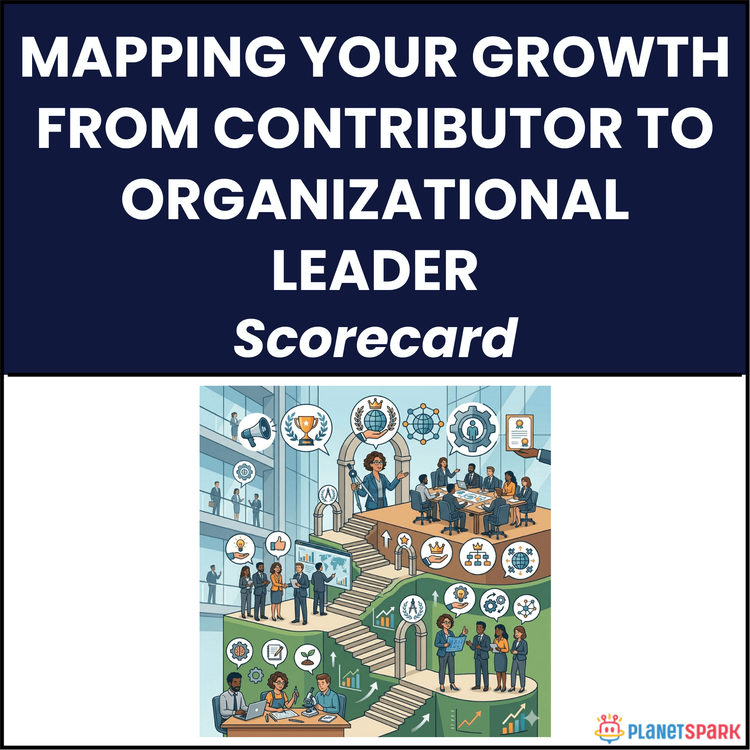
Mapping Your Growth From Contributor to Organizational Leader
How to Transition from Individual Contributor to Organisational Leader
If you’ve been consistently performing well in your role, there’s a good chance you’ve already asked yourself this question:
“What’s next for me?”
You deliver results. You’re dependable. You’re often the go-to person for getting things done. But when it comes to stepping into leadership roles—or succeeding after a promotion—many professionals hit an unexpected wall. Because the skills that made you successful as an individual contributor are not the same ones required to succeed as a leader. In fact, they can sometimes hold you back.
This is exactly why the resource “Mapping Your Growth From Contributor to Organisational Leader” exists. It gives you a clear, structured way to understand what true leadership requires—and how to systematically build those capabilities over time. Instead of guessing what to improve, this scorecard helps you identify your gaps, prioritise your growth, and take focused action.
Who Is This Resource For?
This resource is especially valuable if you are:
- A working professional (0–15 years of experience) preparing for leadership roles
- A high-performing individual contributor aiming for promotion
- A newly promoted manager struggling with the transition
- A consultant or specialist looking to scale impact beyond personal output
- A mid-career professional seeking clarity on leadership development
- Someone who feels “busy and productive” but not necessarily growing as a leader
If you want to move from doing great work to building teams, systems, and long-term impact, this resource is built for you.
What Does This Resource Contain?
This is not a generic leadership guide. It is a structured scorecard and development system grounded in real-world leadership transitions.
Inside the resource, you’ll find:
- A clear explanation of why the shift from contributor to leader is the most critical career transition
- A Leadership Transition Model that maps four stages:
- Individual Expert
- Team Lead
- Function Manager
- Organisational Leader
- Clear signals to help you identify whether you are still operating in contributor mode or evolving as a leader
- A comprehensive Leadership Growth Scorecard built around 6 core dimensions:
- Self-Awareness & Identity Shift
- Strategic Thinking & Vision
- People Development & Delegation
- Stakeholder Influence & Communication
- Systemic Thinking & Decision-Making
- Culture & Psychological Safety
- Detailed explanations of what each score means in real behaviour—not just theory
- Reflection worksheets to uncover blind spots and leadership patterns
- A structured 90-day Leadership Sprint Planner to turn insights into action
- A real-world case study showing how professionals navigate this transition
- Common mistakes that even high performers make—and how to avoid them
- A clear set of leadership truths and next steps to guide your journey
Everything is designed to help you move from awareness to execution.
Summary of the Resource
“Mapping Your Growth From Contributor to Organisational Leader” is a practical leadership development scorecard that helps you understand where you stand today—and what it will take to grow into a true organisational leader.
It replaces vague self-improvement goals with structured self-assessment, focused action, and measurable progress.
If you’re serious about leadership growth, this resource gives you a clear roadmap.
How Will This Resource Be Useful?
This resource helps you shift from execution-focused thinking to leadership-focused impact.
You’ll gain:
- Clarity on what leadership actually looks like in practice
- A realistic understanding of your current strengths and gaps
- A structured way to prioritise your development efforts
- Confidence in navigating the transition from “doer” to “enabler”
- Practical tools to build influence, develop people, and think strategically
- A repeatable system for continuous leadership growth
Most importantly, it helps you stop relying on guesswork—and start building leadership capability intentionally.
How Should You Use This Resource?
To get the best results, follow a structured approach:
Start by reading through the entire resource to understand the leadership model and expectations at each stage.
Next, complete the Leadership Growth Scorecard honestly. Avoid scoring based on where you want to be—focus on where you consistently are today.
Then, identify your 2–3 lowest-scoring dimensions. These are your highest-leverage growth areas.
Use the reflection worksheets to go deeper. These questions are designed to uncover hidden patterns—especially around identity, delegation, and influence.
After that, build your 90-day leadership sprint:
- Choose two focus areas
- Define specific behaviours to start and stop
- Track your progress through real situations
Finally, revisit the scorecard every quarter to measure growth and refine your approach.
Leadership development is not a one-time effort—it’s a continuous cycle.
Action Steps
After accessing this resource, take these steps immediately:
1. Complete the full Leadership Growth Scorecard and calculate your total score
2. Identify your two lowest-scoring dimensions
3. Write one leadership behaviour you will start—and one you will stop
4. Reflect on one habit from your contributor phase you need to let go of
5. Choose one situation this week to practise a leadership behaviour (delegation, feedback, or strategic thinking)
6. Block time in your calendar to review your progress after 30 days
These focused actions create clarity—and clarity is the foundation of leadership growth.
The transition to leadership is not automatic. It is not guaranteed by performance, tenure, or title. It is a deliberate shift in how you think, act, and create value. When you move from doing the work to enabling others, from solving problems to building systems, and from personal success to collective success—you don’t just grow your career. You expand your impact.
This resource helps you make that shift—clearly, practically, and with intention.