
Pivoting After Automation / Job Redundancy

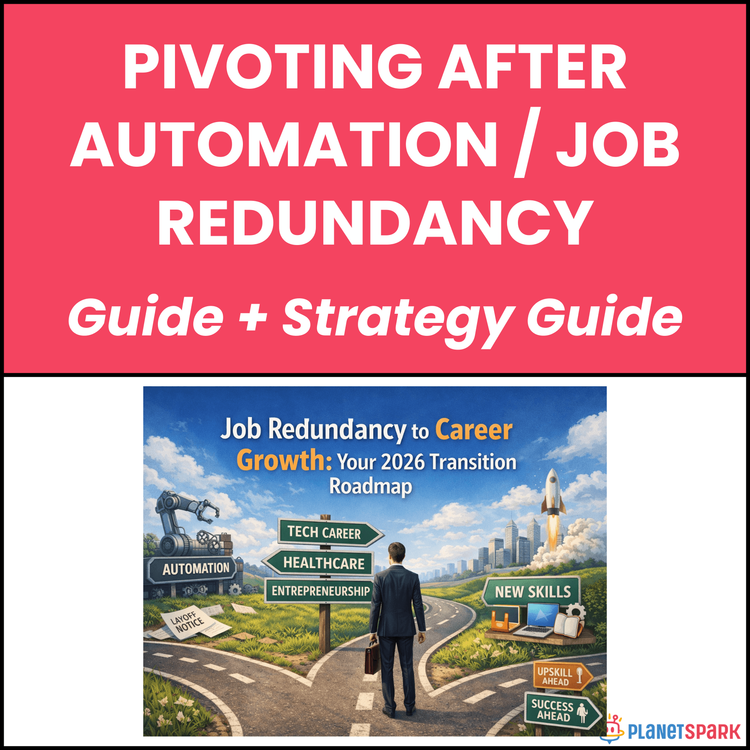
Pivoting After Automation / Job Redundancy
Pivoting After Automation or Job Redundancy: A Practical Career Transition Guide for Working Professionals
Automation is no longer a distant conversation about the future of work. It is already reshaping industries, redefining roles, and changing the skill requirements across organizations. Many professionals today are facing a difficult reality — roles are being restructured, processes are being automated, and entire job categories are evolving faster than expected.
If you have experienced job redundancy, restructuring, or the early signs that your role may be affected by automation, the uncertainty can feel overwhelming. Questions about career direction, financial stability, and professional identity quickly surface.
This is exactly why the resource “Pivoting After Automation & Job Redundancy” exists. It is designed as a practical, step-by-step strategy guide to help professionals move from the initial shock of career disruption to a confident and structured next move.
Instead of offering generic career advice, this resource provides a clear framework for assessing your situation, identifying your pivot direction, closing skill gaps, and executing a focused job search strategy in a rapidly changing job market.
Who Is This Resource For?
This guide is particularly valuable for working professionals who are navigating career transitions due to automation or industry change.
You will benefit the most from this resource if you are:
- A professional whose role has been automated, restructured, or made redundant
- An early to mid-career professional (0–15 years of experience) planning a proactive career pivot
- A job seeker looking for a structured strategy rather than scattered advice
- A professional considering a transition into a new role, function, or industry
- Someone who wants to future-proof their career against automation and technological change
- A professional looking to build stronger skills, networks, and positioning in the job market
The guide is written specifically for busy professionals who want clarity, structure, and actionable steps rather than theoretical career discussions.
What Does This Resource Contain?
The resource provides a complete career pivot framework divided into practical phases. Each phase focuses on a specific step professionals must take when navigating redundancy or automation-driven career changes.
Understanding the Automation Landscape
The guide begins by helping readers understand how automation is transforming the workforce. It highlights the difference between jobs disappearing and new roles emerging, showing that while millions of roles may be displaced, many new opportunities are being created in automation-adjacent and human-centric domains.
Phase 1: Stabilize and Assess
The first phase focuses on immediate actions professionals should take after a redundancy notice or career disruption. This includes reviewing employment terms, understanding severance benefits, securing financial runway, protecting professional relationships, and updating key career assets such as LinkedIn profiles and resumes.
The section also introduces a Career Audit Framework that helps professionals identify their transferable capabilities instead of focusing only on job titles.
Phase 2: Identify Your Pivot Direction
A major challenge during career transitions is deciding what direction to pursue next. This section introduces four types of career pivots:
- Lateral Pivot: Moving to a similar role in a different industry
- Upward Pivot: Transitioning into a more strategic or senior role
- Adjacent Pivot: Shifting into a related function
- Radical Pivot: Entering an entirely new domain
The resource also includes a Pivot Decision Matrix that helps professionals evaluate different career directions based on skill alignment, market demand, income potential, and personal interest.
Automation-Resistant Skill Zones
Another important section of the guide highlights the types of capabilities that are difficult for automation to replace. These include complex reasoning, relational intelligence, creative synthesis, and the ability to collaborate effectively with AI tools.
This helps professionals focus their learning efforts on skills that will remain valuable in the long term.
Phase 3: Close the Skill Gap Quickly
Once a pivot direction is identified, the next step is building the required skills. This section explains how professionals can close skill gaps through focused learning sprints rather than lengthy academic programs.
The guide recommends practical learning formats such as professional certificates, bootcamps, mentorship, freelance projects, and portfolio-based learning.
A 90-day learning plan template is also included to help professionals identify priority skills, learning resources, completion timelines, and proof artifacts that demonstrate real capability.
Phase 4: Build Your Pivot Narrative
One of the most powerful sections of the guide focuses on how professionals should communicate their transition story.
Instead of framing redundancy as a setback, the guide teaches readers how to present their pivot as a deliberate and strategic career decision. The Bridge Formula is introduced to help professionals structure their story by connecting past experience, newly developed skills, and future career direction.
The section also explains how to rewrite a resume for a pivot, highlighting transferable skills, measurable impact, and new capabilities that align with the target role.
Phase 5: Activate Your Network Strategically
Many professionals underestimate the importance of networking during career transitions. This guide emphasizes that a majority of roles are filled through professional networks rather than job boards.
Readers learn how to reconnect with existing contacts, explore new industry relationships, and conduct informational interviews that provide valuable market insight and potential referrals.
A practical informational interview framework is included to guide professionals from the initial outreach message to the follow-up process.
Phase 6: Execute a High-Signal Job Search
The final phase focuses on running a strategic job search rather than applying randomly to hundreds of positions.
The guide introduces a structured weekly activity plan that balances networking, skill-building, job applications, market research, and career reflection. This ensures professionals stay focused and maintain consistent progress throughout the transition period.
Real-World Case Study
To demonstrate how the framework works in practice, the guide includes a real-world example of a logistics professional who successfully pivoted into an operations analyst role after automation eliminated her previous position.
By applying the structured framework, building new skills, and activating her professional network, she secured a new role within fourteen weeks.
Summary of the Resource
In essence, “Pivoting After Automation & Job Redundancy” is a complete strategy guide for professionals navigating career disruption in the age of automation.
Rather than focusing only on job search tactics, the resource provides a holistic framework that covers emotional stabilization, career clarity, skill development, professional positioning, networking strategy, and structured job search execution.
The guide transforms an uncertain career moment into a deliberate strategy for growth and long-term resilience.
How Will This Resource Be Useful?
This resource delivers practical value in several ways.
First, it helps professionals regain clarity during a stressful transition by providing a structured framework for decision-making.
Second, it helps readers identify transferable skills they may have overlooked, allowing them to reposition their experience more effectively in the job market.
Third, it provides a clear roadmap for closing skill gaps through targeted learning rather than long, expensive programs.
Fourth, it teaches professionals how to communicate their career pivot with confidence, which significantly improves their chances during networking conversations and interviews.
Finally, the guide provides practical systems for networking and job searching that generate stronger results than traditional application strategies.
How Should You Use This Resource?
To get the most value from this guide, it should be used as an action-oriented workbook rather than a document that is simply read once.
Start by reading the entire guide from beginning to end so that you understand the overall framework and how the different phases connect.
Next, identify which stage of the pivot process you are currently in. If you have just received a redundancy notice, begin with the stabilization phase. If you already know your target role, focus on skill development and positioning.
Use the worksheets and templates provided in the guide to complete your career audit, evaluate pivot options, and build your learning plan.
Return to the guide regularly as a reference tool while you execute your networking strategy and job search plan.
The professionals who benefit most from this resource are those who treat it as an active roadmap rather than passive reading.
Action Steps
If you are currently navigating career uncertainty or redundancy, here are a few immediate steps you can take after accessing this resource:
1. Complete your career audit and list your top transferable skills.
2. Identify three possible pivot directions based on your experience and interests.
3. Use the pivot decision matrix to evaluate which direction has the strongest potential.
4. Draft your pivot narrative using the bridge formula provided in the guide.
5. Reach out to three professionals in your target domain for informational conversations.
6. Identify one skill you need to build and enroll in a relevant learning program.
7. Update your resume and LinkedIn profile to reflect your new career direction.
Taking these small but deliberate steps can quickly transform uncertainty into momentum.
Career transitions caused by automation or job redundancy can feel unsettling at first. However, they also create an opportunity to reassess your strengths, build future-ready skills, and reposition yourself for more meaningful and resilient career paths.
The professionals who thrive in this changing landscape are not necessarily those with the most experience, but those who adapt strategically and act with intention.
This guide is designed to help you do exactly that — move forward with clarity, confidence, and a structured plan.