
Prioritization Framework (Eisenhower Matrix) Guide

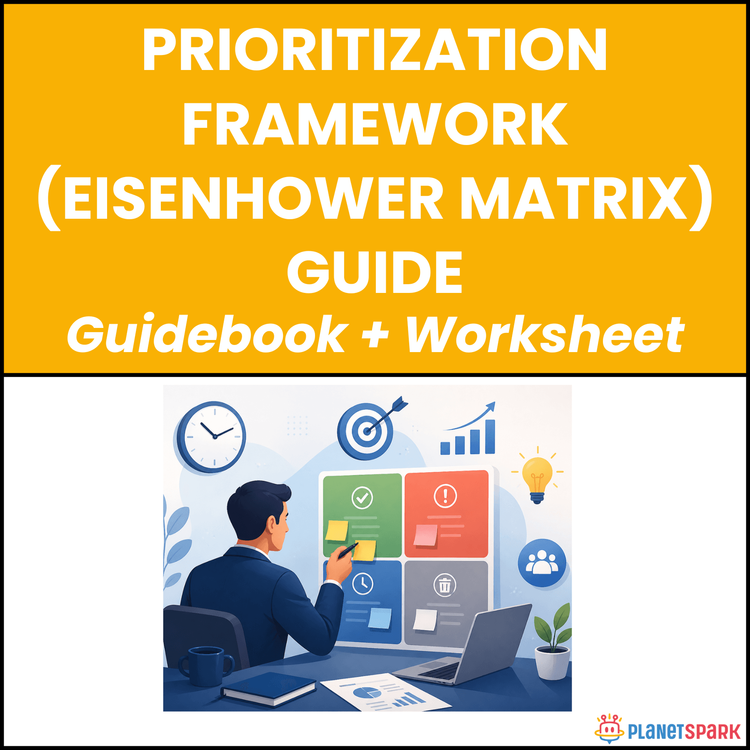
Prioritization Framework (Eisenhower Matrix) Guide
Task Prioritization Framework Using the Eisenhower Method: A Practical System to Stop Being Busy and Start Being Effective
If your workdays feel full but not meaningful, you’re not alone. Many professionals end their day exhausted, yet unsure what they actually accomplished. Emails were answered, meetings were attended, and tasks were completed—but the work that truly moves your career forward keeps getting postponed.
This is exactly the gap the Eisenhower Matrix Prioritization Guide is designed to solve. It helps you shift from reactive work to intentional progress by giving you a clear, repeatable system to decide what truly deserves your time.
Who Is This Resource For?
This guide is built for professionals who want clarity, control, and better outcomes from their time:
- Early to mid-career professionals struggling with overwhelming workloads
- Managers and team leads juggling multiple priorities and constant interruptions
- Consultants handling high-pressure client deliverables
- Career switchers trying to balance job search, upskilling, and current responsibilities
- Anyone who feels “busy all day but unproductive by the end of it”
What Does This Resource Contain?
The guide is not theoretical—it is a complete, actionable system you can start using immediately. Inside, you’ll find:
- A clear breakdown of the Eisenhower Matrix (Urgent vs Important framework)
- Deep explanation of urgency vs importance and why professionals confuse them
- The four quadrants with real-world examples:
- Q1: Do Now (urgent + important)
- Q2: Schedule (important, not urgent)
- Q3: Delegate (urgent, not important)
- Q4: Eliminate (not urgent, not important)
- A step-by-step application system:
- Brain dump method to capture all tasks
- Two-question classification system
- Action rules for each quadrant
- Weekly review ritual
- Practical worksheets:
- Brain dump worksheet
- Task classification table
- Weekly planning template
- Self-assessment quadrant audit
- Real-world case study showing how a consultant reduced overwhelm and improved productivity
- Common mistakes professionals make (and how to fix them)
- Advanced habit-building strategies to make prioritization automatic
Summary of the Resource
This guide gives you a structured, repeatable method to:
- Organize your workload clearly
- Distinguish between what feels urgent and what truly matters
- Reduce time spent on low-value work
- Protect time for strategic, career-building activities
- Build a weekly system that keeps you focused and in control
Instead of reacting to tasks, you start deciding your priorities with clarity and confidence.
How Will This Resource Be Useful?
The real value of this guide lies in the outcomes it creates in your day-to-day work:
- Clarity: You know exactly what to do, what to schedule, and what to ignore
- Better decisions: You stop reacting to noise and start focusing on impact
- Reduced overwhelm: Your workload becomes structured and manageable
- Increased productivity: More time goes into high-impact tasks (Q2)
- Career growth: You consistently invest in skills, strategy, and relationships
- Time recovery: You eliminate or delegate tasks that drain your energy
Most importantly, it helps you move from “busy” to “effective”—a shift that directly impacts your performance and career trajectory.
How Should You Use This Resource?
To get the full benefit, use this guide as a system—not just a one-time read.
Step 1: Read the guide once fully
Understand the framework, quadrants, and logic behind urgency vs importance.
Step 2: Do a complete brain dump
List every task, project, and responsibility currently on your mind.
Step 3: Classify each task
Use the two-question test:
- Is it urgent?
- Is it important?
Assign each task to one of the four quadrants.
Step 4: Act based on the quadrant
- Q1: Do immediately
- Q2: Schedule in your calendar
- Q3: Delegate or batch
- Q4: Eliminate
Step 5: Build a weekly habit
Set aside 20–30 minutes every week to:
- Reassess tasks
- Protect Q2 time
- Review what worked and what didn’t
Over time, this becomes second nature—you stop “using” the matrix and start thinking in it.
Action Steps
If you want to start immediately, follow this simple checklist:
1. Spend 15 minutes today writing down all your current tasks
2. Classify each task into Q1, Q2, Q3, or Q4
3. Identify your top 3 Q2 priorities for the week
4. Block time for these in your calendar right now
5. Delegate or remove at least 3 Q3/Q4 tasks
6. Schedule a weekly review session going forward
These small steps will create immediate clarity and momentum.
The difference between overwhelmed professionals and high performers is not effort—it’s prioritization. When you consistently focus on what truly matters, progress becomes inevitable.
This guide gives you a practical system to take control of your time, reduce noise, and invest in work that actually moves your career forward. Use it regularly, refine it weekly, and you’ll start seeing measurable improvements in both productivity and confidence.