
Problem Prioritization Matrix Template

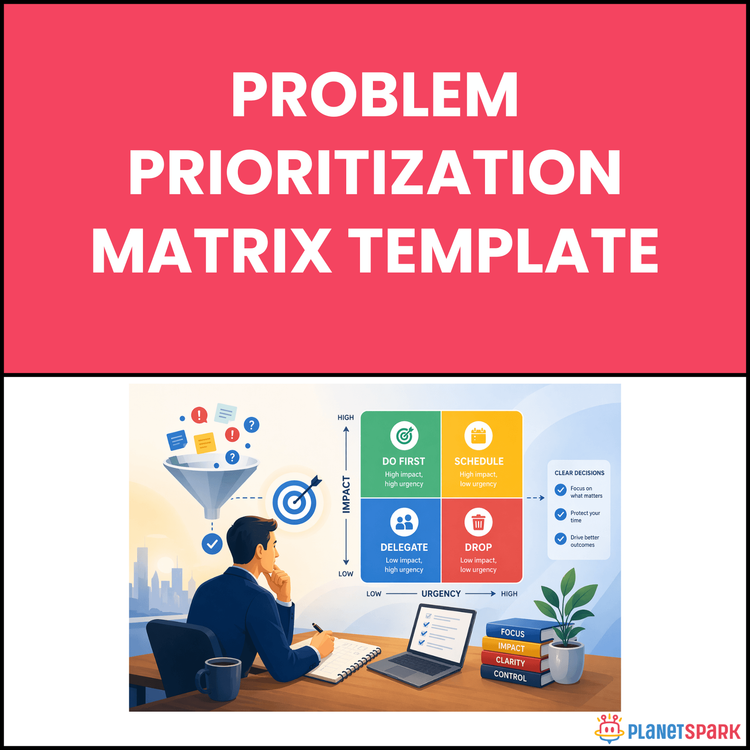
Problem Prioritization Matrix Template
Problem Prioritisation Matrix: A Practical Framework to Focus on What Matters and Eliminate Low-Value Work
If your workday feels like an endless loop of urgent tasks, back-to-back meetings, and constant firefighting—you’re not alone. Most working professionals aren’t overwhelmed because they lack capability. They’re overwhelmed because everything feels equally important.
And when everything is a priority, nothing truly is.
This is exactly the problem the “Problem Prioritisation Matrix Template” is designed to solve. It gives you a clear, structured system to stop reacting to noise and start focusing on the problems that actually move the needle.
Instead of relying on instinct, urgency, or pressure, this resource helps you make decisions based on impact and effort—so you can work smarter, not just harder.
Who Is This Resource For?
This resource is especially useful if you are:
- A working professional managing multiple competing priorities
- A manager or team lead trying to align team focus and resources
- A consultant or strategist advising clients on where to start
- A career switcher navigating unfamiliar challenges in a new role
- A mid-career professional feeling stuck in reactive work cycles
- Someone struggling with decision paralysis or constant task overload
If you’re time-poor, outcome-driven, and want a practical way to decide what deserves your attention—this framework is built for you.
What Does This Resource Contain?
This is not just a concept—it’s a complete, actionable system you can apply immediately.
Inside the resource, you’ll find:
- A clear explanation of why prioritisation—not effort—is the real differentiator in professional success
- A step-by-step 5-stage framework to identify, evaluate, and act on problems
- A structured problem collection worksheet to capture all challenges without bias
- A simple but powerful Impact vs. Effort scoring system (1–5 scale)
- A visual 2×2 Problem Prioritisation Matrix to map and categorise problems
- Defined quadrants:
- Quick Wins (high impact, low effort)
- Strategic Projects (high impact, high effort)
- Fill-ins (low impact, low effort)
- Time Drains (low impact, high effort)
- A prioritisation scoring sheet with a clear formula (Impact ÷ Effort) to rank problems objectively
- An action planning template with ownership, deadlines, and success metrics
- A real-world case example showing how a manager transformed team focus using the matrix
- Common mistakes to avoid when applying the framework
- Reflection questions to sharpen decision-making and accountability
Every section is designed for direct application—not theory.
Summary of the Resource
The “Problem Prioritisation Matrix Template” is a practical decision-making tool that helps you cut through overwhelm, identify high-impact opportunities, and eliminate low-value work.
By combining structured thinking with a simple visual framework, it transforms scattered problems into a clear, actionable plan—so you can focus your time, energy, and resources where they matter most.
How Will This Resource Be Useful?
This resource helps you move from reactive work to intentional action.
You’ll gain:
- Clarity on which problems actually deserve your attention
- A structured way to evaluate impact vs. effort objectively
- Confidence in making prioritisation decisions—even under pressure
- Better alignment within teams on what to focus on (and what to ignore)
- Reduced wasted effort on low-impact, high-complexity tasks
- A repeatable system you can use across projects, roles, and situations
Most importantly, it gives you permission to stop doing work that doesn’t matter—and focus on what truly drives results.
How Should You Use This Resource?
To get the most value, follow this structured approach:
Start by reading the guide end-to-end once. This will help you understand the full framework and how each step connects.
Next, begin with the problem collection worksheet. List every issue, challenge, or friction point—without filtering or judging. Aim for completeness, not perfection.
Then, score each problem independently using the Impact and Effort scales. Avoid comparing too early—objectivity is key here.
Once scored, plot your problems on the 2×2 matrix. This is where clarity emerges. You’ll instantly see which problems are worth acting on.
After mapping, calculate the priority score (Impact ÷ Effort) and rank your problems. This becomes your decision backbone.
Finally, convert your prioritised list into a clear action plan:
- Act immediately on Quick Wins
- Plan Strategic Projects properly
- Delegate or batch Fill-ins
- Eliminate Time Drains
Revisit the matrix regularly—especially when priorities shift or new challenges arise.
Action Steps
After accessing this resource, take these steps immediately:
1. Block 45–60 minutes of uninterrupted time
2. List 10–25 real problems you’re currently facing (be specific)
3. Score each problem on Impact and Effort (1–5 scale)
4. Plot them on the matrix and identify your Quick Wins
5. Calculate priority scores to rank your problems
6. Commit to solving at least one Quick Win within the next two weeks
7. Identify one Time Drain to stop or eliminate immediately
Small, structured actions here can dramatically improve how you work and make decisions.
The ability to prioritise effectively is one of the most valuable skills in any career. It’s what separates busy professionals from impactful ones.
When you stop reacting to everything and start focusing on the right things, your work becomes more meaningful, your time more productive, and your outcomes significantly stronger.
Use this resource not just as a one-time exercise, but as a repeatable system to guide your decisions, align your efforts, and create consistent impact in your role.