
Problem-Solving Tracker

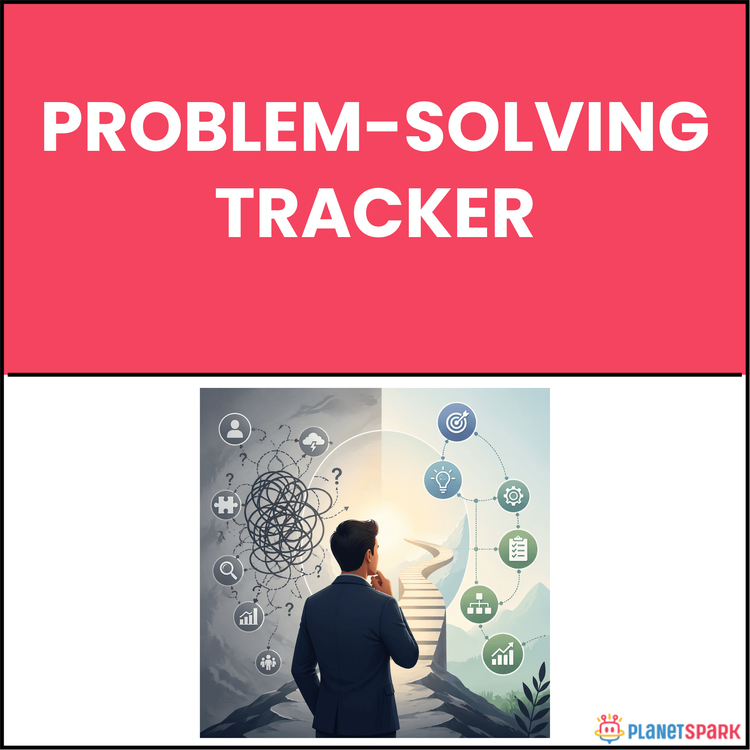
Problem-Solving Tracker
Master Structured Problem-Solving at Work
If you’ve ever felt stuck while solving a problem at work—unsure where to start, overwhelmed by complexity, or pressured to deliver quick answers—you’re not alone. Most working professionals spend a large part of their day solving problems, yet very few are ever taught how to do it systematically.
The result? We jump to solutions too quickly, solve the wrong problems, overcomplicate simple issues, or get stuck in endless analysis. Over time, this doesn’t just affect outcomes—it impacts how others perceive our decision-making ability.
That’s exactly why the “Problem-Solving Tracker” exists. It’s designed to give professionals a clear, repeatable system to move from confusion to clarity—without guesswork, without fluff, and without relying purely on instinct.
This resource introduces a structured framework that helps you think more strategically, act more confidently, and solve problems more effectively—whether you’re working individually or leading a team.
Who Is This Resource For?
This resource is especially valuable if you are:
- A working professional with 0–15 years of experience
- A manager or team lead handling complex decisions under pressure
- A consultant juggling multiple client problems simultaneously
- A career switcher navigating unfamiliar challenges
- A professional who often feels stuck between overthinking and rushing decisions
- Someone who wants to build structured thinking and strategic problem-solving skills
If you want to stop reacting to problems and start approaching them with clarity and confidence, this tracker is built for you.
What Does This Resource Contain?
This is not a theoretical guide. It’s a hands-on, structured system designed for real-world use.
Inside the resource, you’ll find:
- A clear explanation of why problem-solving is a critical professional skill
- A breakdown of common problem-solving mistakes (like jumping to solutions or solving the wrong problem)
- The 5D Framework: Diagnose, Dissect, Design, Decide, Debrief
- Step-by-step guidance for each phase of the framework
- Diagnostic question sets to define the real problem accurately
- A problem statement template to anchor your thinking
- Root-cause analysis tools such as the “5 Whys” technique
- Structured prompts to break down complex problems into manageable components
- Guidance on designing effective solutions instead of quick fixes
- Decision-making checkpoints to evaluate options clearly
- Reflection and debrief tools to improve future problem-solving
- Practical modes like “Speed Mode” for quick thinking and “Team Mode” for collaborative alignment
Everything is designed to be immediately usable—whether you have 10 minutes or a few hours.
Summary of the Resource
The “Problem-Solving Tracker” is a practical, structured guide that helps professionals approach problems with clarity, logic, and confidence. Instead of relying on instinct or trial-and-error, it provides a repeatable system to identify root causes, design effective solutions, and make better decisions.
It transforms problem-solving from a reactive activity into a strategic skill you can consistently apply across roles, industries, and situations.
How Will This Resource Be Useful?
This resource helps you move from scattered thinking to structured execution.
You’ll gain:
- Clarity on what the real problem actually is
- A structured way to break down complex challenges
- Confidence in making decisions backed by logic, not guesswork
- The ability to avoid common mistakes like solving symptoms instead of root causes
- Faster and more effective problem-solving under time pressure
- A shared language for problem-solving in team environments
- Stronger strategic thinking skills that improve long-term career growth
Most importantly, it helps you shift from being reactive to being deliberate in how you approach challenges.
How Should You Use This Resource?
To get the most value, use this tracker as an active tool—not just a read-through guide.
Start by reviewing the full framework once to understand how the five phases connect. This gives you a mental model before you begin applying it.
Next, apply the 5D Framework step-by-step to a real problem you’re currently facing:
- Begin with Diagnose: Clearly define what’s actually happening versus what should be happening
- Move to Dissect: Break the problem into parts and identify root causes using tools like the 5 Whys
- Then Design: Explore possible solutions thoughtfully instead of rushing
- Proceed to Decide: Evaluate options and commit to a clear course of action
- Finally, Debrief: Reflect on outcomes and capture learnings for future improvement
If you’re short on time, use the “Speed Mode” to quickly run through all five phases in a structured way.
You can also use this tracker in team settings to align discussions and avoid unstructured meetings.
Revisit the resource whenever you:
- Face a complex or recurring problem
- Need to make an important decision
- Lead team discussions or strategy meetings
- Want to improve your structured thinking skills over time
Action Steps
After accessing this resource, take these steps immediately:
1. Identify one real problem you’re currently facing at work
2. Spend 10–15 minutes defining the problem using the Diagnose phase prompts
3. Write a clear problem statement using the provided template
4. Use the 5 Whys technique to identify at least one root cause
5. Outline 2–3 possible solutions before choosing one
6. Make a clear decision and define next steps
7. Reflect on the outcome after execution to capture learnings
Even one structured pass through the framework can significantly improve your clarity and results.
Strong problem-solving isn’t about intelligence or experience alone—it’s about having a reliable system you can trust under pressure. When you approach problems with structure instead of instinct, you reduce errors, save time, and make better decisions consistently.
Use this resource not just to solve problems, but to build a skill that compounds across your entire career. The more you apply it, the more naturally strategic your thinking becomes—and the more valuable you become in any professional setting.