
Role Positioning Improvement Worksheet

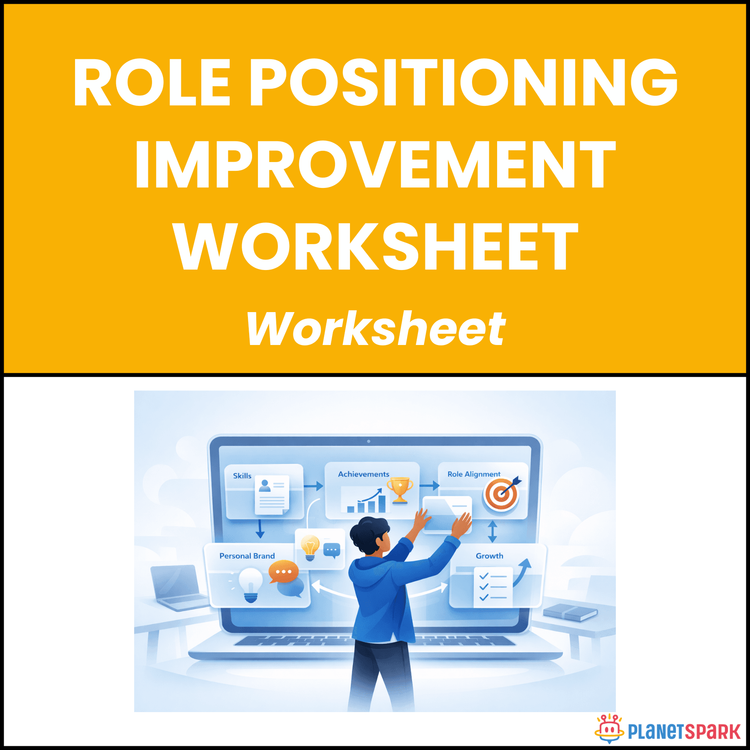
Role Positioning Improvement Worksheet
How to Communicate Your Professional Value and Stand Out in Job Applications
You may have the right skills, the right experience, and even the right mindset.
But if you cannot clearly communicate your value, you will keep getting overlooked.
This is one of the biggest challenges professionals face today. It is not about what you have done. It is about how you present it. In a competitive job market, skills alone are not enough. The way you position those skills determines whether opportunities open up or pass you by.
The Role Positioning Improvement Worksheet is designed to help you fix exactly that. It gives you a structured way to define your value, align it with the right roles, and communicate it with clarity and confidence.
Who Is This For?
This guide is ideal for professionals who want to improve how they present themselves and secure better opportunities.
It is especially useful for:
Professionals with 0 to 15 years of experience aiming for better roles
Career switchers trying to connect their past experience with new opportunities
Managers and consultants targeting higher level or strategic positions
Job seekers who are not getting interview calls despite having strong profiles
Professionals who struggle to explain their value clearly in interviews or networking
If you feel like you are capable but not getting the right opportunities, this will help you bridge that gap.
What Does This Include?
The Role Positioning Improvement Worksheet is structured into five practical steps that guide you from self clarity to confident communication.
Step 1: Audit Your Professional Identity
You create a clear understanding of your skills, experiences, and strengths. This includes identifying hard skills, soft skills, and signature strengths, along with reflection questions that reveal your real value.
Step 2: Define Your Target Role with Precision
You analyze your target role in detail by studying job descriptions, identifying key requirements, understanding hidden expectations, and evaluating your fit. This helps you position yourself strategically rather than generically.
Step 3: Build Your Core Positioning Statement
This is the most critical step. You create a 2 to 3 sentence positioning statement that answers a key question: why you, for this role, right now. It combines who you are, what you deliver, and why it matters.
Step 4: Tailor Your Positioning Across Channels
You learn how to adapt your positioning for LinkedIn, CV, interviews, and networking conversations. Each format is optimized for its specific purpose while maintaining a consistent core message.
Step 5: Stress Test and Refine Your Positioning
You evaluate your positioning using a structured audit. This ensures your message is specific, outcome focused, relevant, credible, and conversational.
The worksheet also includes real world examples, common mistakes, and a practical 7 day action plan to help you implement everything effectively.
Summary
This is a complete positioning system for your career.
It helps you define your professional identity, align it with the right opportunities, and communicate your value in a way that gets noticed.
Instead of listing skills and hoping they speak for themselves, you build a clear narrative that makes your value obvious to decision makers.
How Will This Help You?
This approach creates tangible improvements in how you present yourself and how others perceive you.
You communicate your value clearly and confidently
You stand out in job applications and interviews
You align your experience with the right roles
You avoid being overlooked due to weak positioning
You build a strong and consistent professional narrative
Most importantly, you stop underselling yourself and start owning your career story.
How Should You Use It?
You can use this worksheet in a structured and practical way based on your schedule.
You can complete it step by step over a few focused sessions
You can revisit specific steps when preparing for interviews or applications
You can treat it as a living document and refine your positioning over time
The best approach is to complete all five steps in sequence and then test your positioning in real conversations.
According to the framework on page 6, your positioning should be adapted across different channels like LinkedIn, CV, interviews, and networking to ensure consistency and impact.
Action Steps
List your key skills, strengths, and achievements clearly
Define your target role and understand its requirements
Write your first draft positioning statement
Refine it using the three part structure
Adapt it for LinkedIn, CV, and interviews
Test it in conversations and gather feedback
Update your profiles with your improved positioning
Progress comes from action, not perfection.
Your career growth depends not just on what you can do, but on how clearly you can communicate it.
The professionals who move ahead faster are not always the most skilled. They are the ones who can clearly show their value and align it with the right opportunities.
This worksheet gives you a system to do exactly that. Use it consistently, refine your message, and make sure your next opportunity clearly sees what you bring to the table.
Book your free session today!