
Thinking Bias Identification Worksheet

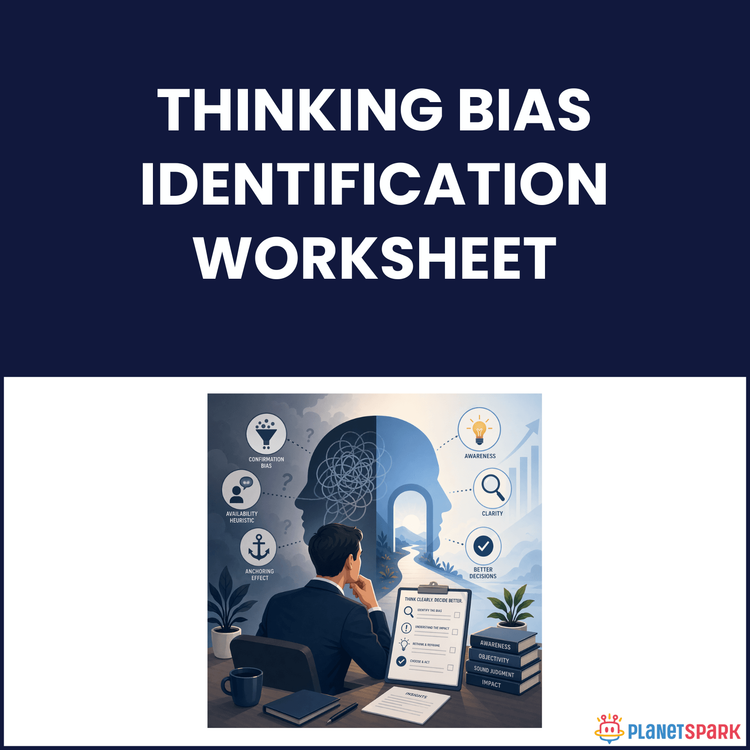
Thinking Bias Identification Worksheet
Improve Decision-Making by Recognizing Mental Biases with Worksheet
Most professionals believe they make rational decisions—but in reality, hidden thinking biases often influence how we interpret information, judge situations, and choose actions. These biases can lead to poor decisions, missed opportunities, and flawed problem-solving, especially under pressure or uncertainty.
The Thinking Bias Identification Worksheet is designed to help you slow down your thinking, recognize these biases, and make more objective, well-informed decisions. It gives you a structured way to reflect on your thought process and correct it in real time.
Who Is This Resource For?
This worksheet is especially useful for professionals who regularly make decisions, analyze situations, or solve problems, including:
- Working professionals aiming to improve decision quality
- Managers and team leads making high-impact decisions
- Consultants and analysts evaluating complex scenarios
- Job seekers preparing for interviews that test critical thinking
- Career switchers building strong analytical and reasoning skills
If you’ve ever second-guessed a decision or realized you overlooked something important, this worksheet will help you sharpen your thinking.
What Does This Resource Contain?
The Thinking Bias Identification Worksheet is structured to guide reflection and correction. Inside, you’ll find:
- Sections to describe the situation or decision clearly
- Prompts to capture your initial assumptions and judgments
- A checklist of common cognitive biases (e.g., confirmation bias, anchoring, overconfidence)
- Guided questions to identify which biases may be influencing your thinking
- Space to challenge assumptions and consider alternative perspectives
- Areas to re-evaluate your decision with a more objective lens
- Reflection prompts to build long-term awareness of your thinking patterns
Each section helps you move from automatic thinking to deliberate, structured reasoning.
Summary of the Resource
This worksheet helps you identify and correct hidden thinking biases that affect your decisions. By making your thought process visible and structured, it enables you to think more clearly, objectively, and effectively.
How Will This Resource Be Useful?
Consistently using this worksheet can significantly improve the quality of your thinking and decisions:
- Reduces errors caused by unconscious biases
- Improves clarity and objectivity in decision-making
- Helps you evaluate situations from multiple perspectives
- Builds stronger analytical and critical thinking skills
- Enhances confidence in high-stakes decisions
- Strengthens your ability to justify and communicate decisions
Over time, you’ll develop a more disciplined and reliable thinking process.
How Should You Use This Resource?
To get the best results, use this worksheet whenever you face an important decision or complex situation.
Step 1: Define the situation
Clearly describe the decision or problem you’re dealing with.
Step 2: Capture your initial thinking
Write down your first assumptions, judgments, and conclusions.
Step 3: Identify potential biases
Use the checklist to spot biases that may be influencing your thinking.
Step 4: Challenge your assumptions
Question your initial beliefs and consider alternative viewpoints.
Step 5: Re-evaluate the decision
Look at the situation again with a more objective perspective.
Step 6: Decide with clarity
Make a more informed and balanced decision.
Step 7: Reflect and learn
Review how your thinking changed and what you learned from the process.
Using this worksheet regularly will help you catch biases faster—even without writing them down over time.
Action Steps
- Choose one recent or upcoming decision to analyze
- Fill out the worksheet honestly without skipping steps
- Identify at least one bias affecting your thinking
- Write down an alternative perspective
- Revisit your decision and adjust if needed
- Repeat this process for future decisions
- Track patterns in your thinking over time
Even a single use of this worksheet can reveal insights that change how you approach decisions.
Strong decision-making is not just about intelligence—it’s about awareness. When you learn to recognize and manage your thinking biases, you gain a powerful advantage in both your professional and personal life. With practice, you’ll make clearer, more balanced decisions that lead to better outcomes.
Book your free session today!