
Role Expectation Mapping Worksheet

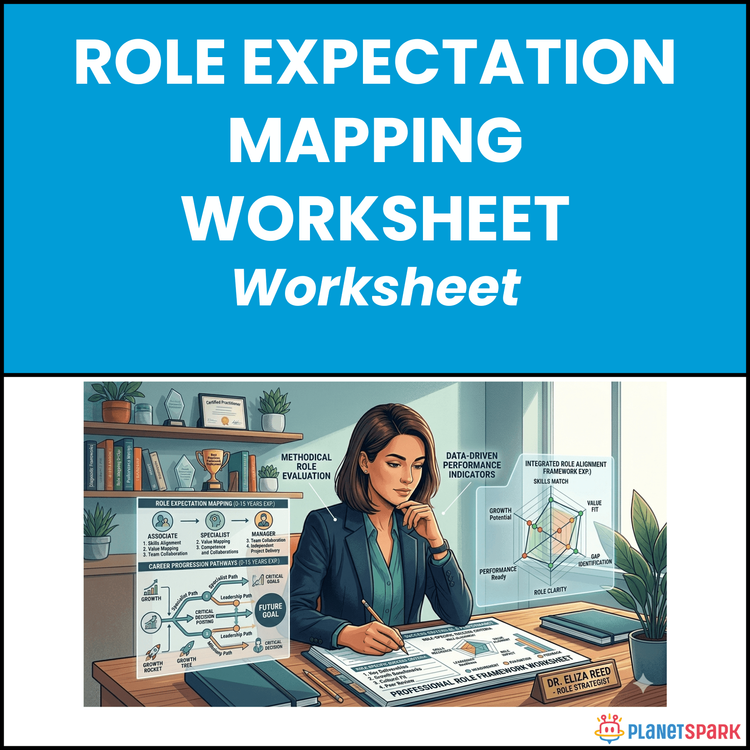
Role Expectation Mapping Worksheet
Role Expectation Mapping Worksheet: A Practical Guide to Understanding What Success Looks Like in Any Role
Stepping into a new role should feel like progress. But for many professionals, it quickly turns into guesswork.
You join with a job description in hand, a few conversations in mind, and a rough idea of what success might look like. Then reality sets in. Your manager seems to care about one thing, your peers expect something else, and the actual day-to-day work looks different from what was written in the role. That mismatch is where confusion starts, performance suffers, and good professionals begin to feel like they are underperforming even when they are working hard.
That is exactly the problem the Role Expectation Mapping Worksheet is designed to solve. This resource gives professionals a structured way to decode what success really looks like in a role, beyond the written job description. It helps you move from assumptions to clarity by mapping priorities, stakeholders, time horizons, unwritten rules, and development gaps in a practical, usable format. It is built as a worksheet plus framework for career changers, job seekers, consultants, and managers who want to understand role expectations with precision.
Who Is This Resource For?
This resource is especially useful for professionals who want more clarity, faster alignment, and fewer avoidable mistakes in a role.
It is a strong fit for:
- Career changers entering unfamiliar functions, industries, or team cultures
- Job seekers who want to understand what success actually looks like before accepting a role
- Consultants and contractors who need to get up to speed quickly in a new engagement
- Managers stepping into broader ownership and cross-functional expectations
- Early- and mid-career professionals who want to perform with more confidence and less guesswork
- Professionals who feel they are working hard but are not fully sure what their stakeholders value most
This worksheet is particularly valuable for people who are smart, capable, and motivated, but have realised that effort alone is not enough. In most roles, clarity is what creates momentum. The worksheet treats role clarity as a strategic advantage, not a soft skill.
What Does This Resource Contain?
This is not a motivational PDF or a generic career article. It is a structured, step-by-step worksheet built to help professionals map expectations in a way they can immediately act on.
Inside the resource, you will find:
- A strong introduction explaining why role clarity is often the unfair advantage professionals overlook
- A JD Decoder that helps you read beyond the job description by focusing on verbs, priority order, missing signals, and role type
- A Builder, Operator, or Hybrid role classification model to identify the true nature of a role
- A stakeholder expectation mapping framework covering direct managers, skip-level leaders, peers, cross-functional partners, and clients
- A three-horizon planning tool to define expectations across 30 days, 90 days, and 12 months
- A diagnostic section for uncovering unwritten rules around communication, speed, visibility, quality, power dynamics, and culture
- A gap audit framework that helps you assess yourself across technical skills, domain knowledge, stakeholder relationships, and cultural fluency
- A highest-leverage gap prioritisation model to focus your development where it matters most
- A worked example showing how a newly promoted Marketing Manager uses the framework in her first 90 days
- A common mistakes and fixes section that helps readers avoid the traps most professionals fall into
- A 30-day action checklist broken into Week 1 and Weeks 2 to 4 actions
- Reflection prompts to help readers move from mapping expectations to making smarter behavioural choices
- A final summary of key takeaways with a practical next-step prompt
The structure is practical throughout. Every section combines explanation with guided fill-in prompts, making it useful for immediate action, not passive reading.
Summary of the Resource:
The Role Expectation Mapping Worksheet helps you understand what success really looks like in a role before assumptions turn into problems.
At a high level, the worksheet teaches you how to decode the written role, identify the people who define your success, separate short-term and long-term expectations, recognise hidden cultural rules, and audit the gaps between where you are and where you need to be. It then helps you turn that insight into a concrete action plan.
For a busy professional, that is the real value. Instead of spending months trying to read the room, you get a clear system for finding out what matters, who it matters to, and what you should prioritise first. The resource is especially strong because it does not stop at analysis. It pushes you toward direct conversations, real documentation, and better choices in your first days, first months, and beyond.
How Will This Resource Be Useful?
The biggest benefit of this resource is that it reduces invisible career friction.
Many professionals underperform not because they lack capability, but because they are solving for the wrong priorities. They focus on what is written instead of what is expected. They manage upward but ignore peers. They think long term when the business needs a short-term win. Or they miss unwritten rules that shape how performance is judged.
This worksheet helps correct those problems early.
Used properly, it can help you:
- Understand the real job behind the job description
- Clarify what different stakeholders expect from you
- Identify the behaviours and outcomes that build trust quickly
- Avoid early mistakes caused by unclear assumptions
- Prioritise your energy across the right time horizon
- Understand hidden team norms before violating them
- Identify the one development gap that matters most right now
- Build stronger credibility in the first 30, 90, and 365 days
- Perform more deliberately instead of reactively
One of the strongest features of the worksheet is how it reframes career growth. It shows that success is not only about talent or effort. It is about knowing what winning looks like and aiming there on purpose. That idea comes through clearly in both the guidance sections and the final summary.
How Should You Use This Resource?
The worksheet itself recommends a practical first pass of 60 to 90 minutes, followed by quarterly revisits. That is exactly the right way to approach it. :contentReference[oaicite:9]{index=9}
A useful way to work through it is in phases:
Phase 1: Decode the role before you act
Start by reading the introduction and Step 1 carefully. Use the JD Decoder to examine the actual job description you are working with. Highlight the verbs, identify the first responsibility listed, and notice what is missing. Then classify the role as Builder, Operator, or Hybrid.
This step matters because it helps you stop taking the job description at face value.
Phase 2: Map the people who define success
Move to the stakeholder mapping section next. Write down your direct manager, skip-level leader, key peers, cross-functional partners, and internal or external clients. For each group, document what they want from you, how they judge success, and where friction may already exist.
This is where the worksheet becomes especially practical. It encourages direct expectation-alignment conversations rather than passive guessing. :contentReference[oaicite:10]{index=10}
Phase 3: Anchor expectations to time
Use the three-horizon framework to separate what matters in the first 30 days, the first 90 days, and the first 12 months. That prevents one of the most common mistakes in new roles: trying to prove long-term value before meeting short-term expectations.
This section is useful for both new hires and existing professionals whose roles have evolved. :contentReference[oaicite:11]{index=11}
Phase 4: Surface the hidden rules
Complete the unwritten rules section honestly. Think about response times, disagreement norms, pace, visibility, and informal power structures. These are often the real performance rules, even though no one formally writes them down. :contentReference[oaicite:12]{index=12}
Phase 5: Run the gap audit
Once you know what is expected, assess where you stand. Rate yourself on skills, knowledge, relationships, and cultural fluency. Then choose your highest-leverage gap and define one action you can take this week to start closing it. :contentReference[oaicite:13]{index=13}
Phase 6: Turn insight into action
Finish with the 30-day action checklist and reflection questions. This is where the worksheet moves from awareness to action. Use the checklist to schedule conversations, define priorities, and build an actual calendar-based plan. Then use the reflection prompts to think more deeply about what surprised you, where your strengths align, and what conversation you have been avoiding.
Action Steps:
After accessing this resource, do these things immediately:
1. Set aside 60 to 90 focused minutes for your first full pass through the worksheet
2. Pull up your current job description or target job description and complete the JD Decoder
3. List at least four key stakeholders who shape success in the role
4. Draft your own 30-day definition of success before speaking with others
5. Schedule expectation-alignment conversations with your manager and other core stakeholders
6. Fill in the 30, 90, and 365-day horizons table
7. Write down three unwritten rules you have already noticed
8. Run the gap audit and identify your single highest-leverage gap
9. Define one action to close that gap this week
10. Put a quarterly re-mapping session on your calendar so this does not become a one-time exercise
The worksheet also includes a sharp note for consultants and career changers: if you are entering a contract role or transitioning industries, compress the process into 72 hours. That is a useful reminder. Early questions are expected. Delayed questions are often judged.
A simple but powerful starting point is this: complete Steps 1 to 3 this week, then hold one expectation conversation. Even those two actions can change how confidently and strategically you operate in a role.
Success at work is rarely only about working harder. More often, it is about understanding what matters, to whom, and when. That is what makes the Role Expectation Mapping Worksheet so useful. It helps professionals stop operating on assumptions and start performing with intention.
Whether you are entering a new role, adjusting to a promotion, switching careers, or trying to get unstuck in your current position, this resource gives you a practical framework to create clarity where most people stay confused. And that clarity has real consequences. It improves trust, reduces wasted effort, sharpens your priorities, and helps your contribution get recognised in the way it deserves.
Use this worksheet as more than a one-time exercise. Use it as a career discipline. Expectations change. Teams evolve. Roles shift. The professionals who keep mapping those changes are the ones who stay aligned, credible, and effective over time.
Book your free session today!