
Salary Expectation Calculator Sheet

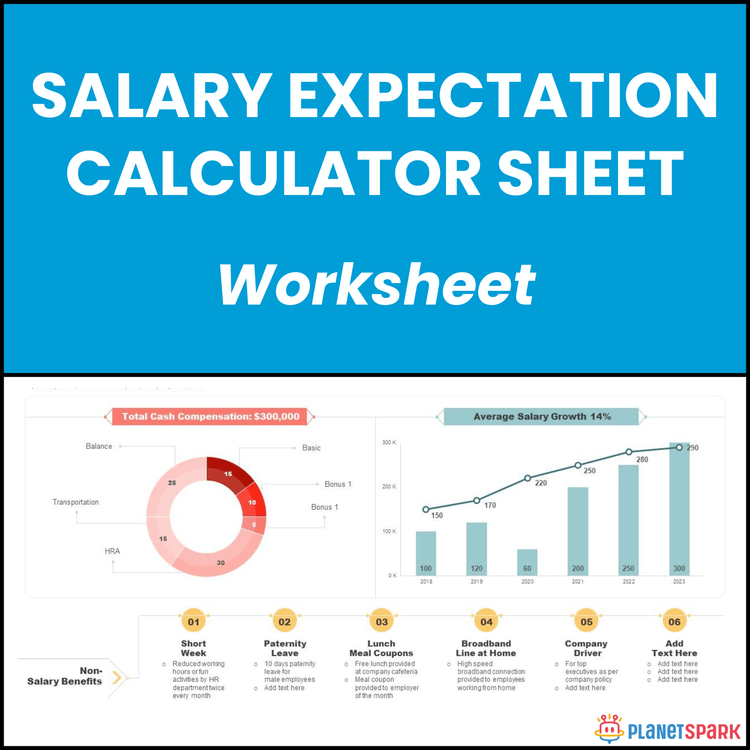
Salary Expectation Calculator Sheet
Salary Expectation Calculator Sheet: How to Calculate, Justify, and Negotiate the Right Salary with Confidence
Most professionals don’t lose money because they lack skills — they lose it because they lack clarity. When asked about salary expectations, many either undershoot, overguess, or say “I’m flexible.” The result? Missed opportunities, weak negotiations, and long-term financial impact.
The Salary Expectation Calculator Sheet is built to fix exactly this problem. It gives you a structured, data-backed way to calculate your ideal salary — not based on guesswork, but on logic, market benchmarks, and your unique value.
If you’ve ever felt unsure about what number to quote in an interview, this resource is designed for you.
Who Is This Resource For?
This worksheet is specifically designed for:
- Professionals with 0–15 years of experience
- Job seekers preparing for interviews
- Career switchers entering new domains
- Managers negotiating promotions or raises
- Consultants evaluating offers or contracts
Whether you are early in your career or stepping into a senior role, this resource helps you move from uncertainty to clarity.
What Does This Resource Contain?
The Salary Expectation Calculator Sheet is a step-by-step worksheet that walks you through six critical stages of salary calculation and negotiation:
1. Financial Baseline Calculation
- A detailed monthly expense breakdown
- A formula to convert your needs into a minimum CTC floor
- Helps you define your “non-negotiable” salary baseline
2. Market Benchmark Research
- Guidance on using platforms like LinkedIn, Glassdoor, AmbitionBox
- A structured worksheet to compare multiple salary data sources
- Helps you identify the true market midpoint
3. Skills & Experience Premium
- A checklist to evaluate your unique value
- Percentage-based premium calculation (+5%, +10%, etc.)
- Converts your experience into a justified salary increase
4. Full Compensation Breakdown
- Covers fixed pay, variable pay, ESOPs, benefits, and perks
- A comparison table for current vs new offer
- Helps you evaluate “real” compensation, not just CTC
5. Contextual Adjustments
- Factors like company type, location, urgency, and leverage
- A framework to adjust your salary range dynamically
- Ensures your number fits the real-world situation
6. Salary Pitch Script
- A ready-to-use structure for negotiation conversations
- Helps you confidently communicate your number
- Includes responses to pushback and negotiation tactics
Additionally, the resource includes a real-world case study (Priya’s example on page 9) that demonstrates how to apply the entire framework in practice, making the process tangible and easy to follow.
Summary of the Resource
In 30–45 minutes, this worksheet helps you:
- Calculate your minimum acceptable salary
- Identify the correct market range for your role
- Adjust your value based on skills and experience
- Evaluate complete compensation (not just base salary)
- Build a confident, structured negotiation script
By the end, you don’t just have a number — you have a number you can defend.
How Will This Resource Be Useful?
This is not just a worksheet — it’s a decision-making tool.
Here’s what it enables you to do:
- Eliminate guesswork: You walk into interviews with clarity instead of uncertainty
- Avoid underpricing yourself: Anchoring to data prevents costly mistakes
- Negotiate with confidence: You can explain and justify your expectations
- Evaluate offers smarter: You compare total compensation, not just CTC
- Make better career decisions: You know when to accept, negotiate, or walk away
Most importantly, it shifts your mindset — from reactive to prepared.
How Should You Use This Resource?
To get the best results, follow this structured approach:
Step 1: Complete It End-to-End Once
Go through all six steps sequentially to build your first salary range.
Step 2: Focus on Accuracy, Not Speed
Spend time gathering real data and honestly evaluating your skills.
Step 3: Fill Every Section
The value comes from completing the worksheets — not just reading them.
Step 4: Practice Your Pitch Script
Say your salary expectation out loud until it feels natural and confident.
Step 5: Revisit Regularly
Update your numbers every 6 months or before any negotiation cycle.
Step 6: Use It in Real Conversations
Apply your calculated range directly in interviews and offer discussions.
Action Steps
If you’re ready to take control of your salary conversations, here’s what to do next:
1. Block 30–45 minutes of focused time
2. Fill in your financial baseline (Step 1)
3. Research at least 3 market data sources
4. Calculate your skills premium honestly
5. Build your final ask range
6. Write and rehearse your negotiation script
7. Use your range in your next interview or appraisal discussion
Consistency is key — the more you use this framework, the sharper your decisions become.
Salary negotiation is not about being aggressive or persuasive. It is about being prepared.
When you know your numbers, understand your value, and can communicate both clearly, you stop negotiating from fear — and start negotiating from strength.
This resource gives you that preparation.
Use it before every major career move. Refine it as your experience grows. And most importantly, trust the process — because the professionals who earn more are not guessing better, they are preparing better.