
Solution-Oriented Experiment Tracker

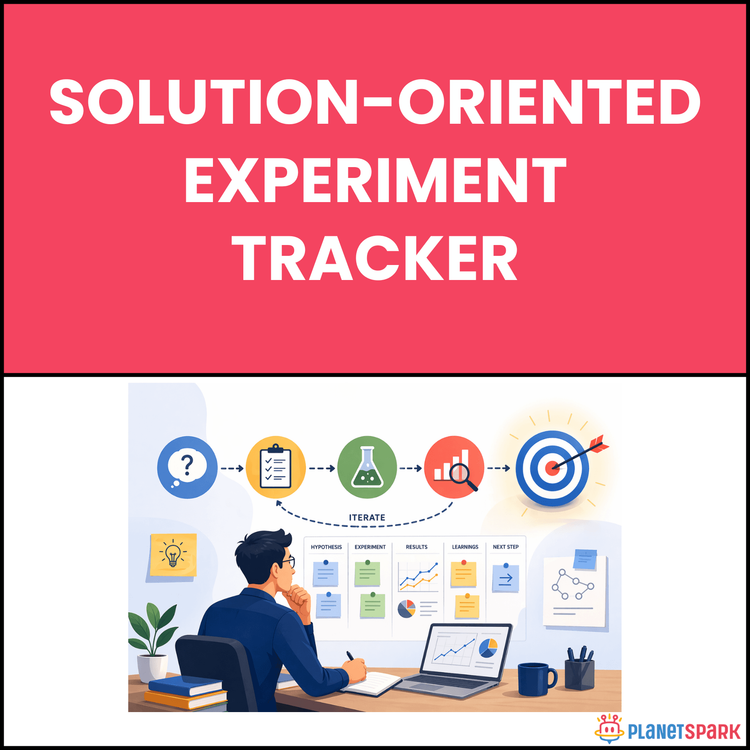
Solution-Oriented Experiment Tracker
Solution-Oriented Experiment Tracker: A Practical Guide to Stop Overthinking and Start Driving Real Results at Work
If you’ve ever spent days thinking through a problem—only to feel stuck, uncertain, or hesitant to act—you’re not alone. Most working professionals are trained to plan, analyse, and perfect decisions before execution. But in fast-moving workplaces, this often leads to a frustrating cycle: overthinking without action or acting without clarity.
That’s exactly the gap the “Solution-Oriented Experiment Tracker” is designed to solve.
Instead of forcing you to choose between endless planning and risky execution, this resource gives you a structured middle path: small, focused experiments that help you test ideas, learn quickly, and make better decisions with real evidence.
Whether you're trying to fix a broken process, improve team outcomes, or navigate a career transition, this tracker helps you move forward with clarity—without waiting for the “perfect” solution.
Who Is This Resource For?
This resource is especially valuable if you are:
- A working professional with 0–15 years of experience
- Someone who tends to overthink decisions or delay action
- A manager or team lead trying to improve processes or outcomes
- A consultant or problem-solver working with ambiguous challenges
- A career switcher testing new strategies or directions
- A professional dealing with recurring workplace problems that never seem to get resolved
If you often find yourself stuck between analysis paralysis and trial-and-error execution, this tracker is built specifically for you.
What Does This Resource Contain?
This is not just a theoretical framework—it’s a hands-on system designed for immediate application in real work scenarios.
Inside the resource, you’ll find:
- A clear explanation of why experimentation is more effective than over-planning
- The 5-Phase Experiment Cycle:
- Define the Problem
- Frame the Hypothesis
- Design the Experiment
- Run & Observe
- Reflect & Decide
- A structured Problem Precision Framework to turn vague issues into actionable problems
- A Hypothesis Builder using the “If / Then / Because” format to clarify assumptions
- Experiment design tools covering scope, observation, and exit criteria
- A daily observation log template to capture real-time insights
- A reflection worksheet to convert results into decisions
- Clear decision pathways: Continue, Pivot, or Stop
- A detailed real-world case study showing how a professional applied the framework successfully
- Practical checklists, prompts, and templates for each phase
Everything is designed to help you take action quickly while learning systematically from your results.
Summary of the Resource
The “Solution-Oriented Experiment Tracker” is a structured, practical playbook that helps professionals solve problems through small, controlled experiments instead of guesswork or over-analysis.
It enables you to define problems clearly, test solutions intelligently, and make decisions based on real-world feedback—not assumptions.
If you want a faster, smarter way to move from thinking to doing, this resource provides a repeatable system you can use across projects, roles, and career stages.
How Will This Resource Be Useful?
This resource helps you shift from confusion to clarity—and from hesitation to action.
You’ll gain:
- A repeatable system to approach complex workplace challenges
- Faster decision-making based on real evidence
- Reduced overthinking and mental fatigue
- Better problem definition and sharper thinking
- Increased confidence in testing and validating ideas
- Stronger professional judgment over time
- A personal “evidence base” of what works in your specific context
Most importantly, it helps you stop relying on guesswork—and start building a structured approach to learning and improving at work.
How Should You Use This Resource?
To get the most value, use this tracker as a working tool—not just a document to read.
Start by skimming the full guide to understand the overall flow of the 5-phase cycle.
Next, pick one real problem you’re currently facing. Avoid hypothetical scenarios—this works best when applied to actual situations.
Begin with Phase 1 and take the time to define your problem with precision. This step is critical and sets the foundation for everything that follows.
Move to Phase 2 and write a clear hypothesis using the structured format. Be honest about your assumptions.
In Phase 3, design a small, time-bound experiment. Keep it simple, focused, and low-risk.
During Phase 4, run your experiment consistently. Log observations daily without bias or interpretation.
Finally, in Phase 5, review your data and make a clear decision: continue, pivot, or stop. Use your insights to guide your next step.
You can reuse this tracker across multiple situations—projects, team challenges, performance improvement, or even career decisions.
Action Steps
After accessing this resource, take these steps immediately:
1. Identify one problem you’ve been overthinking or avoiding
2. Block 60–90 minutes to define the problem and build your hypothesis
3. Design a small experiment you can start within the next 3–5 working days
4. Schedule 15 minutes daily to log observations
5. Run the experiment for a fixed time period (1–2 weeks for quick tests)
6. Book 60 minutes at the end to reflect and decide your next move
7. Document your learning and plan your next experiment
Consistent small experiments can create powerful long-term results.
The professionals who grow fastest aren’t the ones who always get it right—they’re the ones who learn the fastest. This resource helps you build that capability in a structured, practical way.
Instead of waiting for perfect clarity, you start creating it—one experiment at a time. Over time, this approach compounds into sharper thinking, better decisions, and stronger professional impact.