
Stakeholder Influence Mapping Worksheet

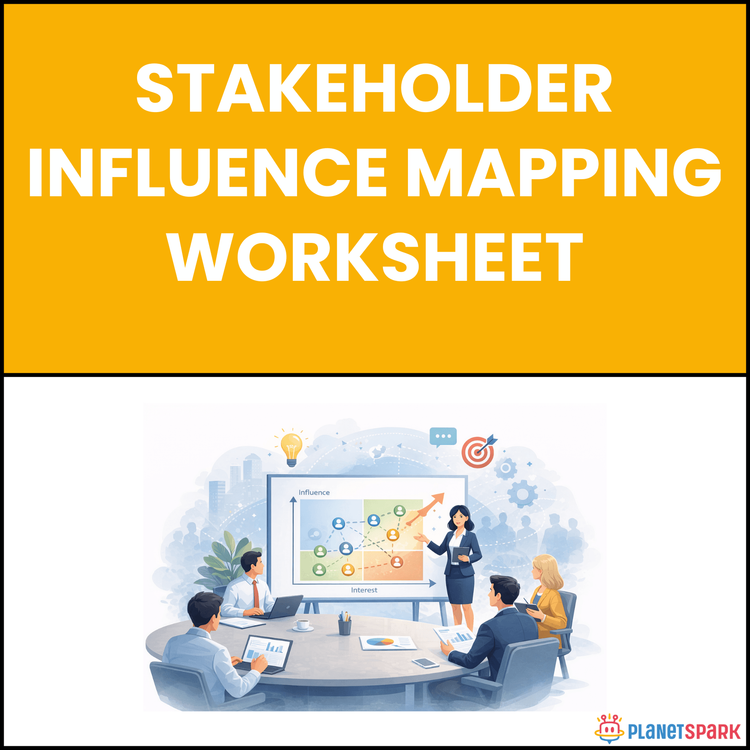
Stakeholder Influence Mapping Worksheet
Stakeholder Influence Mapping Worksheet: A Practical Guide to Navigating Power, Alignment, and Decision-Making at Work
You can have the best idea in the room — and still watch it go nowhere.
Not because it’s flawed. Not because you didn’t execute well. But because the right people weren’t aligned, involved, or convinced at the right time.
This is one of the most common reasons projects stall, decisions get delayed, and opportunities slip — especially in complex, cross-functional environments.
Success at work is not just about what you do. It’s about who supports it, who can block it, and how well you navigate that landscape.
The Stakeholder Influence Mapping Worksheet is designed to give you a clear, structured system to do exactly that. It helps you move from reactive communication to strategic alignment — so your work doesn’t just get done, it gets supported and approved.
Who Is This Resource For?
This worksheet is built for professionals who operate in environments where influence matters as much as execution, including:
- Early to mid-career professionals working on cross-functional projects
- Managers and team leads coordinating across multiple stakeholders
- Career switchers navigating new organisational dynamics
- Consultants and client-facing professionals managing multiple decision-makers
- Anyone who feels their ideas don’t get traction despite strong work
If you’ve ever thought, “I did everything right, but it still didn’t move forward,” this resource is highly relevant.
What Does This Resource Contain?
This worksheet is structured as a complete, step-by-step system you can apply immediately. It includes:
- A 5-Step Stakeholder Mapping Framework
A clear process to move from identification to execution:
1. Identify stakeholders (internal, external, hidden influencers)
2. Assess power and interest
3. Understand motivations
4. Design engagement strategy
5. Monitor and adapt continuously
- Stakeholder Brain Dump Exercise
A structured prompt to capture your full stakeholder ecosystem — beyond obvious roles
- Power–Interest Grid
A practical framework to prioritise stakeholders based on influence and engagement
- Stakeholder Assessment Table
A detailed worksheet capturing:
- Power and interest levels
- Current stance (champion, neutral, blocker)
- What each stakeholder cares about
- Your priority action
- Motivation Mapping Framework
Helps you understand what drives each stakeholder:
- Outcomes and results
- Risk and reputation
- Relationships and recognition
- Autonomy and control
- Engagement Strategy Framework
Clear guidance on how to engage different stakeholder groups:
- Manage closely (high power, high interest)
- Keep satisfied (high power, low interest)
- Keep informed (low power, high interest)
- Monitor (low power, low interest)
- Engagement Planning Template
A structured plan including:
- Communication channel and format
- Frequency
- Key message framing
- Next action with timeline
- Real-World Case Study
A practical example showing how proactive stakeholder mapping prevents delays and builds support
- Common Mistakes & Fixes
Insights into pitfalls like late mapping, ignoring blockers, and one-size-fits-all communication
- Conversation Toolkit
Ready-to-use scripts for handling sceptics, updating senior stakeholders, and surfacing hidden concerns
- Self-Evaluation Framework
A maturity model to assess your current stakeholder management capability
- Quick Reference Guide
A one-page summary you can use during live projects
Summary of the Resource
This worksheet gives you a complete system to understand and manage the people dynamics around your work.
Instead of relying on assumptions or reacting to issues, you learn how to identify key stakeholders early, prioritise effectively, and engage each person in a way that aligns with their motivations.
It turns stakeholder management from guesswork into a structured, repeatable process.
How Will This Resource Be Useful?
By applying this worksheet consistently, you will:
- Ensure the right stakeholders are involved at the right time
- Prevent last-minute blockers and unexpected resistance
- Improve alignment across teams and functions
- Communicate more strategically based on stakeholder priorities
- Increase the chances of your ideas being approved and implemented
- Build stronger professional relationships and influence
Over time, this skill becomes a major differentiator — especially in complex organisations where influence drives outcomes.
How Should You Use This Resource?
To get the most value, use this worksheet actively alongside your real work.
Step 1: Start at the Beginning of a Project
Before execution begins, complete the stakeholder brain dump to capture your full ecosystem.
Step 2: Build Your Power–Interest Grid
Assess each stakeholder and visually map where your attention should go.
Step 3: Complete the Assessment Table
Document each stakeholder’s stance, motivations, and required actions.
Step 4: Identify Top Priority Stakeholders
Focus on high-power individuals — especially those who are neutral or sceptical.
Step 5: Design Your Engagement Plan
Define:
- How often you will engage
- What channel you will use
- How you will frame your message
Step 6: Use Conversation Scripts
Prepare in advance for difficult conversations — don’t improvise under pressure.
Step 7: Review and Update Regularly
Treat your stakeholder map as a living document. Revisit it during:
- Project milestones
- Organisational changes
- Shifts in stakeholder behaviour
Action Steps
If you want to apply this immediately:
1. Choose one active project or responsibility
2. List at least 15 stakeholders using the brain dump exercise
3. Rate each stakeholder on power and interest (1–3 scale)
4. Identify your top 5 high-priority stakeholders
5. Write one key motivation for each of them
6. Plan one specific engagement action for each stakeholder this week
7. Schedule at least one proactive conversation with a stakeholder you’ve been avoiding
Clarity and action together create results.
In most professional environments, outcomes are not decided in isolation. They are shaped by conversations, perceptions, alignment, and influence.
The professionals who succeed consistently are not just skilled at execution — they are skilled at navigating people and power dynamics with intention.
This worksheet gives you that capability. Use it consistently, and you’ll find that your work moves faster, faces fewer obstacles, and gains stronger support from the people who matter.
Book your free session today!