
Strategic Career Opportunity Matching Guide

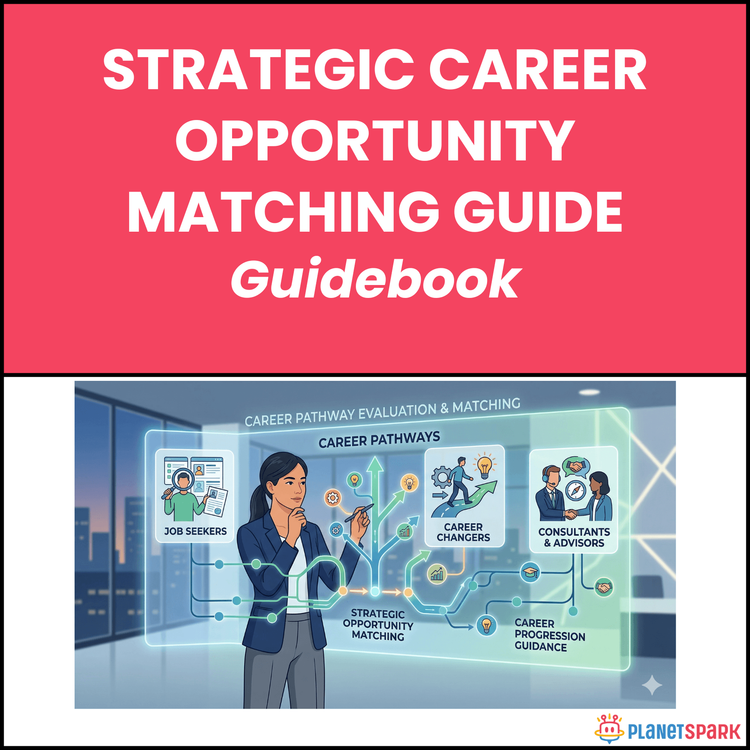
Strategic Career Opportunity Matching Guide
Strategic Career Opportunity Matching Guide: How Working Professionals Can Find the Right Roles Faster and Smarter
If you have ever felt busy in your job search but not truly effective, this resource will feel immediately relevant. Many professionals are not struggling because they lack capability. They are struggling because they are chasing roles without a clear decision-making system. They apply broadly, respond reactively to openings, and spend time on opportunities that were never the right fit in the first place. That is the central problem this guide addresses. It is built to help professionals align their skills, values, and ambitions with the right opportunities through a deliberate and repeatable framework, rather than relying on guesswork or job-title attraction alone. :contentReference[oaicite:0]{index=0}
The Strategic Career Opportunity Matching Guide is a practical playbook for professionals who want to stop searching harder and start searching smarter. Instead of teaching you how to apply to more jobs, it teaches you how to evaluate better opportunities, filter out poor-fit roles earlier, and build a focused pipeline that improves both efficiency and outcomes. The result is a more confident, criteria-driven job search that reduces wasted effort and increases the likelihood of stronger career decisions.
Who Is This Resource For?
This resource is especially useful for:
- Career changers trying to move into a new function or industry
- Early to mid-career professionals with 0 to 15 years of experience
- Consultants and managers who want more strategic control over their next move
- Job seekers who feel overwhelmed by too many options but too little clarity
- Professionals who are getting interviews that do not convert because the role fit is weak
- People who want to evaluate opportunities based on skills, values, growth, compensation, and culture, not just brand name or title
It is particularly valuable for time-poor professionals who do not want theory-heavy career advice. The guide is designed for people who need a system they can use quickly, practically, and repeatedly during a live job search. That positioning is made clear from the beginning of the resource, where it defines itself as a step-by-step playbook for aligning skills, values, and ambitions with the right opportunities faster and smarter.
What Does This Resource Contain?
This guide is structured like an action-oriented framework rather than a passive read. It walks the reader through the full process of strategic career matching in a sequence that is easy to apply.
Inside the resource, you will find:
- A clear explanation of why career matching matters more than ever, especially in a market full of job postings, alerts, and referrals that can create more noise than clarity
- A practical introduction to the core problem, which is reactive applying without a filter system, and the solution, which is a deliberate, criteria-driven matching process :contentReference[oaicite:3]{index=3}
- A Career Equity framework that helps you assess your hard skills, soft skills, top career values, and non-negotiables before evaluating any external opportunity
- Guidance on how to decode job descriptions more strategically by identifying repeated keywords, urgency language, missing information, growth signals, and red flags
- The 70% Rule, which encourages professionals to apply when they meet at least 70% of the stated requirements rather than waiting for a perfect match
- An Opportunity Matching Matrix that scores roles against key factors such as skills alignment, values alignment, growth potential, compensation fit, culture signal, and non-negotiables
- A scoring guide that helps you decide whether to strongly pursue, conditionally pursue, or deprioritise an opportunity based on its total score
- A framework for building a targeted pipeline of 8 to 12 high-fit opportunities instead of using a scatter-gun application approach
- Career-stage-specific lead source suggestions, including LinkedIn, company career pages, referrals, niche communities, executive search firms, and peer networks
- Pipeline hygiene rules that help maintain momentum, track follow-ups, and keep your search focused and active
- A real-world case example showing how a professional shifted from broad, unfocused applications to a more strategic search and improved results significantly
- A section on common career matching mistakes and how to fix them
- A 30-day quick-start checklist that turns the framework into an immediate execution plan
- A concise takeaway summary that reinforces the professional habits needed for intentional career decision-making.
Summary of the Resource:
At a high level, this resource helps you build a smarter filter for career opportunities. It is not about applying to more roles. It is about applying to the right roles with better judgment and stronger self-awareness.
The guide shows you how to start with yourself first by understanding your skills, values, and boundaries. It then teaches you how to read opportunities more critically, score them objectively, and build a manageable pipeline of high-fit roles. By the end, you do not just have career advice. You have a working system for evaluating opportunities with more clarity and less emotional noise. That is what makes this resource especially practical for professionals who want better decisions, not just more motivation.
How Will This Resource Be Useful?
This resource is useful because it solves a common but costly problem in modern job searching: misdirected effort.
Many qualified professionals spend months applying to roles that sound appealing but are not aligned with what they actually want, what they are strongest at, or what they can realistically grow into next. This guide helps reduce that mismatch.
By working through it, readers can expect to gain:
- Better clarity on what they truly bring to the market
- Stronger understanding of what makes a role genuinely high fit
- A more objective way to compare opportunities instead of relying on instinct alone
- Better quality applications because effort is focused on stronger targets
- Less decision fatigue during the job search process
- More confidence in saying no to poor-fit roles
- Better momentum through a curated pipeline instead of scattered outreach
- A practical method to evaluate career moves repeatedly over time, not just once
One of the strongest aspects of the guide is that it connects reflection with execution. It does not stop at self-assessment. It pushes the reader toward scoring roles, building a pipeline, sending targeted outreach, and maintaining weekly momentum. That makes it especially useful for professionals who need action, not just insight.
How Should You Use This Resource?
The best way to use this guide is as both a read-through framework and a working job search tool.
Start by reading the full guide once from beginning to end. This will help you understand the logic of the system and how each part connects to the next.
Then go back and use it in phases.
Phase 1: Build your internal foundation
Complete the Career Equity work first. Map your hard and soft skills, rank your top career values, and define your non-negotiables. This gives you the baseline you need before judging any external opportunity. Without this step, it is very easy to confuse excitement with fit. :contentReference[oaicite:7]{index=7}
Phase 2: Improve how you read job descriptions
Use the guide’s Step 2 framework whenever you review a job post. Pay attention to repeated keywords, hidden urgency, missing information, and red-flag language. This helps you move from passive reading to strategic decoding. It also prepares you to ask better questions in screening calls. :contentReference[oaicite:8]{index=8}
Phase 3: Score opportunities objectively
Apply the Opportunity Matching Matrix to each serious opportunity. Score the role based on skills alignment, values alignment, growth potential, compensation fit, and culture signal. Then test whether it clears your non-negotiables. This step helps you stop overinvesting in weak-fit roles. :contentReference[oaicite:9]{index=9}
Phase 4: Build and maintain a focused pipeline
Use the pipeline guidance to keep 8 to 12 strong-fit opportunities in motion. Track where each role stands. Refresh leads weekly. Archive roles that go cold. Keep momentum without overwhelming yourself. The guide is very clear that a strategic search is not about volume. It is about a curated, actively managed opportunity set.
Phase 5: Revisit the guide regularly
This is not a one-time-use resource. It can support you whenever you:
- Start a new job search
- Explore a career pivot
- Reassess your current role
- Evaluate an internal move or promotion
- Rebuild your career direction after burnout, stagnation, or dissatisfaction.
Action Steps:
After accessing this resource, take these steps immediately:
1. Complete your Career Equity Worksheet by listing your skills, ranking your values, and identifying your hard boundaries.
2. Write a short career positioning statement that clearly defines what you do, what strengths you bring, and what type of organisation or outcome you want to support.
3. Choose three target role types and ten target companies based on actual alignment, not just familiarity or brand appeal.
4. Review live job descriptions and decode them using the guide’s criteria, including repeated keywords, missing information, and red flags.
5. Score each opportunity using the Matching Matrix and shortlist only the strongest-fit roles.
6. Build a focused pipeline of active opportunities rather than applying randomly.
7. Send warm outreach messages where relevant instead of depending only on cold applications.
8. Tailor your first few applications more intentionally using what you learned about fit, positioning, and role requirements.
9. Review your pipeline every week for at least 30 minutes so your search stays current, active, and strategic.
A useful detail in the guide’s 30-day quick-start section is that it breaks the work into two phases: foundation and execution. That makes it easier for busy professionals to take action without feeling like they need to overhaul their entire career strategy in one sitting.
Why This Resource Stands Out?
What makes this resource especially strong is that it helps readers shift from emotional job searching to evidence-based career decision-making. It does not assume that more applications equal better results. Instead, it shows that clarity, criteria, and consistency produce better career outcomes.
The case example in the guide reinforces this well. A professional transitioning from marketing to product management was able to improve results not by changing her entire background, but by changing her targeting strategy, clarifying transferable skills, narrowing her pipeline, and tailoring her applications with more precision. That example makes the guide feel grounded and realistic for professionals navigating similar transitions. :contentReference[oaicite:13]{index=13}
The section on common mistakes is also highly practical. It addresses real patterns that affect job seekers, such as applying without a filter, ignoring transferable skills, treating all roles as equal, skipping culture research, and waiting for the perfect role. These are not abstract mistakes. They are everyday behaviours that quietly reduce job search effectiveness, and the guide gives clear fixes for each one. :contentReference[oaicite:14]{index=14}
The bigger message behind this resource is simple but powerful: good career decisions require a framework. Professionals who move faster are often not the ones with the most options. They are the ones with the clearest criteria.
That is why this guide is valuable even beyond an immediate job search. It helps readers build a stronger professional habit. It teaches them how to think about opportunities with more intention, more structure, and more self-awareness. In a market full of noise, that kind of clarity is a real advantage.
If you are tired of reactive applications, unclear targeting, and job search fatigue, this resource gives you a better way forward. Use it to define what matters, evaluate opportunities with discipline, and build a pipeline that reflects where you actually want your career to go.
Book your free session today!