
Strategic Introductions Framework

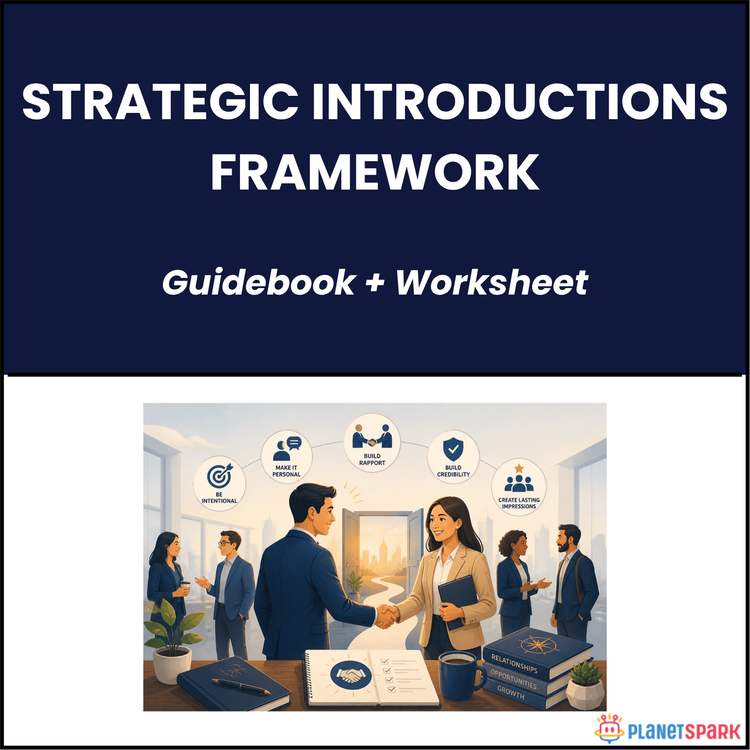
Strategic Introductions Framework
Build Strong Professional Connections with a Strategic Introductions Framework for Effective Networking
Every major career opportunity starts with a conversation. A promotion, a client opportunity, a referral, a leadership role, or even a successful interview often begins with a simple introduction. Yet most professionals are never taught how to introduce themselves strategically. Instead, they rely on vague self-descriptions, overly technical explanations, or awkward “tell me about yourself” responses that fail to communicate real value. In high-stakes professional situations, that lack of clarity can quietly cost opportunities.
That’s exactly why the resource “Strategic Introductions Framework” exists. It’s designed for working professionals who want to communicate their value clearly, build credibility quickly, and create stronger professional connections across networking events, interviews, meetings, and digital platforms. This guidebook helps you move beyond generic elevator pitches and build introductions that are clear, memorable, adaptable, and rooted in real professional value.
Who Is This Resource For?
This resource is especially valuable if you are:
- A working professional with 0–15 years of experience
- A career switcher entering a new industry or role
- A consultant, freelancer, or specialist building professional credibility
- A manager preparing for leadership opportunities
- A job seeker struggling with interviews or networking conversations
- Someone who finds self-introductions uncomfortable or inconsistent
- A professional looking to strengthen personal branding and communication
- Someone who wants to sound confident without sounding scripted
If you want to make stronger first impressions and communicate your value more effectively in professional settings, this guide is built for you.
What Does This Resource Contain?
This is not a generic networking or communication guide. It’s a structured, practical system for building professional introductions that work in real-world situations.
Inside the resource, you’ll find:
- A complete 5-part Strategic Introductions Framework
- The “Anchor” system to define your professional identity clearly
- The “Value Bridge” framework for communicating outcomes instead of just skills
- “Context Calibration” guidance to adapt introductions for different audiences and situations
- The “Proof Pulse” method to build credibility with concise evidence
- The “Forward Hook” framework to turn introductions into meaningful conversations
- Detailed worksheets for every framework component
- Before-and-after examples of strong and weak introductions
- Real-world case studies showing professional transformation
- Templates for networking events, interviews, LinkedIn outreach, meetings, and conferences
- A complete Before / During / After execution model
- Common professional introduction mistakes and how to fix them
- A self-evaluation sheet to assess and improve your introductions over time
Everything is designed for practical application—not passive reading.
Summary of the Resource
“Strategic Introductions Framework” is a practical communication guide that helps professionals introduce themselves with clarity, confidence, and strategic intent. The resource teaches you how to structure introductions using five core elements:
- Anchor
- Value Bridge
- Context Calibration
- Proof Pulse
- Forward Hook
Together, these components help you communicate who you are, what value you bring, and why someone should continue the conversation.
Instead of memorising rigid elevator pitches, this framework gives you a flexible system that can adapt to different professional situations while still sounding natural and authentic. If you want your introductions to create stronger professional opportunities instead of awkward small talk, this guidebook provides a repeatable process that works.
How Will This Resource Be Useful?
This resource helps you move from uncertainty to clarity in professional communication.
You’ll gain:
- Greater confidence in introducing yourself professionally
- Clearer communication of your expertise and value
- Stronger first impressions in interviews, meetings, and networking situations
- Better positioning for leadership, consulting, and career opportunities
- More effective networking conversations
- Improved personal branding across professional settings
- The ability to adapt introductions for different audiences
- Increased credibility through stronger proof and positioning
Most importantly, it helps you stop underselling yourself and start communicating your professional value with clarity and confidence.
How Should You Use This Resource?
To get the best results, follow a phased approach:
First, read through the entire guide once to understand how all five framework components work together. This creates clarity around the overall structure and flow.
Next, complete each worksheet module one step at a time. Start with your Anchor statement, then move into building your Value Bridge and identifying your strongest Proof Pulse examples.
After that, practise calibrating your introductions for different professional situations such as interviews, networking events, leadership meetings, or LinkedIn outreach.
Once your introductions are drafted, practise delivering them aloud in real conversations. The guidebook strongly emphasises real-world application and feedback—not perfection on paper.
Finally, use the self-evaluation sheet to identify weak areas and continue refining your introductions over time.
You can also revisit this resource whenever you:
- Prepare for interviews
- Attend networking events
- Change industries or roles
- Build a consulting or freelance practice
- Update your LinkedIn profile
- Step into leadership opportunities
- Prepare for conferences or speaking engagements
Action Steps
After accessing this resource, take these steps immediately:
1. Block 1–2 focused hours to work through the framework
2. Draft your first professional Anchor statement
3. Identify 2–3 measurable Proof Pulse examples from your experience
4. Create separate introduction versions for networking, interviews, and digital outreach
5. Practise your introduction aloud instead of silently reading it
6. Test your introduction with someone outside your industry
7. Refine your wording based on clarity and feedback
8. Use the self-evaluation sheet to strengthen weak areas
Small improvements in how you introduce yourself can create major long-term career opportunities. Your introduction is more than a formality—it’s a professional positioning tool. The way you communicate your experience, value, and credibility shapes how people perceive you from the very first interaction. A strong introduction is not about sounding impressive. It’s about being clear, relevant, and memorable.
The “Strategic Introductions Framework” helps you build that clarity through practical systems, structured thinking, and real-world application. Whether you’re networking, interviewing, consulting, leading, or building your professional brand, this resource helps you communicate with greater confidence and purpose.
Use this resource not just to improve introductions, but to strengthen how you think about your career, your value, and the opportunities you want to create moving forward.