
Strategic Prioritization Framework

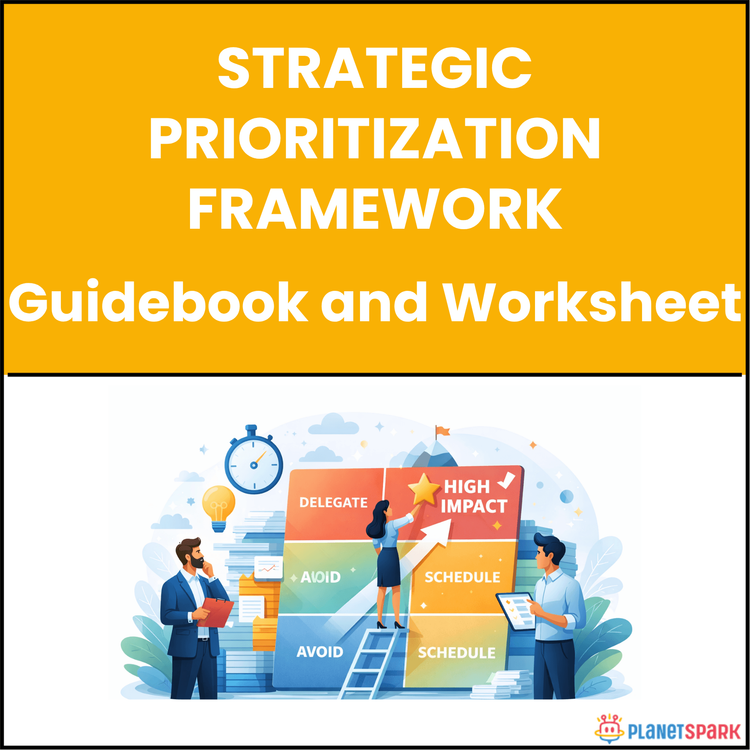
Strategic Prioritization Framework
Master Strategic Prioritization: Your Step-by-Step Framework for Smarter, Faster Decisions
Feeling overwhelmed by the constant pressure of deadlines, meetings, and never-ending to-do lists? You're not alone. Many professionals face a daily battle against urgency bias — responding to the loudest tasks instead of focusing on what truly moves the needle. Strategic prioritization is the key to transforming this reactive cycle into a focused, high-impact workday. The Strategic Prioritization Framework provides a proven, actionable system that helps you focus on what matters, manage your time better, and execute with confidence, even when everything feels urgent.
Who Is This Resource For?
- Working professionals struggling with overwhelming tasks and conflicting priorities
- Career switchers who need to focus their efforts on the most impactful aspects of their career transition
- Managers and consultants who need a system to handle multiple projects and stakeholders without burning out
- Time-poor professionals who need practical tools to manage their workload and achieve higher performance without sacrificing quality
- Anyone looking to work smarter, not harder, by making quicker, more intentional decisions
What Does This Resource Contain?
The Strategic Prioritization Framework is designed to help you make better decisions and manage your time effectively through five core modules:
- Module 1: Priority Audit: Capture everything competing for your attention and gain clarity on your full workload. This audit helps you externalize your tasks and start the prioritization process with a clear, complete picture.
- Module 2: Classify: Use the Eisenhower Matrix to sort your tasks by urgency and importance. This helps you focus on what truly drives value and avoid getting trapped in low-impact tasks.
- Module 3: Focus: Protect your highest-value time by time-blocking and eliminating distractions. You'll learn how to manage your energy and attention to ensure you're working on your most important tasks when you're at your peak.
- Module 4: Execute: Prioritize execution with intention using tools like the MIT (Most Important Task) method, the 80/20 rule, and Pomodoro sessions. This module ensures that your efforts match the strategic goals you’ve set.
- Module 5: Review: The weekly review process allows you to assess your progress, recalibrate, and maintain a focused strategy. It ensures that your prioritization system evolves with your changing tasks and goals.
Summary of the Resource:
The Strategic Prioritization Framework is a practical guide designed for professionals who need a structured, repeatable process for making smarter decisions. By completing a priority audit, classifying tasks, focusing on what matters, executing effectively, and reviewing your progress, you'll transform your approach to work. This system not only helps you manage tasks but also enables you to align your actions with strategic goals. In just a few weeks, you'll build the habit of strategic prioritization that will lead to greater clarity, confidence, and career momentum.
How Will This Resource Be Useful?
This framework offers tangible benefits for every professional:
- Clear decision-making: By focusing on high-impact work and eliminating distractions, you’ll make faster, more confident decisions.
- Better time management: The system allows you to organize your time around your highest-priority tasks, reducing the feeling of being constantly overwhelmed.
- Increased productivity: By protecting focused time and eliminating the need to multitask, you’ll increase the quality and speed of your work.
- More strategic thinking: You’ll learn how to prioritize long-term goals (Q2 work) alongside short-term tasks, ensuring your daily work aligns with your broader career and organizational objectives.
- Ongoing improvement: Regular reviews ensure your prioritization system remains flexible and adaptable as your workload evolves.
How Should You Use This Resource?
- Phase 1: Priority Audit: Start by setting aside 15–20 minutes to conduct a Priority Audit. Capture every task, project, or commitment you’re currently managing. The goal is not perfection, but completeness.
- Phase 2: Classify: Once you have your audit list, classify each task using the Eisenhower Matrix (Do First, Schedule, Delegate, Eliminate). This will help you identify which tasks should get your immediate attention and which ones can wait.
- Phase 3: Focus: Block time in your calendar for Q1 and Q2 tasks before the week begins. Protect your highest-energy hours for deep work, and use time-blocking to stay focused on high-priority work.
- Phase 4: Execute: Every morning, identify your Most Important Task (MIT) for the day. Use execution tactics like the Pomodoro technique to stay focused and ensure that your work directly supports your strategic goals.
- Phase 5: Review: Every week, set aside 30–45 minutes for a structured review of your tasks and progress. Adjust your priorities as necessary and block your time for the upcoming week.
Action Steps:
1. Conduct your Priority Audit. Write down all your active tasks and commitments.
2. Classify your tasks using the Eisenhower Matrix and identify your high-priority Q1 and Q2 tasks.
3. Set up time blocks for deep work, ensuring your highest-priority tasks are protected during your peak energy hours.
4. Identify your Most Important Task (MIT) every day and prioritize it before engaging with emails or meetings.
5. Review your progress weekly by following the weekly review checklist, recalibrating your priorities as needed.
Book your free session today!