
Strategic Thinking Consistency Tracker

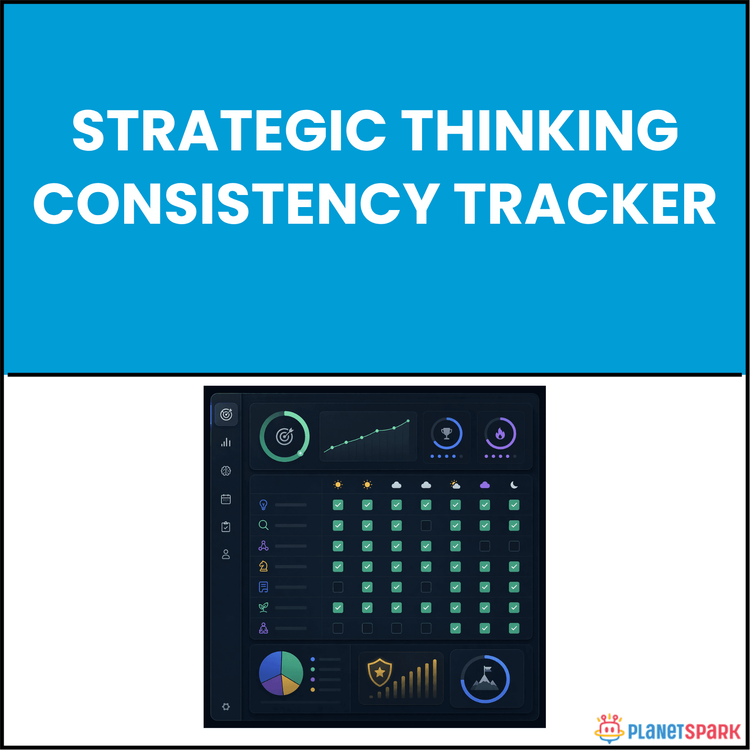
Strategic Thinking Consistency Tracker
Strategic Thinking Consistency Tracker: A Practical System to Build Strategic Thinking as a Daily Habit
If you’ve ever attended a strategy session, read about frameworks, or felt inspired to “think bigger”—only to get pulled back into daily tasks within hours—you’re not alone.
Most professionals don’t struggle with understanding strategy.
They struggle with practising it consistently.
As highlighted in the resource, this gap isn’t a knowledge problem—it’s a habit problem. Strategic thinking fades not because it’s difficult, but because it’s not systemised.
That’s exactly why the “Strategic Thinking Consistency Tracker” exists.
It gives you a simple, structured system to embed strategic thinking into your weekly workflow—so it becomes a habit, not an occasional effort.
Who Is This Resource For?
This resource is especially valuable if you are:
- A working professional with 0–15 years of experience
- A manager or aspiring leader looking to think beyond execution
- A mid-career professional stuck in “task mode”
- A consultant or specialist wanting to improve strategic visibility
- Someone who understands strategy—but struggles to apply it daily
- Anyone who wants to move from reactive work to proactive thinking
If you want to consistently think ahead—not just react—this tracker is built for you.
What Does This Resource Contain?
This is not a theory-heavy guide. It’s a structured execution system.
Inside the resource, you’ll find:
1. The Strategic Thinking Model (Page 3)
A three-level progression:
- Awareness → Notice patterns, ask better questions
- Application → Use frameworks in real decisions
- Mastery → Shape direction and influence outcomes
This model ensures gradual, practical growth.
2. Weekly Strategic Thinking Rhythm (Page 4)
A powerful yet simple system:
- Monday Zoom-Out → Set strategic intent
- Wednesday Check-In → Review direction
- Friday Reflection → Capture insights
Just 15–30 minutes per week creates consistency.
This rhythm turns strategy from an abstract concept into a weekly practice.
3. Weekly Strategic Thinking Checklist (Page 5)
A structured checklist across four areas:
- Big-picture thinking
- Framework application
- Communication & influence
- Reflection & learning
It acts as a mirror—not a scorecard—helping you identify gaps and patterns over time.
4. Strategic Thinking Weekly Log (Page 6)
A powerful reflection tool where you track:
- Strategic intent
- Actions taken
- Patterns observed
- Frameworks used
- Wins and improvements
Over 8–12 weeks, this becomes career evidence you can use in reviews and promotions.
5. The SPOT Framework (Page 7)
A simple but powerful decision tool:
- Situation → What’s really happening?
- Purpose → What’s the real goal?
- Options → What are all possible paths?
- Trade-offs → What are we gaining vs sacrificing?
As shown in the visual on page 7, this framework helps you shift from reactive thinking to structured decision-making in under 5 minutes.
6. Monthly Self-Evaluation System (Page 8)
A reflection tool to assess:
- Strategic presence
- Framework usage
- Pattern recognition
- Communication effectiveness
This ensures continuous improvement—not random effort.
7. Real-World Case Study (Page 9)
The tracker shows how a professional:
- Moved from execution to strategic contribution
- Identified flawed initiatives early
- Asked better questions in meetings
- Gained visibility and leadership opportunities
The key takeaway:
Consistency—not intelligence—drives strategic growth.
8. Common Pitfalls & Fixes (Page 10)
The guide highlights critical mistakes like:
- Confusing busyness with strategy
- Waiting for “big moments” to think strategically
- Skipping reflection
- Overusing frameworks
- Keeping strategic thinking invisible
Each comes with practical fixes.
9. 12-Week Strategic Thinking Plan (Page 11)
A structured roadmap:
- Weeks 1–4 → Awareness
- Weeks 5–8 → Application
- Weeks 9–12 → Influence
This ensures measurable progress over time.
Summary of the Resource
The “Strategic Thinking Consistency Tracker” is a habit-building system that helps you:
- Think strategically every week—not occasionally
- Apply frameworks in real work situations
- Track and measure your thinking patterns
- Build visible evidence of strategic contribution
- Move from execution to influence
It transforms strategy from a concept into a daily practice.
How Will This Resource Be Useful?
This resource helps you move from reactive to intentional.
You’ll gain:
- Clarity on what strategic thinking looks like in practice
- A structured weekly system to apply it
- Better decision-making and prioritisation
- Stronger presence in meetings and discussions
- Improved communication of ideas and insights
- Tangible proof of your strategic growth
Most importantly, it helps you stop feeling “busy but stuck”—and start progressing.
How Should You Use This Resource?
To get the best results, follow a consistent approach:
Start with structure:
- Block Monday, Wednesday, and Friday sessions in your calendar
Use the tracker weekly:
- Set intent → Check progress → Reflect
Apply one framework at a time:
- Focus on depth, not variety
Track everything:
- Use the weekly log consistently
Review monthly:
- Identify patterns and improvement areas
Most importantly—make your thinking visible.
Action Steps
After accessing this resource, take these steps immediately:
1. Block 3 weekly slots (Mon, Wed, Fri) for strategic thinking
2. Define one strategic intent for this week
3. Use the SPOT framework for one decision
4. Complete your first weekly log entry
5. Share one strategic insight in a meeting
6. Identify one pattern or trend in your work
7. Commit to a 4-week consistency streak
Small, consistent actions create long-term strategic capability.
Strategic thinking is not about being smarter—it’s about being more consistent.
When you build a system, you remove randomness.
When you remove randomness, you build momentum.
And when momentum compounds, your career accelerates.
Use this tracker not just to think better—but to think consistently, visibly, and strategically.
Book your free session today!