
Strategic Thinking Framework

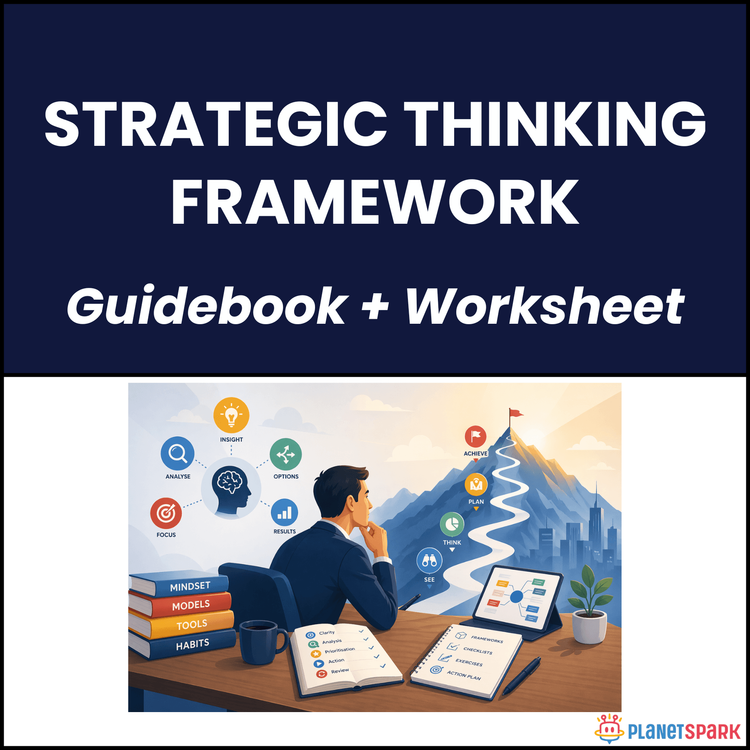
Strategic Thinking Framework
Strategic Thinking Framework: A Practical Guide to Think Bigger, Decide Smarter, and Lead with Confidence
Most professionals are rewarded for execution. You deliver tasks, meet deadlines, and solve immediate problems. But at some point in your career, execution alone stops being enough.
You’re expected to think ahead. Connect the dots. Make better decisions under uncertainty. Contribute to bigger conversations.
And that’s where many professionals feel stuck.
You may find yourself:
- Reacting instead of proactively shaping outcomes
- Struggling to “see the bigger picture”
- Making decisions without a clear framework
- Being seen as reliable—but not strategic
The reality is simple: strategic thinking is the skill that separates high performers from high-impact professionals.
That’s exactly why the resource “Strategic Thinking Framework: Guidebook & Worksheet” exists. It’s built for time-poor professionals who want practical tools—not theory—to think more clearly, act more intentionally, and grow into strategic roles.
Who Is This Resource For?
This resource is especially valuable if you are:
- A working professional with 0–15 years of experience
- A manager or individual contributor looking to step into strategic roles
- A consultant, analyst, or specialist solving complex problems
- A career switcher navigating uncertainty or transition
- A professional who feels stuck in execution-heavy work
- Someone who wants to improve decision-making and long-term thinking
If you want to move from “doing the work” to “shaping the work,” this guide is built for you.
What Does This Resource Contain?
This is not a theoretical textbook. It’s a structured, action-oriented system designed for immediate application.
Inside the resource, you’ll find:
- A clear breakdown of what strategic thinking actually means (and what it doesn’t)
- A self-assessment tool to evaluate your current strategic thinking ability
- A 3-phase learning journey: Awareness, Application, and Mastery
Core frameworks used by top professionals:
- The 3 Horizons Model for balancing short-term and long-term thinking
- The Issue Tree for structured problem-solving
- The Strategy Pyramid for aligning vision to execution
- Pre-Mortem Analysis for risk identification
- Stakeholder Power Mapping for influence and alignment
- SCQA framework for clear, structured communication
Practical tools and worksheets:
- Strategic thinking diagnostic and priority mapping
- Issue tree builder worksheet
- Pre-mortem risk planning worksheet
- Stakeholder mapping grid
- SCQA communication builder
Real-world application:
- A detailed case study of a professional using these frameworks to pivot careers
- Practical guidance for applying strategy in meetings, emails, projects, and career decisions
Daily and long-term systems:
- 15-minute daily strategic thinking habits
- Weekly strategic routines
- A structured 90-day strategic thinking accelerator plan
A final master checklist to evaluate decisions, communication, and projects in under 5 minutes
Everything is designed to move you from understanding to action quickly.
Summary of the Resource
“Strategic Thinking Framework: Guidebook & Worksheet” is a practical, structured system that helps you develop one of the most critical career skills—thinking strategically.
It equips you with:
- Clear mental models
- Repeatable frameworks
- Real-world application tools
Instead of reacting to work, you’ll learn how to anticipate, prioritise, and make decisions that create long-term impact.
If you only have limited time, this resource ensures every minute you invest translates into better thinking—and better outcomes.
How Will This Resource Be Useful?
This resource helps you move from reactive execution to intentional leadership.
You’ll gain:
- Clarity in complex situations
- Structured decision-making under pressure
- The ability to see patterns and long-term implications
- Strong problem-solving skills using proven frameworks
- Confidence in communicating ideas to senior stakeholders
- Better career positioning for growth, leadership, and transitions
Most importantly, it helps you shift your professional identity—from someone who completes tasks to someone who shapes direction.
How Should You Use This Resource?
To get the most value, follow a phased approach:
Start with a full read-through
Go through the guide once to understand the overall structure and how the frameworks connect.
Complete the self-assessment
Identify your current strengths and gaps. Focus on your two lowest-scoring areas.
Apply one framework at a time
Don’t try to use everything at once. Start with:
- Issue Tree for problem-solving
- SCQA for communication
- 3 Horizons for career thinking
Use the worksheets actively
Each worksheet is designed to take 10–15 minutes. Apply them to real work situations—not hypothetical examples.
Integrate into daily work
Use the frameworks in:
- Meetings
- Emails
- Presentations
- Career decisions
Follow the 90-day plan
Build consistency using the weekly rhythm:
- Monday: Strategy Sprint
- Wednesday: Stakeholder Pulse
- Friday: Strategic Review
Revisit regularly
Use this guide as a living reference whenever you:
- Face complex decisions
- Start a new project
- Prepare for leadership conversations
- Plan your career next steps
Action Steps
After accessing this resource, take these steps immediately:
1. Block 2–3 focused hours in your calendar
2. Complete the strategic thinking self-assessment
3. Identify your top 2 development areas
4. Apply the Issue Tree to one real work problem this week
5. Run a Pre-Mortem on an ongoing project
6. Use SCQA in your next important email or presentation
7. Schedule your weekly strategic thinking routine
Small, consistent actions here can significantly elevate how you think, communicate, and lead.
Strategic thinking is not about being the smartest person in the room. It’s about asking better questions, making clearer decisions, and consistently focusing on what truly matters.
When you build this skill, you don’t just improve your work—you change the trajectory of your career.
Use this resource as a starting point to think more deliberately, act more strategically, and position yourself for opportunities that go beyond execution.