
Structured Communication Templates

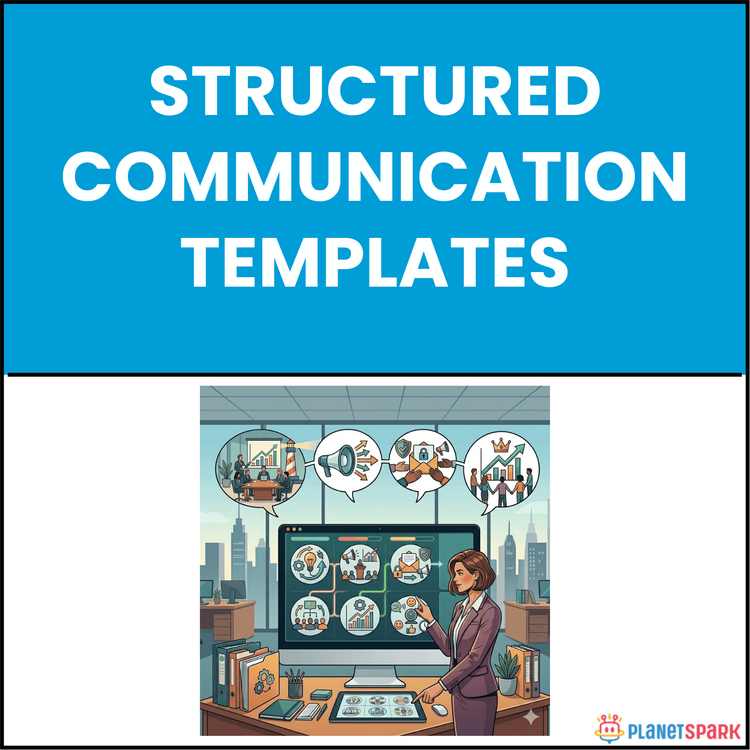
Structured Communication Templates
A Complete Toolkit of Structured Templates to Communicate Ideas Clearly and Drive Better Outcomes
If you’ve ever walked out of a meeting thinking, “That didn’t land the way I wanted,” or sent an email that led to more confusion instead of clarity—you’re not alone.
Most working professionals don’t struggle with ideas. They struggle with how those ideas are communicated.
In fast-paced work environments, unclear communication leads to missed opportunities, delayed decisions, and unnecessary back-and-forth. Whether it’s a proposal that doesn’t get approved, feedback that doesn’t drive change, or meetings that go nowhere—the root problem is often the same: lack of structure.
That’s exactly why the “Structured Communication Template” resource was created. It’s a practical, ready-to-use toolkit designed to help you communicate with clarity, confidence, and impact—across emails, meetings, presentations, and high-stakes conversations.
Who Is This Resource For?
This resource is especially useful if you are:
- A working professional with 0–15 years of experience
- Someone who struggles to express ideas clearly in meetings or emails
- A manager or team lead responsible for driving alignment and decisions
- A consultant or client-facing professional who needs to influence outcomes
- A job seeker or career switcher aiming to sound more confident and structured
- Anyone who wants to reduce misunderstandings and communicate more effectively
If you’re outcome-driven and don’t have time for trial-and-error communication, this toolkit gives you structured shortcuts that work immediately.
What Does This Resource Contain?
This is not a theoretical guide. It’s a highly practical toolkit built for real-world use.
Inside, you’ll find:
- 5 core communication templates covering the most common professional scenarios
- The BLUF (Bottom Line Up Front) email framework for clear, action-driven emails
- The PREP framework (Point, Reason, Example, Point) for confident verbal communication
- A structured meeting template covering before, during, and after communication
- The SBI-I feedback framework (Situation, Behaviour, Impact, Intent) for effective feedback conversations
- A 5-part pitch and proposal structure to influence decisions and gain approvals
- Fill-in worksheets to practice each framework using real scenarios
- A communication audit checklist to review and improve your communication habits
- A real-world case study showing before-and-after improvements
- A quick reference card for daily use
Each section is designed to be modular—so you can either learn deeply or apply instantly depending on your need.
Summary of the Resource
The “Structured Communication Template” is a practical toolkit that helps professionals communicate with clarity and purpose across emails, meetings, feedback, and pitches.
It replaces guesswork with proven frameworks—so instead of figuring out what to say in the moment, you rely on structures that consistently get results.
If you want to be understood faster, reduce friction, and influence decisions more effectively, this resource gives you a repeatable system to do exactly that.
How Will This Resource Be Useful?
This resource helps you move from reactive communication to deliberate communication.
Here’s what you gain:
- Clear, structured thinking that improves how you express ideas
- Stronger email responses with faster decision-making from stakeholders
- More confident and persuasive speaking in meetings
- Productive meetings with clear outcomes and accountability
- Feedback conversations that drive actual improvement—not defensiveness
- Higher chances of getting approvals, buy-in, and alignment
- Reduced back-and-forth and communication fatigue
Most importantly, it positions you as someone who is clear, reliable, and ready for greater responsibility—qualities that directly impact career growth.
How Should You Use This Resource?
To get the most value, use this toolkit in a flexible, practical way:
Start with a full read-through. Spend about 25–30 minutes going through the entire resource once. This helps you understand the logic behind each framework.
Next, use it as a quick reference. When you’re about to send an email, run a meeting, or prepare for a conversation, jump directly to the relevant template and apply it immediately.
Then, move into practice mode. Use the worksheets provided to apply each framework to real situations in your current role. This is where real skill-building happens.
Finally, integrate it into your workflow. Use the communication audit checklist weekly to identify patterns and improve consistently over time.
You can also share these templates with your team to create alignment and reduce communication friction across projects.
Action Steps
After accessing this resource, take these steps immediately:
1. Identify one communication challenge you currently face (email, meeting, feedback, or pitch)
2. Choose the relevant template from the toolkit
3. Apply it to a real situation within the next 24–48 hours
4. Use the worksheet to structure your message before delivering it
5. Observe how people respond differently to your communication
6. Repeat the same template for one week to build consistency
7. Add a second template once the first becomes natural
Small improvements in communication can create disproportionately large improvements in outcomes.
Structured communication is not about sounding robotic—it’s about being clear, intentional, and effective. When you stop “figuring it out as you go” and start using proven frameworks, you reduce friction, build confidence, and make it easier for others to trust and act on your ideas.
Over time, this doesn’t just improve how you communicate—it changes how you are perceived in your organisation.
Use this resource as a daily tool, not a one-time read. The more you apply it, the more natural structured communication becomes—and the more impact you create in every professional interaction.