
Structuring Breaks for Maximum Recovery and Focus

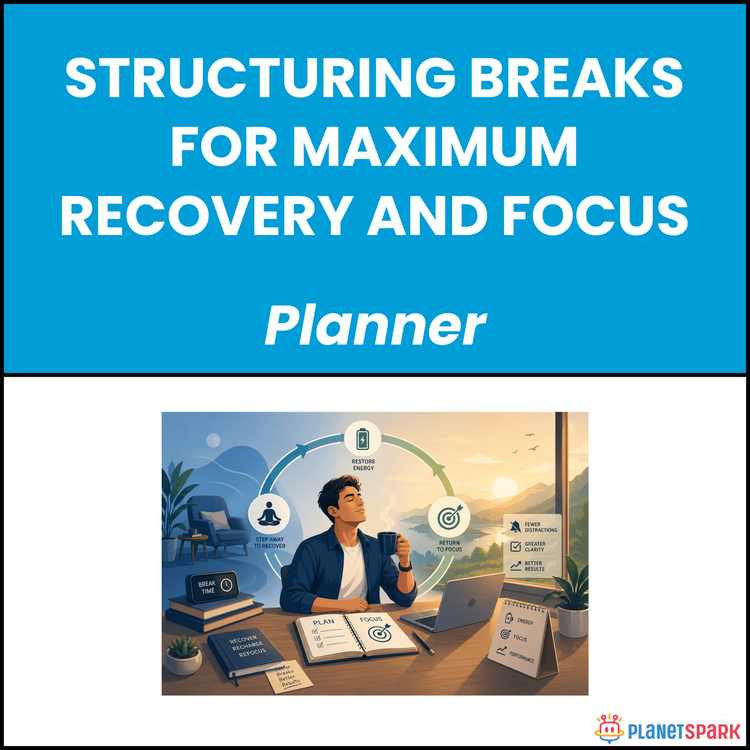
Structuring Breaks for Maximum Recovery and Focus
Break Structuring for Maximum Recovery and Focus: A Practical Planner to Improve Energy, Productivity, and Mental Clarity
If your workdays feel long, mentally draining, and increasingly difficult to sustain—despite putting in the hours—you’re not alone. Most professionals are not struggling because they lack discipline or work ethic. They’re struggling because they don’t recover.
In many workplaces, staying continuously busy is seen as a sign of commitment. Breaks are treated as optional—or worse, as a distraction. But this approach comes at a cost: reduced focus, slower thinking, more mistakes, and lower-quality output as the day progresses.
The reality is simple. Your brain is not designed for nonstop work.
That’s exactly why the resource “Structuring Breaks for Maximum Recovery and Focus” exists. It helps you rethink breaks not as interruptions—but as a strategic tool to improve performance, protect energy, and sustain high-quality work throughout the day.
Who Is This Resource For?
This planner is especially valuable if you are:
- A working professional experiencing mid-day fatigue or mental burnout
- Someone who struggles to maintain focus across long work hours
- A manager or consultant juggling multiple priorities and constant context-switching
- A professional who works through breaks but still feels unproductive
- Someone who takes breaks—but doesn’t feel refreshed afterward
- Anyone looking to improve output without increasing working hours
If you want better focus, fewer errors, and more consistent performance, this resource is designed for you.
What Does This Resource Contain?
This is not a generic productivity guide. It is a structured system that helps you design breaks that actually restore your energy.
Inside the resource, you’ll find:
- A clear explanation of why breaks are essential for cognitive performance—not optional
- The 3-Phase Break Architecture:
- Micro Breaks (2–5 minutes for physical and visual reset)
- Mid-Session Breaks (10–15 minutes for mental detachment)
- Deep Recovery Breaks (20–30 minutes for full cognitive reset)
- Practical timing guidance to align breaks with your natural work rhythm
- A Daily Break Planner template to schedule and track your breaks
- A Break Quality Checklist to distinguish real recovery from “pseudo-breaks”
- Weekly reflection questions to improve your break strategy over time
- A real-world case study showing measurable improvements in focus and output
- Common mistakes professionals make—and practical fixes
- A simple re-entry ritual to regain focus after every break
Everything is designed for immediate, real-world application.
Summary of the Resource
“Structuring Breaks for Maximum Recovery and Focus” is a practical planner that helps professionals use structured breaks to maintain energy, improve concentration, and sustain performance across the day.
Instead of working longer and feeling drained, this resource teaches you how to recover intentionally—so every work session starts with better focus and clarity.
How Will This Resource Be Useful?
This resource helps you move from constant fatigue to consistent performance.
You’ll gain:
- Better focus throughout the day—not just in short bursts
- Reduced mental fatigue and fewer cognitive errors
- Higher-quality output in less time
- Improved decision-making and clarity
- More energy during critical afternoon hours
- A sustainable way to manage demanding workloads
Most importantly, it helps you stop relying on willpower—and start using structured recovery to perform better.
How Should You Use This Resource?
To get the best results, follow a simple, phased approach:
First, read through the guide to understand the 3-Phase Break Architecture. This will help you see why different types of breaks serve different purposes.
Next, map your current workday. Identify where your energy drops and where breaks are missing or ineffective.
Then, use the Daily Break Planner to schedule your breaks in advance. Treat them like non-negotiable appointments.
Start by implementing:
- Micro breaks every 45–60 minutes
- Mid-session breaks every 90–120 minutes
- One deep recovery break during the afternoon
As you apply the system, use the Break Quality Checklist to ensure your breaks are actually restorative—not just distractions.
At the end of each week, reflect using the provided questions and refine your approach based on what worked best.
You can revisit this resource whenever:
- Your workload increases
- Your focus starts declining
- You feel mentally exhausted
- You want to optimise your daily performance
Action Steps
After accessing this resource, take these steps immediately:
1. Review your current workday and identify energy dips
2. Schedule at least 3–5 breaks into your calendar for tomorrow
3. Start with one micro break and one mid-session break
4. Plan one 20–30 minute deep recovery break in the afternoon
5. Use the Break Quality Checklist after each break
6. Track how you feel after each break (1–5 scale)
7. Review and adjust your break structure after one week
Small changes in how you take breaks can lead to significant improvements in how you work.
Most professionals try to push through fatigue. But high performance doesn’t come from working non-stop—it comes from working in cycles of focus and recovery.
When you start treating breaks as a strategic advantage instead of a distraction, everything changes. Your focus sharpens, your energy stabilises, and your work improves.
Use this resource to build a system that supports your performance—not one that drains it.
Book your free session today!