
Structuring Clear Communication in Meetings

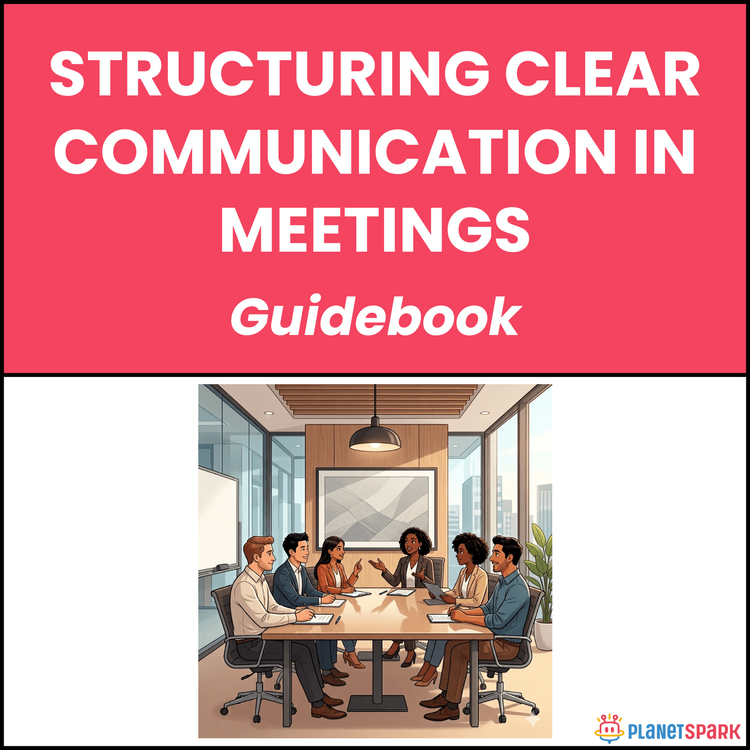
Structuring Clear Communication in Meetings
How to Structure Clear Communication in Meetings: A Practical Guide for Working Professionals
If you’ve ever walked out of a meeting wondering, “What exactly did we decide?” — you’re not alone.
For most working professionals, meetings are a daily reality. Yet, despite spending hours every week in discussions, a large number of meetings end without clarity, ownership, or action. Conversations drift, key points get lost, and follow-ups create more confusion than progress.
The problem isn’t the number of meetings. It’s how communication is structured within them.
That’s exactly why the resource **“Structuring Clear Communication in Meetings”** exists. It’s designed to help professionals stop “winging it” in meetings and start communicating with clarity, confidence, and purpose — before, during, and after every discussion.
Who Is This Resource For?
This resource is especially valuable if you are:
- A working professional with 0–15 years of experience
- A manager or team lead responsible for running meetings
- A consultant or client-facing professional
- A career switcher adapting to new workplace expectations
- Someone who struggles to communicate clearly in group discussions
- A professional who wants to be seen as structured, confident, and outcome-driven
If you attend, contribute to, or lead meetings regularly — and want those meetings to actually drive results — this guide is built for you.
What Does This Resource Contain?
This is not a theoretical communication guide. It’s a complete, practical system you can apply immediately.
Inside the resource, you’ll find:
- A **three-phase meeting communication model** (Before, During, After)
- The **Purpose Stack framework** to define meeting intent clearly
- The **PACT agenda format** to create outcome-driven agendas
- The **MEC framework (Message, Evidence, Call-to-Action)** for structured communication
- The **CLEAR opening framework** to start meetings with confidence
- The **BLUF principle (Bottom Line Up Front)** for concise speaking
- Techniques for **active listening and structured responses**
- Practical methods to **manage difficult meeting dynamics**
- A **Decision Log system** to close meetings with clarity
- The **3A follow-up template (Agreements, Actions, Ahead)**
- Pre-meeting, in-meeting, and post-meeting **worksheets and checklists**
- Real-world case study demonstrating transformation in meetings
- Common meeting mistakes and how to fix them
- Advanced strategies for leadership presentations, disagreements, and facilitation
Everything is designed to be actionable, repeatable, and easy to integrate into your daily work.
Summary of the Resource
“Structuring Clear Communication in Meetings” is a practical guide that helps professionals transform meetings from unstructured conversations into outcome-driven interactions.
It gives you a clear system to:
- Prepare effectively before meetings
- Communicate with clarity and confidence during meetings
- Ensure accountability and action after meetings
If you apply even a few of these frameworks consistently, you’ll see immediate improvements in how meetings run — and how you’re perceived as a professional.
How Will This Resource Be Useful?
This resource helps you move from passive participation to structured influence.
You’ll gain:
- Clarity on what to say and how to say it in meetings
- Confidence in presenting ideas and driving discussions
- The ability to keep meetings focused and productive
- Stronger professional credibility and presence
- Better alignment within teams and fewer misunderstandings
- Faster decision-making and clearer accountability
- Reduced follow-up confusion and rework
Most importantly, it helps you become someone who doesn’t just attend meetings — but makes them count.
How Should You Use This Resource?
To get the best results, follow a structured approach:
1. Start with a full read-through
Go through the entire guide once to understand the complete system and how the phases connect.
2. Focus on one phase at a time
Begin with the “Before” phase — defining purpose, building agendas, and preparing your message.
3. Apply frameworks in real meetings
Use tools like MEC, BLUF, and CLEAR in your very next meeting. Start small, but be consistent.
4. Use the worksheets actively
Fill out the pre-meeting worksheet before important discussions and use the checklists during and after meetings.
5. Build post-meeting habits
Make the Decision Log and 3A follow-up a non-negotiable part of your workflow.
6. Reflect and improve
Spend a few minutes after meetings reviewing what worked and what didn’t. This is where real growth happens.
You can revisit this resource whenever you:
- Lead important meetings
- Prepare for client or leadership discussions
- Work in cross-functional teams
- Want to improve your communication effectiveness
Action Steps
After accessing this resource, take these steps immediately:
1. Block 1–2 upcoming meetings where you will apply these frameworks
2. Define the **Purpose Stack** before your next meeting
3. Create a **PACT agenda** for at least one meeting
4. Prepare your **MEC message** before contributing
5. Use **BLUF** when speaking in discussions
6. Close your next meeting with a **Decision Log**
7. Send a **3A follow-up** within 2 hours
Consistent application — even in a few meetings — will create noticeable improvements quickly.
Clear communication in meetings is not about speaking more. It’s about speaking with structure, intent, and impact.
When you prepare better, communicate clearly, and close with clarity, you don’t just improve meetings — you strengthen your professional presence and influence.
Use this resource to make every meeting purposeful, every contribution meaningful, and every outcome actionable.
Book your free session today!