
Structuring Weekly Decision Reviews to Improve Judgment Quality

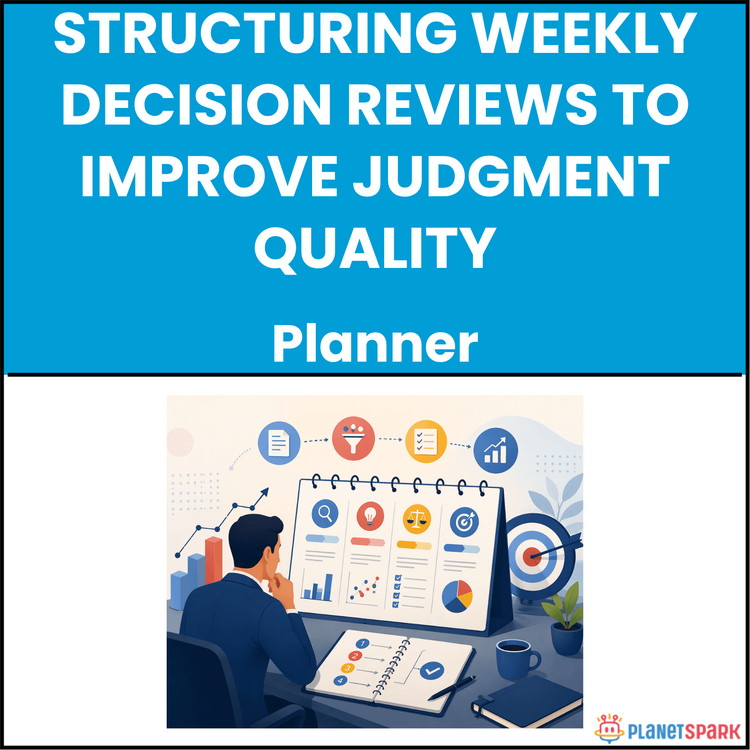
Structuring Weekly Decision Reviews to Improve Judgment Quality
Organizing Weekly Decision Reviews to Enhance Judgment Quality: A Practical Planner for Professionals
In a fast-paced professional environment, decision-making can feel like a never-ending process. You make decisions daily, some big, some small, but often, you don’t take the time to reflect on them. This lack of reflection can lead to stagnating judgment quality, where the same biases and blind spots resurface repeatedly. The solution? Structured weekly decision reviews. This planner provides a clear, actionable method to examine your decisions systematically, identify patterns, and sharpen your decision-making over time. It’s not about making the right decision every time; it’s about improving your decision-making process to make better choices in the future.
Who Is This Resource For?
This resource is for:
- Managers and leaders: Making decisions that affect teams, resources, and long-term strategies.
- Career switchers: Navigating decisions in a new industry or role with confidence.
- Consultants: Making impactful decisions for clients under pressure.
- Mid-career professionals: Seeking to fine-tune their decision-making skills to break through plateaus in their careers.
If you're looking to refine your decision-making ability and move from reactive to proactive decision-making, this planner is designed for you.
What Does This Resource Contain?
The planner is built around a 3-phase weekly decision review system:
1. Capture: List all significant decisions made during the week. This includes micro-decisions, not just major ones.
2. Analyse: Evaluate the quality of your decisions. Ask what information you had, what you ignored, and how emotional factors may have influenced your decisions.
3. Calibrate: Identify one specific adjustment to make going into the next week based on what you learned from your review.
In addition, the toolkit includes:
- Decision Capture Log: A tool to record your decisions before analyzing them.
- Decision Quality Scorecard: A self-assessment tool to evaluate your decisions based on five key dimensions.
- Weekly Reflection Questions: Prompts to help you extract valuable insights from each week's decisions.
Summary of the Resource
This resource helps you improve judgment quality by encouraging a structured approach to reviewing your decisions weekly. It provides a systematic method to capture decisions, analyze their reasoning process, and calibrate for future improvements. Over time, this practice helps you develop sharper, faster, and more confident decision-making skills, while also building a decision record that you can refer back to for growth.
How Will This Resource Be Useful?
This planner will:
- Reduce cognitive bias: By systematically reflecting on decisions, you’ll surface hidden biases and avoid repeating past mistakes.
- Increase decision-making speed and accuracy: The process helps you act decisively while ensuring your choices are grounded in sound reasoning.
- Build long-term judgment quality: The planner helps track patterns over time, allowing you to fine-tune your decision-making process.
- Boost confidence: By separating the process from the outcome and reflecting consistently, you’ll develop trust in your decision-making.
How Should You Use This Resource?
1. Start with the Capture phase: At the end of each week, list all significant decisions made, both professional and personal. Don’t evaluate them yet; just capture them.
2. Move to the Analyse phase: For each decision, ask yourself key questions about the information you had, your assumptions, emotional influences, and stakeholder considerations.
3. Use the Decision Quality Scorecard: For each decision, score yourself on five critical dimensions (Information Quality, Options Considered, Emotional Clarity, Stakeholder Consideration, and Reversibility Awareness).
4. Finalize with the Calibrate phase: Identify one belief or assumption to adjust next week. Write a commitment statement about how you’ll improve your decision-making in the future.
5. Repeat weekly: Consistently apply this framework to enhance your decision-making over time.
Action Steps
1. Complete the Decision Capture Log: Write down all your significant decisions for the week.
2. Use the Decision Quality Scorecard: Rate each decision based on the five dimensions.
3. Reflect on your decisions: Answer the Weekly Reflection Questions to identify patterns and areas for improvement.
4. Make your Calibration Commitment: Write down one specific action you will take to improve your decision-making next week.
5. Review and adjust: At the end of the month, look back at your decisions and refine your process further.
Book your free session today!