
Structuring Your Personal Brand for Different Career Phases

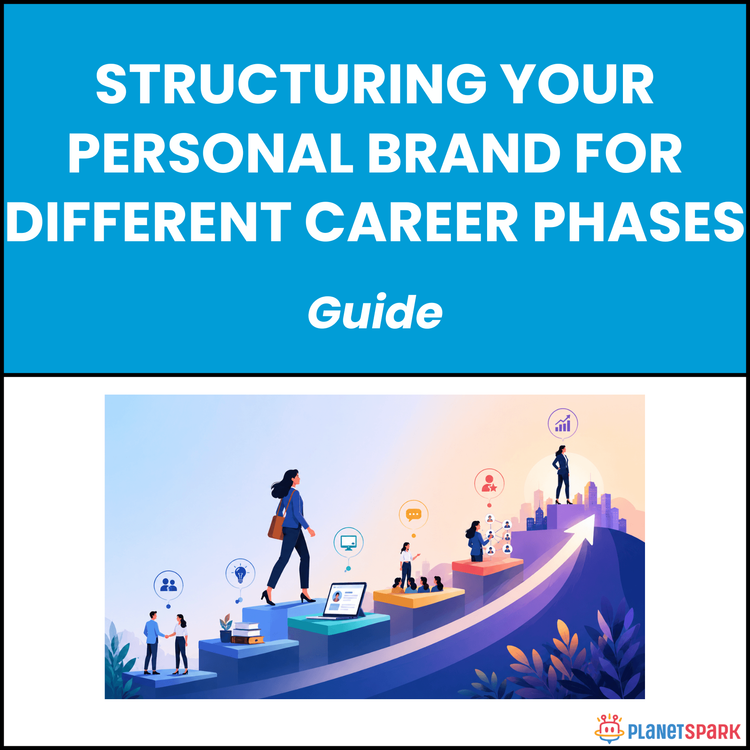
Structuring Your Personal Brand for Different Career Phases
Structuring Your Personal Brand for Different Career Phases: A Practical Template Pack for Professionals Who Want to Stand Out
Your personal brand is already speaking for you.
It shows up in your LinkedIn headline, resume summary, portfolio bio, email signature, speaker profile, proposal introduction, and even the way you describe yourself in networking conversations. The problem is that most professionals build these pieces at different times, for different purposes, and rarely update them when their career changes.
That is how your personal brand becomes inconsistent.
You may still be using early-career language even though you are now leading teams. You may be describing your old industry even though you are trying to pivot into a new one. You may have strong experience, but your profile still sounds generic because it focuses on job titles instead of measurable outcomes.
The “Structuring Your Personal Brand for Different Career Phases” template pack is designed to solve exactly that problem. It gives working professionals a structured, scenario-based way to define, update, and deploy their personal brand across different career moments, from entry-level roles to leadership, consulting, freelancing, entrepreneurship, and executive thought leadership.
Instead of giving you one generic personal branding worksheet, this resource provides 10 specific templates for real professional situations. Each template helps you clarify what to say, how to say it, and where to use it so your brand reflects where your career is going, not just where it has been.
Who Is This Resource For?
This resource is for professionals who know they need a stronger personal brand but do not want vague advice like “be authentic” or “build your online presence.”
It is especially useful for:
- Fresh graduates and early-career professionals building a credible identity without years of work experience
- Career switchers moving into a new industry, function, or role
- Mid-career professionals preparing for promotion, leadership, or senior responsibilities
- Freelancers and independent consultants who need to communicate their value clearly to clients
- Professionals returning after a career break who want to rebuild confidence and credibility
- Senior managers, directors, and executives who want to establish thought leadership
- Side-hustle founders transitioning into full-time entrepreneurship
- Professionals updating LinkedIn, resumes, portfolios, bios, proposals, or speaker profiles
- Anyone preparing for a major career move and needing brand consistency across platforms
If your current LinkedIn profile, resume, bio, and portfolio do not tell the same story, this resource will help you bring them into alignment.
What Does This Resource Contain?
The resource contains 10 scenario-specific personal branding templates, plus supporting strategy guides, language frameworks, and an action plan.
Each template is built for a distinct career situation, so you can choose the one that fits your current phase instead of trying to force your story into a generic format.
1. The Entry-Level Brand Blueprint
This template is designed for fresh graduates and professionals with 0–1 year of experience.
It helps you build a professional identity when you do not yet have a long work history. Instead of over-relying on your degree or university name, the template helps you highlight:
- Academic projects
- Internships
- Volunteer experience
- Transferable skills
- Technical tools
- Early achievements
- Portfolio or LinkedIn links
The goal is to lead with potential, initiative, and evidence of early impact.
2. The Industry Pivot Positioning Statement
This template is for professionals moving from one industry, function, or career track to another.
It helps you reframe your past experience in the language of your target field. The resource includes a transferable value map where you connect old skills to new contexts, supported by measurable proof points.
This is especially useful for career switchers who do not want their pivot to look random or reactive. The template helps position the move as intentional, strategic, and valuable.
3. The Promotion-Ready Leadership Profile
This template is for mid-level professionals with around 3–8 years of experience who are preparing for a promotion, senior title, or people management role.
It shifts your brand away from task execution and toward:
- Leadership capability
- People development
- Strategic contribution
- Cross-functional impact
- Readiness for the next level
This is helpful when you want decision-makers to see you not only as someone who performs well, but as someone who can lead teams, influence stakeholders, and solve organisational problems.
4. The Freelancer’s Value Proposition Canvas
This template is for freelancers and independent professionals who need to communicate their services clearly to prospective clients.
It helps you define:
- Your specialisation
- Client types served
- Engagement formats
- Value proposition
- Service offerings
- Client proof points
- Working style
- Contact channels
The template replaces vague positioning like “available for projects” with a client-focused statement that explains who you help, what result you deliver, and why you are the right person to hire.
5. The Career Re-entry Brand Rebuild
This template is for professionals returning to work after a planned or unplanned career break.
It helps you acknowledge a gap without apologising for it. The structure guides you to lead with your professional identity, explain the break strategically if needed, and show readiness to contribute again.
It includes sections for:
- Last role held
- Career break period
- Target role on return
- Pre-break career highlights
- Productive use of break time
- Upskilling and certifications
- Return readiness signals
This is especially useful for professionals returning after caregiving, relocation, health recovery, further education, entrepreneurship, or other life transitions.
6. The Executive Thought Leadership Bio
This template is designed for senior professionals, directors, VPs, principals, and C-suite-adjacent leaders.
It helps you move beyond a resume-style summary and build a public-facing authority bio suitable for:
- Speaking invitations
- Panel profiles
- Media commentary
- Advisory roles
- Board appointments
- Award nominations
- Editorial submissions
The template includes both a short executive bio and a longer version, along with sections for speaking topics, media presence, advisory roles, and booking contact details.
7. The Side-Hustle to Main Business Transition Statement
This template is for professionals who are transitioning from employment into a business, venture, or founder identity.
It helps you rewrite your brand narrative so people see you as a serious business owner, not someone casually leaving a job to try something new.
The template helps connect your previous professional background to your venture’s mission, showing that the transition is the logical next step in your career.
It includes:
- Venture identity
- Previous professional identity
- New founder identity
- Business stage
- Transition brand narrative
- Venture proof points
- Founder competence map
- Brand channels
8. The Consultant’s Expertise Positioning Template
This template is for independent consultants, boutique firm principals, and subject-matter experts.
It helps you communicate not only what services you offer, but also your niche, methodology, client philosophy, and the specific problems you are uniquely qualified to solve.
The resource includes a consulting methodology overview built around four stages:
- Diagnose
- Design
- Deploy
- Debrief
This makes the template especially useful for proposals, capability statements, and client introductions.
9. The LinkedIn Summary Refresh by Career Stage
This template helps professionals update their LinkedIn About section based on career stage.
It includes three frameworks:
- Early Career: energetic, curious, specific, and focused on projects or potential
- Mid-Career: confident, concrete, outcome-focused, and supported by metrics
- Senior or Executive: authoritative, visionary, generous, and focused on perspective and contribution
The resource also includes LinkedIn About section rules, such as writing in first person, using short paragraphs, including relevant keywords naturally, and updating every 6–12 months or after major career events.
10. The Cross-Platform Brand Consistency Checklist
This checklist helps you audit your personal brand across multiple platforms.
It covers:
- LinkedIn headline
- LinkedIn About section
- LinkedIn Featured section
- Resume or CV summary
- Resume experience framing
- Portfolio or website bio
- Email signature
- Conference or speaker bio
- Twitter/X profile
- Instagram bio, if used professionally
It also includes brand consistency rules and a brand voice alignment check, helping you identify whether your current tone, confidence level, outcome focus, and audience alignment match your target career direction.
Summary of the Resource
This resource is a practical personal branding system for professionals at different career stages.
At a high level, it helps you answer four important questions:
1. What career phase am I in right now?
2. What professional story should I be telling at this stage?
3. Which platforms and documents need to reflect that story?
4. How do I turn my experience into clear, credible, outcome-focused language?
The biggest strength of this resource is that it recognises personal branding is not static. The way you present yourself as a graduate should not be the same way you present yourself as a manager, consultant, founder, or executive.
The resource helps you calibrate your brand language to your current situation. For example, early-career professionals are encouraged to lead with potential, skills, and education. Growth-phase professionals are encouraged to lead with impact metrics and specialisation. Senior contributors are encouraged to lead with strategic leadership and domain authority. Executive thought leaders are encouraged to lead with vision, industry contribution, and public presence.
This makes the pack useful not only for writing better bios, but for making better career decisions about how you want to be known.
How Will This Resource Be Useful?
This resource is useful because it turns personal branding from a vague idea into a structured process.
Many professionals struggle not because they lack value, but because they do not know how to communicate that value in the right format, for the right audience, at the right stage of their career.
Here is how this template pack helps.
It helps you create clarity
If you are unsure how to describe yourself professionally, the templates give you a clear starting point. You do not have to stare at a blank page or guess what to include.
Each section prompts you to think about your experience in a structured way, including your skills, proof points, achievements, goals, and target audience.
It helps you avoid generic branding
The resource directly addresses common phrases and habits that weaken professional profiles, such as:
- “Responsible for managing…”
- “Passionate about…”
- “Hardworking team player”
- “Results-driven professional”
- “Strong communication skills”
- “Seeking opportunities to grow”
Instead, it encourages stronger, evidence-led language that connects actions to outcomes.
It helps you communicate impact
The resource encourages professionals to move from task-led descriptions to impact-led statements.
For example, instead of simply saying you managed a project, you would explain what changed because of your work. That could include revenue generated, time saved, people developed, processes improved, customers supported, or systems transformed.
This is valuable because employers, clients, collaborators, and decision-makers respond to evidence, not just claims.
It helps you prepare for career transitions
Career transitions often create branding confusion.
A career switcher may not know how to explain past experience in a new field. A returning professional may worry about how to discuss a career break. A side-hustle founder may struggle to be taken seriously as a business owner. A mid-career professional may still sound like an individual contributor even while seeking leadership.
The resource gives each of these situations a specific structure, helping you make the transition feel confident and intentional.
It helps you align your brand across platforms
A strong personal brand is not just one great LinkedIn summary. It needs consistency across every professional touchpoint.
This pack helps you check whether your resume, LinkedIn profile, portfolio, website bio, email signature, speaker bio, and social profiles are all telling the same story.
That consistency matters because people often encounter your brand in more than one place before deciding whether to contact, hire, refer, promote, or collaborate with you.
It helps you take action quickly
The resource is designed for busy professionals who need practical tools, not theory.
The templates include placeholders, formulas, examples, checklists, and a 30-day action plan. This makes it easier to move from thinking about your personal brand to actually updating it and using it.
How Should You Use This Resource?
To get the most value from this resource, do not try to complete every template at once.
Start with your current career situation, choose the most relevant template, and use the supporting tools to refine and deploy your brand.
Step 1: Start with the Brand Consistency Audit
Begin with Template 10, the Cross-Platform Brand Consistency Checklist.
Before rewriting anything, assess what already exists. Review your LinkedIn profile, resume, portfolio, bio, email signature, and any other public professional profiles.
Ask yourself:
- Is my current headline still accurate?
- Does my LinkedIn About section reflect my current career goal?
- Does my resume summary match my LinkedIn positioning?
- Are my proof points current and measurable?
- Is my tone consistent across platforms?
- Are my links and contact details active?
This step helps you identify what needs rewriting, updating, removing, or aligning.
Step 2: Identify your career phase
Next, decide which career phase or situation best matches where you are now.
You may be:
- Entering the workforce
- Switching industries
- Seeking a promotion
- Starting freelance work
- Returning after a break
- Building executive visibility
- Moving from side hustle to main business
- Positioning as a consultant
- Refreshing your LinkedIn profile
- Preparing for a major career move
Once you know your situation, choose the primary template that fits best.
Step 3: Complete your primary template fully
Work through the relevant template section by section.
Do not skip the parts that feel difficult. The sections that are hardest to complete are often the ones that reveal where your brand needs the most clarity.
For example:
- If you cannot name your measurable outcomes, you may need to review past projects more carefully.
- If you cannot explain your target audience, your positioning may be too broad.
- If your pivot narrative feels weak, you may need stronger proof of upskilling or transition work.
- If your leadership profile lacks examples, you may need to gather evidence from team, stakeholder, or project outcomes.
Use the template as a thinking tool, not just a writing tool.
Step 4: Gather proof points before publishing
A strong personal brand is built on evidence.
Before updating your public profiles, collect 5–10 proof points from your recent work. These may include:
- Projects delivered
- Metrics improved
- Teams led
- Clients served
- Revenue influenced
- Processes improved
- Certifications completed
- Public speaking or writing
- Portfolio samples
- Testimonials or recommendations
Then use these proof points to make your brand statement more credible.
Step 5: Update your core platforms first
Once your brand statement is ready, apply it to your most important platforms.
Start with:
- LinkedIn headline
- LinkedIn About section
- Resume or CV summary
- Portfolio or website bio
- Email signature
Make sure the same core message appears across all of them, even if the wording is adapted for each format.
Step 6: Adapt the language by platform
The resource also explains how to adapt your brand across formats.
For a resume or CV, your brand statement can become the summary section, and your proof points can become achievement bullets.
For LinkedIn, your headline should include your target role, top skill or domain, and one differentiator. Your About section should match your career stage.
For a portfolio website, your homepage bio should be short and clear, while your About page can include a longer career narrative.
For email outreach, use a concise positioning statement before making a request.
This platform-specific thinking helps your brand feel consistent without sounding copy-pasted.
Step 7: Review and refresh regularly
Your personal brand should evolve as your career evolves.
The resource recommends refreshing your brand after major career events, such as:
- A new job
- A promotion
- A title change
- A new certification
- A major project
- A new service or venture
- A speaking opportunity
- An award nomination
- A shift in target audience
Even without a major change, review your brand every 6–12 months to keep it current.
Action Steps
Use the resource with a clear execution plan.
Here is a practical way to start:
1. Complete the Cross-Platform Brand Consistency Checklist.
2. Identify your current career phase or transition situation.
3. Choose the most relevant primary template.
4. Gather 5–10 measurable proof points from your work, education, projects, or business.
5. Draft your personal brand statement using the template prompts.
6. Replace generic phrases with specific, outcome-focused language.
7. Update your LinkedIn headline and About section.
8. Refresh your resume or CV summary so it matches your LinkedIn positioning.
9. Check your portfolio, website bio, email signature, and public profiles for consistency.
10. Ask a mentor, colleague, or trusted peer to review your updated brand.
11. Publish your updates within 7 days.
12. Set a reminder to review your personal brand again in 90 days.
For best results, treat this as a working document. Return to it when you apply for a new role, seek promotion, launch a service, prepare for a speaking opportunity, or move into a new phase of your career.
Why This Resource Matters
A strong personal brand is not about self-promotion for the sake of visibility. It is about helping the right people understand your value quickly.
When your brand is clear, you make it easier for hiring managers to see your fit. You make it easier for clients to understand your expertise. You make it easier for leaders to consider you for bigger opportunities. You make it easier for your network to refer you accurately.
Most importantly, you make it easier for yourself to move through your career with intention.
The “Structuring Your Personal Brand for Different Career Phases” template pack gives you a practical way to define who you are professionally, what you bring to the table, and how your story should evolve as your career grows.
Whether you are just starting out, preparing for leadership, returning after a break, building a consulting practice, or stepping into thought leadership, this resource helps you communicate your value with more clarity, confidence, and consistency.
Your career will keep changing. Your personal brand should change with it. Use this template pack not just once, but every time your professional direction, audience, or ambition evolves.