
Team Accountability System Design

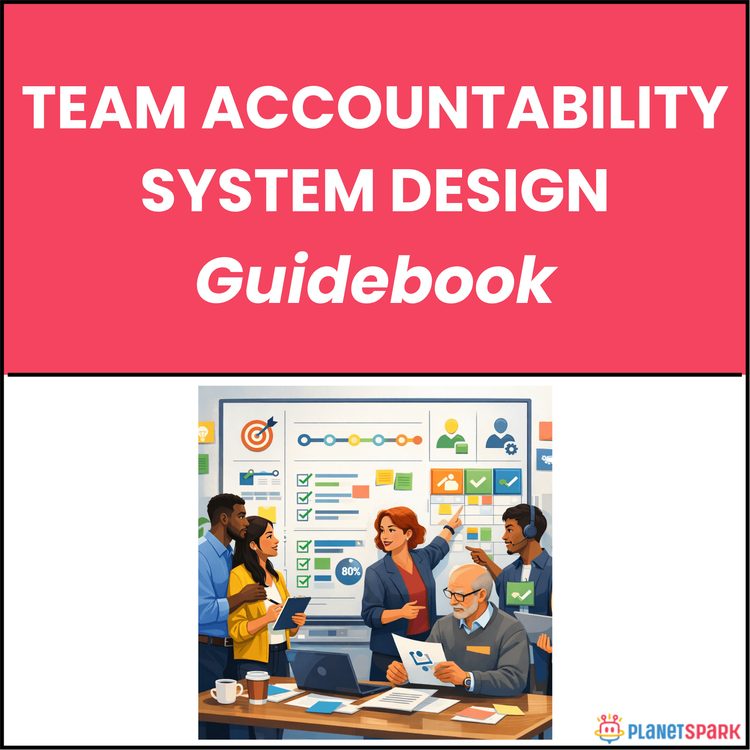
Team Accountability System Design
Team Accountability System Design: A Practical Guide to Building High-Ownership Teams
If you constantly find yourself chasing updates, following up on missed deadlines, or stepping in to fix work your team should own—you’re not alone.
Most leaders assume accountability is a people problem. They try to motivate harder, push more, or hold stricter reviews. But the reality is much simpler—and more powerful: accountability is a system problem.
That’s exactly what the “Team Accountability System Design” resource addresses. It gives you a structured, practical way to build a system where ownership becomes the default—not something you have to enforce repeatedly.
Instead of managing people harder, you learn how to design better systems.
Book your free trial session today with PlanetSpark.
Download for more details or PDF file.
Who Is This Resource For?
This resource is especially useful if you are:
- A manager or team lead dealing with missed deadlines and unclear ownership
- A professional responsible for team delivery and performance
- A consultant working on improving team productivity or execution
- A mid-career leader struggling with follow-ups and accountability gaps
- Someone managing cross-functional teams with shared responsibilities
- A leader who wants to move from “chasing work” to “driving outcomes”
If your team depends too much on you to keep things moving, this guide helps you fix that at the root.
What Does This Resource Contain?
This is a complete accountability system design playbook—not just theory or high-level advice.
Inside the resource, you’ll find:
- The core framework of accountability built on four pillars: Clarity, Commitment, Cadence, and Consequence (explained in detail on page 3)
- A step-by-step system to design accountability from scratch across five structured stages
- The RACI framework to clearly define ownership and eliminate ambiguity
- An Ownership Charter template to define deliverables, owners, success criteria, and timelines
- A Team Agreement Canvas to build shared commitment and working norms collaboratively
- A cadence model including daily updates, weekly reviews, monthly 1:1s, and quarterly deep dives
- A Weekly Accountability Meeting template (30-minute structure for consistent execution)
- A structured Accountability Conversation Framework to handle missed commitments effectively
- A consequence system that balances recognition and correction consistently
- A sustainability model to embed accountability into team culture—not just processes
- A Team Accountability Health Check diagnostic tool to measure system strength
- A real-world case study showing measurable improvement in delivery and team performance
- A 30-day implementation plan broken into weekly sprints
- Reflection worksheets and leader self-evaluation tools
Each component is designed for immediate application in real teams—not theoretical understanding.
Summary of the Resource
“Team Accountability System Design” is a practical execution playbook that helps leaders build systems where accountability becomes automatic.
It shows you how to:
- Eliminate ambiguity in ownership
- Turn assigned tasks into committed outcomes
- Build structured rhythms that keep work on track
- Create consistent consequences that reinforce accountability
- Sustain the system without constant managerial pressure
If you want your team to take ownership without being pushed, this resource gives you the blueprint.
How Will This Resource Be Useful?
This resource helps you move from reactive management to structured leadership.
You’ll gain:
- Clear ownership across tasks and projects
- Reduced need for constant follow-ups and micromanagement
- Faster execution and improved on-time delivery
- Higher team accountability and ownership mindset
- Better team morale—especially among high performers
- More time for strategic work instead of operational chasing
As highlighted in the case study (page 15), teams using this system improved on-time delivery from 54% to 87% within 8 weeks—without adding resources.
Most importantly, it shifts accountability from being leader-driven to system-driven.
How Should You Use This Resource?
To get maximum value, treat this as an implementation guide—not just a reading document.
Start by reading the full guide once to understand the four-pillar framework.
Then implement step-by-step:
- Begin with Clarity: define ownership using the RACI framework and Ownership Charter
- Build Commitment: involve your team in setting goals and making commitments
- Establish Cadence: introduce structured weekly and daily check-ins
- Apply Consequence: consistently recognise wins and address gaps
- Focus on Sustainability: make accountability visible and self-reinforcing
Use the provided templates and tools directly with your team rather than adapting them later.
Follow the 30-day implementation plan (page 16) to build the system gradually and sustainably.
Revisit the Health Check tool every quarter to evaluate and improve your system.
Action Steps
After accessing this resource, take these steps immediately:
1. Identify one project where accountability is currently weak
2. Define clear ownership using the Ownership Charter template
3. Run a short conversation to confirm understanding with the owner
4. Introduce a weekly accountability review meeting (30 minutes max)
5. Ask team members to publicly state one commitment for the week
6. Address one missed commitment using the accountability conversation framework
7. Recognise at least one accountability behaviour publicly
These small steps will immediately start shifting your team’s behaviour.
Accountability is not about pushing people harder—it’s about designing systems better.
When clarity is strong, commitments are real, cadence is consistent, and consequences are fair, teams don’t need to be managed constantly.
They manage themselves.
And that’s when leadership becomes scalable, teams become reliable, and performance becomes predictable.
Book your free session today!