
Team Decision-Making Framework

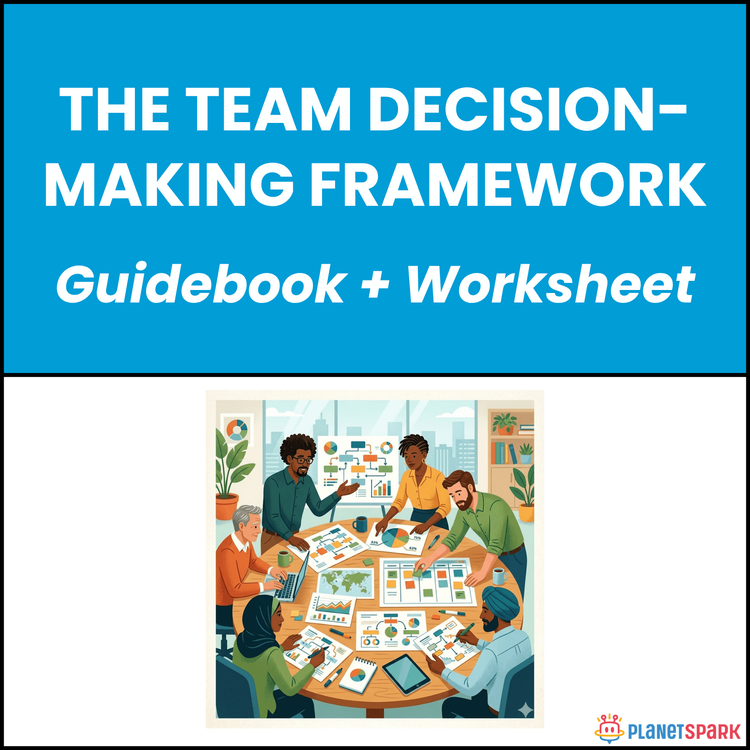
Team Decision-Making Framework
How to Make Better Team Decisions Faster: A Practical Framework for Managers and Working Professionals
If you’ve ever sat through a long meeting where everyone shared opinions but no clear decision was made, you’ve experienced one of the most common workplace frustrations. Teams debate endlessly, revisit the same topics, and leave the room without clarity on what happens next.
This isn’t a talent problem. It’s a process problem.
Many capable professionals struggle with team decisions because they were never formally taught how to structure them. Yet decision-making is one of the most critical leadership and collaboration skills in today’s fast-paced workplaces. When decisions are unclear, projects stall, timelines slip, and team morale suffers.
That’s exactly why the resource “The Team Decision-Making Framework” was created. It provides a clear, repeatable system that helps professionals lead team decisions with confidence, alignment, and speed—without confusion or unnecessary debate.
Whether you’re managing projects, collaborating across teams, or stepping into leadership responsibilities for the first time, this guide equips you with practical tools to make decisions that stick.
Who Is This Resource For?
This resource is especially valuable if you are:
- A working professional with 0–15 years of experience involved in team decisions
- A manager or team lead responsible for guiding discussions and driving outcomes
- A consultant facilitating decisions for clients or cross-functional teams
- A career switcher stepping into roles that require collaboration and leadership
- A project manager struggling with delays caused by unclear decisions
- A professional who wants meetings to be productive, focused, and action-oriented
If you want to make faster, smarter decisions without unnecessary friction, this framework is designed for you.
What Does This Resource Contain?
This is not a theoretical leadership guide. It’s a practical, field-tested toolkit that helps teams move from discussion to decision with clarity and structure.
Inside the resource, you’ll find:
- The DECIDE framework — a structured 5-step decision-making model
- A decision definition template to clarify what needs to be decided
- Tools to generate better options and avoid rushed decisions
- Role clarity systems using DACI and RACI frameworks
- A decision matrix to evaluate options objectively
- A Decision Record template to document outcomes clearly
- A pre-meeting decision preparation worksheet
- Reflection questions to diagnose decision-making gaps
- A before-during-after decision checklist
- Guidance on different decision-making styles
- Techniques to overcome common cognitive biases in teams
- Real-world case studies showing the framework in action
- A self-evaluation scorecard to measure decision effectiveness
Every section is designed to be used immediately in real meetings—not just read and forgotten.
Summary of the Resource
“The Team Decision-Making Framework” is a structured guide that helps professionals make clear, confident team decisions using a repeatable process.
Instead of relying on intuition or endless discussion, this resource provides a step-by-step system that ensures:
- Everyone understands the decision
- Roles and responsibilities are clear
- Options are evaluated logically
- Decisions are documented and executed
It transforms decision-making from a stressful, time-consuming activity into a predictable and efficient process.
How Will This Resource Be Useful?
This resource helps you move from confusion to clarity in team environments.
You’ll gain:
- Confidence in leading team discussions and decisions
- Faster decision-making without sacrificing quality
- Clear accountability for execution
- Reduced meeting time and fewer repeated discussions
- Stronger alignment among team members
- Improved credibility as a professional or leader
Most importantly, it helps you replace uncertainty with structure—so decisions move forward instead of getting stuck.
How Should You Use This Resource?
To get the best results, use this resource in a structured, phased approach.
First, read through the guide once to understand the overall decision-making process and the flow of the framework.
Next, identify a real decision your team needs to make. Use the decision definition template to clarify the exact question and expected outcome.
Then, apply the five steps of the DECIDE framework:
Step 1 — Define the decision clearly
Step 2 — Explore multiple realistic options
Step 3 — Assign roles and responsibilities
Step 4 — Evaluate trade-offs using criteria
Step 5 — Decide, document, and execute the plan
Finally, use the decision checklist to review the process and ensure the decision is implemented effectively.
You can revisit this resource whenever you:
- Lead team meetings
- Manage projects or initiatives
- Facilitate client decisions
- Handle complex team discussions
- Plan strategic changes
- Resolve disagreements within teams
Over time, consistent use of this framework builds stronger decision habits and better team performance.
Action Steps
After accessing this resource, take these steps immediately:
1. Identify one upcoming team decision that needs clarity
2. Write the decision as a clear question
3. Generate at least four possible options
4. Assign one person responsible for the final decision
5. Use evaluation criteria to compare options
6. Document the final decision and assign next actions
Even applying this process once can significantly improve team efficiency and confidence.
Strong teams are not defined by how long they discuss problems, but by how effectively they decide and act. Decision-making is not about authority or hierarchy—it’s about clarity, structure, and accountability.
Use this resource not just to run better meetings, but to build a professional reputation as someone who drives outcomes. When you bring structure to decisions, you create momentum for progress, trust within teams, and measurable results in your work.
Book your free session today!