
Team Development Planning Roadmap

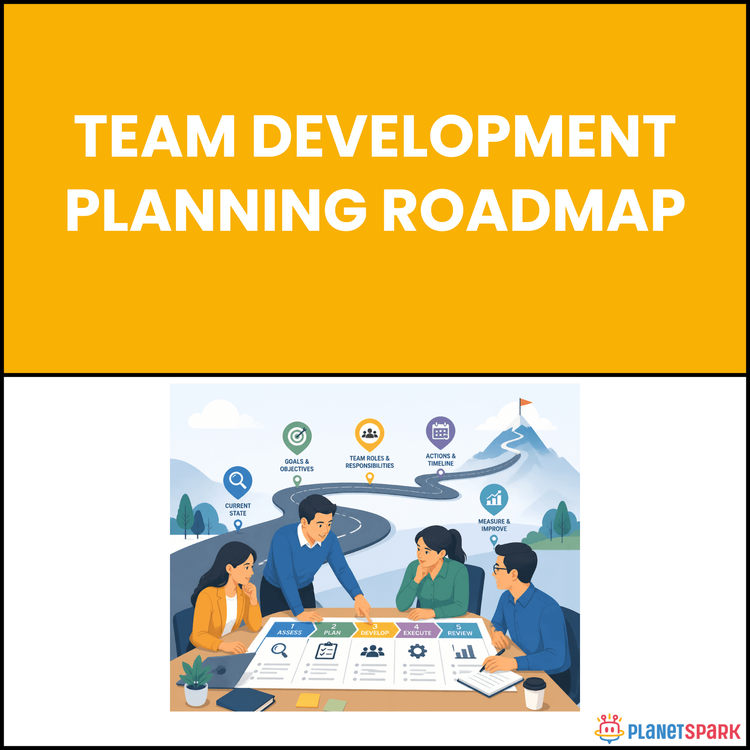
Team Development Planning Roadmap
Team Development Planning Roadmap: A Practical Guide to Building High-Performing Teams Faster
Most professionals don’t struggle because they lack talent — they struggle because they’re expected to lead teams without ever being taught how to develop them.
You might be a high performer who recently stepped into a managerial role. Or a consultant expected to “fix” team capability. Or someone managing cross-functional stakeholders without formal authority. In all these situations, one challenge remains constant: how do you systematically build a team that performs, grows, and sustains results?
This is exactly where the Team Development Planning Roadmap becomes invaluable. It is not theory. It is a structured, practical system that helps you assess your team, identify meaningful gaps, and take consistent action that leads to real performance improvement.
Who Is This Resource For?
This roadmap is designed for professionals who need clarity and action — not abstract leadership advice. It is especially useful if you are:
- A first-time manager figuring out how to lead and develop people
- A mid-career professional managing teams, stakeholders, or projects
- A consultant responsible for building client team capability
- A career switcher stepping into leadership roles
- A project lead working without formal authority
- Someone struggling with team performance, engagement, or accountability
If you are responsible for outcomes that depend on other people, this resource is directly relevant to you.
What Does This Resource Contain?
The roadmap is structured into a clear, five-phase system that you can apply immediately:
Phase 1: Assess
- Evaluate team members across skills, motivation, and team dynamics
- Use structured checklists and real observations
- Avoid common mistakes like relying only on performance reviews
Phase 2: Define
- Create meaningful development goals using the 3-Layer Goal Framework
- Connect learning to real work and business outcomes
- Includes strong vs weak goal examples and reflection worksheets
Phase 3: Design
- Build development actions using the 70:20:10 framework
- Combine on-the-job experience, social learning, and formal training
- Includes a ready-to-use development action planner template
Phase 4: Activate
- Turn plans into action with accountability systems
- Includes kickoff conversations, ownership clarity, and check-in cadence
- Provides an activation checklist to ensure execution
Phase 5: Monitor
- Track progress using structured check-ins
- Identify positive signals and early warning signs
- Learn how to adapt without abandoning goals
Additional components include:
- A real-world case example showing how the roadmap works in practice
- A self-evaluation tool to assess your effectiveness as a team development leader
- A concise summary of key principles for quick reference
Summary of the Resource
This roadmap gives you a repeatable system to build stronger teams by focusing on five critical actions: assess accurately, define meaningful goals, design practical learning experiences, activate with accountability, and monitor continuously.
Instead of relying on guesswork or one-time training interventions, you create an ongoing development system embedded in real work.
How Will This Resource Be Useful?
The value of this roadmap shows up in real, tangible outcomes:
- You gain clarity on where your team actually stands — not assumptions
- You stop setting vague goals and start driving measurable growth
- You build development into daily work instead of treating it as a separate activity
- You reduce firefighting and become more proactive as a leader
- You improve team engagement by aligning development with individual motivation
- You create accountability systems that ensure follow-through
- You build a culture where learning translates into performance
Most importantly, you shift from managing tasks to developing people — which is what drives long-term results.
How Should You Use This Resource?
To get maximum value, follow a structured approach:
Step 1: Read Once for Context
Go through the entire roadmap to understand the full system before taking action.
Step 2: Start with Assessment
Use the provided checklist to evaluate your team across skills, motivation, and dynamics. Do not skip this step.
Step 3: Define Individual Goals
Apply the 3-layer goal framework for each team member. Focus on clarity and real work connection.
Step 4: Design Development Actions
Use the 70:20:10 model to create practical, work-based learning experiences.
Step 5: Activate Immediately
Hold 1:1 kickoff conversations, assign ownership, and schedule check-ins.
Step 6: Monitor and Adapt
Use regular check-ins to track progress, identify issues early, and adjust actions as needed.
Step 7: Reuse and Refine
Treat this as a continuous system. Revisit and improve it as your team evolves.
Action Steps
If you want to start applying this immediately, follow this simple checklist:
1. Schedule 1:1 conversations with each team member this week
2. Assess their skills, motivation, and role alignment
3. Identify one key development gap per person
4. Write one clear, work-connected development goal
5. Assign a stretch task aligned with that goal
6. Set a recurring check-in (bi-weekly or monthly)
7. Create a simple shared tracker for visibility
These small actions will start shifting your team from static performance to continuous growth.
Building a high-performing team is not about quick fixes or one-time interventions. It is about consistent, structured effort over time.
The professionals who stand out in today’s workplace are not just those who deliver individually — but those who can build teams that deliver consistently, even in changing environments.
This roadmap gives you a practical way to do exactly that. Start small. Stay consistent. Build momentum.
Your team’s growth is directly linked to your decision to prioritise it.