
Tracking Communication Wins And Failures For Improvement

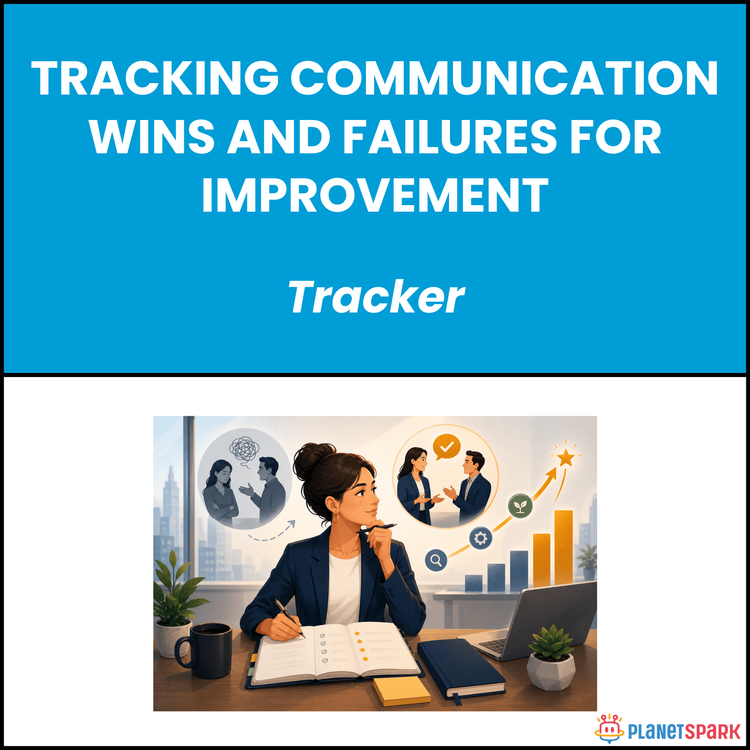
Tracking Communication Wins And Failures For Improvement
How to Improve Workplace Communication Through Self-Tracking and Reflection
Most professionals assume communication improves automatically with experience. But the reality is very different. Many people spend years in meetings, presentations, client calls, interviews, and workplace discussions without ever understanding why some conversations succeed while others fail.
You may walk out of a meeting feeling unheard. You may send emails that create more confusion instead of clarity. You may struggle to explain ideas confidently under pressure even when you know your work inside out. The challenge is not always a lack of communication skill. Often, it is a lack of visibility.
That’s exactly where this resource becomes valuable.
This practical guide helps professionals track, analyse, and improve their communication patterns systematically instead of relying on guesswork. Rather than offering generic communication advice, it gives you a structured framework to identify what is working, what is not, and how to improve consistently over time.
Whether you want to communicate more confidently in meetings, write clearer emails, handle difficult conversations better, or strengthen executive presence, this resource helps you turn everyday interactions into measurable learning opportunities.
Who Is This Resource For?
This resource is especially useful for:
- Early-career professionals trying to build confidence and credibility
- Managers navigating team communication and stakeholder conversations
- Career switchers adapting to new professional environments
- Consultants and client-facing professionals who rely on clarity and trust
- Job seekers preparing for interviews and networking conversations
- Professionals who often replay conversations afterward wishing they had communicated differently
- Anyone looking to improve communication intentionally rather than randomly
If you regularly work in collaborative environments, lead discussions, communicate with clients, or participate in high-stakes conversations, this resource provides a practical self-improvement system you can apply immediately.
What Does This Resource Contain?
This guide is designed as a hands-on communication improvement toolkit rather than a theory-heavy manual.
Inside the resource, you’ll find:
- A structured framework for identifying meaningful communication events
- Guidance on tracking spoken, written, and non-verbal communication
- A practical 5-part communication event log for structured reflection
- Methods to evaluate intent versus actual impact
- A communication grid to categorize wins, learning moments, and high-stakes situations
- Techniques for identifying recurring communication patterns
- A 2-week communication improvement sprint framework
- Pre-event preparation checklists for important interactions
- Post-event reflection questions for deeper self-awareness
- Practical self-audit worksheets and review exercises
- Real-world case examples showing measurable improvement
- Common communication mistakes and actionable fixes
- A 30-day implementation plan to build consistent communication habits
The resource is designed to help professionals move from reactive communication to deliberate communication.
Summary of the Resource
This communication tracking guide helps professionals build self-awareness around how they communicate in real workplace situations.
Instead of focusing only on theory or tips, the resource teaches you how to observe communication patterns systematically, reflect on outcomes honestly, and improve through consistent practice.
The framework encourages professionals to treat conversations, presentations, emails, meetings, and feedback discussions as learning data rather than isolated events.
Over time, this process helps build:
- Better communication clarity
- Stronger confidence under pressure
- More intentional messaging
- Improved professional relationships
- Greater self-awareness in workplace interactions
Most importantly, it helps professionals identify the gap between what they intended to communicate and how others actually experienced it.
How Will This Resource Be Useful?
One of the biggest reasons communication problems persist is because most professionals never pause to analyze them properly. This resource changes that.
By consistently tracking communication wins and failures, you can begin to:
- Recognize recurring communication patterns
- Improve clarity in meetings and presentations
- Handle difficult conversations more confidently
- Reduce misunderstandings in written communication
- Strengthen executive presence and professional credibility
- Become more intentional in high-pressure situations
- Improve listening, framing, and response quality
- Build confidence based on evidence instead of assumptions
The resource is particularly valuable because it focuses on long-term improvement through reflection and action.
Instead of giving one-time advice, it helps you create a repeatable self-coaching system that improves communication across different professional situations.
How Should You Use This Resource?
To get the best results, approach this guide as an active practice system rather than passive reading material.
Start by reading through the full framework once so you understand how all the sections connect together.
After that, begin applying the system gradually.
Step 1: Start Tracking Communication Events
Begin by logging 2–3 meaningful communication interactions each week. Focus initially on spoken communication such as:
- Meetings
- Presentations
- Client calls
- Feedback discussions
- Interviews
The goal is not perfection. The goal is observation.
Step 2: Use the 5-Part Event Log
After each important interaction, document:
- The context
- Your intended message
- The actual outcome
- What worked well
- What could improve
- One specific action for next time
This structure helps transform vague feelings into actionable insights.
Step 3: Identify Patterns
After tracking multiple events, review your entries carefully.
Look for recurring themes such as:
- Losing confidence with senior stakeholders
- Overexplaining ideas
- Writing unclear emails
- Avoiding difficult conversations
- Speaking too quickly under pressure
These recurring behaviours are often more important than individual communication mistakes.
Step 4: Run Improvement Sprints
Choose one communication habit to improve over a two-week period.
Focus on one change at a time instead of trying to fix everything simultaneously.
This focused approach makes improvement more measurable and sustainable.
Step 5: Review Consistently
Use the reflection worksheets, review questions, and communication grids regularly to measure progress and refine your approach.
Consistency is what transforms this from a useful exercise into a long-term professional advantage.
Action Steps
After accessing this resource, take these practical steps immediately:
1. Create a dedicated communication tracking document or journal
2. Log your first communication event today
3. Start with spoken workplace interactions before expanding into written communication
4. Complete the 5-part reflection process after each important interaction
5. Schedule a recurring bi-weekly review session in your calendar
6. Identify one recurring communication challenge to improve first
7. Run a focused 2-week improvement sprint around that challenge
8. Revisit the worksheets and checklists before high-stakes conversations
Small, consistent improvements in communication often create disproportionate career growth over time.
Strong communication is rarely built through natural talent alone. It is built through awareness, reflection, adjustment, and repetition.
Professionals who improve fastest are not necessarily the most charismatic or naturally confident communicators. They are the ones willing to observe themselves honestly, identify patterns clearly, and improve deliberately.
This resource gives you a structured way to do exactly that.
If you apply the frameworks consistently, you will not just become better at speaking or writing. You will become more intentional, more self-aware, and more effective in how you show up professionally every day.
Communication improvement does not happen overnight. But every meaningful interaction you track brings you closer to becoming a clearer, calmer, and more confident professional communicator.