
Tracking Decision Speed vs Accuracy Trade-Offs

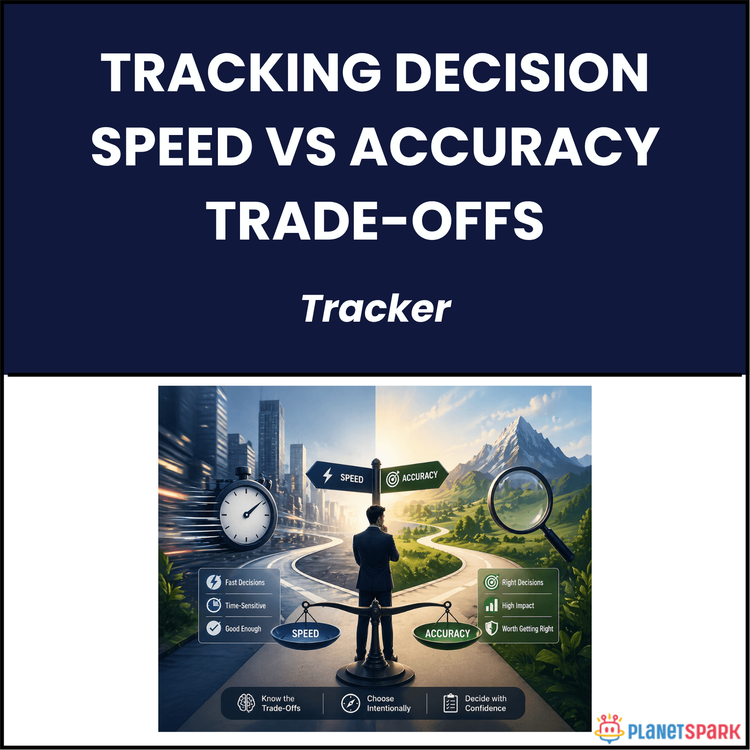
Tracking Decision Speed vs Accuracy Trade-Offs
How to Track and Master the Decision Speed vs Accuracy Trade-Off
Every professional has faced the pressure of making a fast decision. Whether in a meeting, client call, or job interview, you are often faced with a quick choice — and the clock is ticking. Do you act fast, or do you wait and deliberate? The truth is, both approaches come with their own costs, and knowing when to apply which is a critical skill. If you've ever found yourself second-guessing your decisions in high-stakes situations, you're not alone. The “Tracking Decision Speed vs Accuracy Trade-Offs” resource is designed to solve this problem, providing you with a repeatable system to know exactly when speed wins, when accuracy matters more, and how to avoid mistakes. This system helps you make smarter decisions, faster, without sacrificing quality.
Who Is This Resource For?
This resource is valuable for:
- Working professionals looking to enhance their decision-making skills.
- Career-driven individuals, managers, and leaders who need to make smart, quick decisions.
- Those who struggle with balancing speed and accuracy in high-pressure scenarios.
- Professionals who want to build confidence in their decision-making processes.
- Time-poor individuals who need actionable frameworks for decision-making under pressure.
What Does This Resource Contain?
This practical playbook equips you with tools and frameworks to master the speed vs accuracy trade-off. Here's a breakdown of what’s inside:
- The Speed-Accuracy Spectrum: Understand where your decisions fall on the scale, and how to adjust your approach based on decision type (reflex vs irreversible).
- The Decision Triage Framework: A step-by-step guide for evaluating decisions in real-time.
- Self-Assessment Tools: Determine your personal bias—whether you're more of a “Rusher” or a “Ruminator.”
- Weekly Decision Log: A tracker to monitor your decisions and improve your decision-making process over time.
- Situational Playbooks: Real-world examples and scenarios to apply the speed vs accuracy framework immediately.
- Key Takeaways & Reflection Questions: Use these to refine your decision-making skills consistently.
Summary of the Resource:
“Tracking Decision Speed vs Accuracy Trade-Offs” provides professionals with a powerful framework to make more confident, effective decisions. Whether you tend to rush decisions or overthink them, this resource gives you a systematic way to assess each decision, prioritize speed or accuracy accordingly, and improve your decision-making pattern for better outcomes.
How Will This Resource Be Useful?
This resource helps you make smarter decisions by giving you the tools to evaluate when speed is necessary and when accuracy is paramount. By mastering the balance between speed and accuracy, you’ll gain:
- Clear visibility into your decision-making process
- The ability to act decisively when needed, without sacrificing quality
- A method to overcome decision fatigue and second-guessing
- A framework for handling high-pressure scenarios efficiently
- Improved personal growth and leadership effectiveness through consistent decision-making
How Should You Use This Resource?
Start by reading through the entire guide to understand the frameworks and tools provided. Then, apply the following phased approach:
1. Diagnostic Phase: Use the 4-question triage framework to evaluate your decision type.
2. Self-Assessment: Complete the personal bias tracker to identify whether you tend to act too quickly (Rusher) or too slowly (Ruminator).
3. Live Use: Incorporate the weekly decision log into your routine to track decisions and their outcomes.
4. Review and Reflect: After 4 weeks, assess your progress by reviewing patterns and refining your decision rules.
5. Real-World Application: Implement the situational playbooks for key scenarios like job offers, client proposals, or hiring decisions.
Action Steps:
Here’s what you can do immediately after accessing the resource:
1. Block 1 hour to familiarize yourself with the frameworks.
2. Run through the 4-question triage the next time you face a significant decision.
3. Track your decisions using the Weekly Decision Log.
4. Assess your speed vs accuracy patterns weekly to fine-tune your approach.
5. Revisit the resource whenever you need to make a major decision or evaluate your decision-making process.
Remember, effective decision-making doesn’t require you to always move fast or always be perfect. It’s about knowing when to prioritize one over the other — and with this resource, you’ll have the tools to do just that.