
Tracking Deep Work Hours Vs Shallow Work

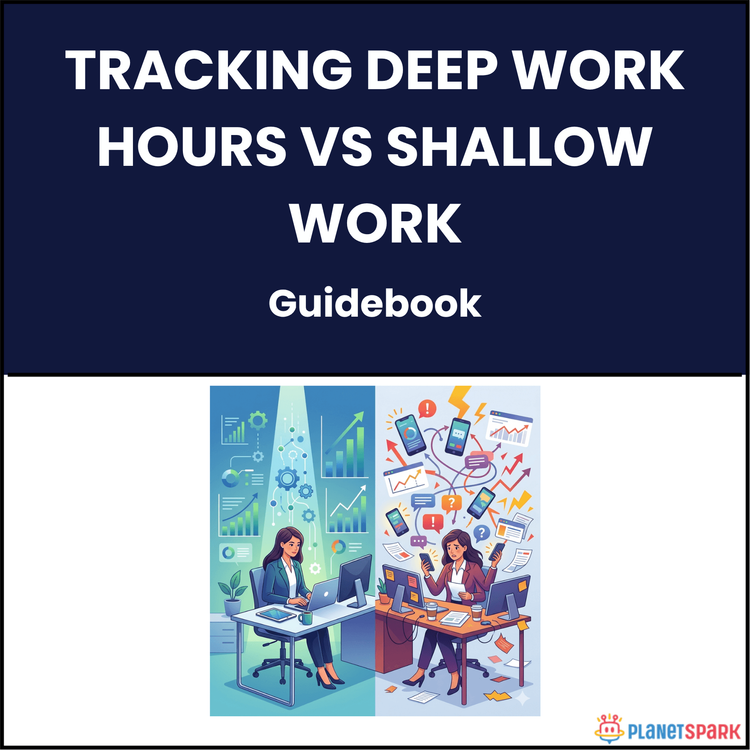
Tracking Deep Work Hours Vs Shallow Work
From Busy to Productive: A Practical Guide to Tracking Deep Work and Reducing Shallow Tasks
If you end most workdays feeling busy but not truly productive, you’re not alone. Most working professionals spend hours responding to emails, attending meetings, and handling urgent tasks—yet struggle to make meaningful progress on high-impact work.
The problem isn’t effort. It’s misallocation of attention.
That’s exactly why the resource “Tracking Deep Work vs Shallow Work” exists. It helps you understand where your time is actually going, identify hidden productivity leaks, and systematically increase the hours that truly move your career forward.
Instead of guessing where your time disappears, this guide gives you a clear, structured system to measure, improve, and protect your most valuable resource—focused attention.
Who Is This Resource For?
This resource is especially valuable if you are:
- A working professional with 0–15 years of experience
- A manager or team lead struggling with constant interruptions
- A consultant trying to increase billable, high-value output
- A career switcher building new skills alongside a busy schedule
- A knowledge worker who feels “busy all day” but underproductive
- Someone looking to build better focus, discipline, and work habits
If you want to stop reacting to work and start producing meaningful outcomes, this guide is built for you.
What Does This Resource Contain?
This is not a generic productivity guide. It is a structured, data-driven system designed for real-world application.
Inside the resource, you’ll find:
- Clear definitions of deep work vs shallow work with practical examples
- The 1-minute test to instantly categorize any task
- A step-by-step weekly time audit framework to measure your work patterns
- A Deep Work Ratio formula to track your true productivity
- A complete tracking system (journal, spreadsheet, or app-based)
- Daily scorecards to compare planned vs actual deep work
- A Deep Work Dashboard with key performance metrics
- A three-layer protection system (structural, environmental, social)
- Weekly planning worksheets to design focused work schedules
- Energy mapping frameworks to identify your peak cognitive hours
- A shallow work elimination system (eliminate, delegate, batch, automate)
- A 90-day transformation roadmap to build lasting habits
- Real-world case studies showing measurable productivity improvements
- Common mistakes and precise fixes to improve consistency
Everything is designed to help you take immediate action—not just consume information.
Summary of the Resource
“Tracking Deep Work vs Shallow Work” is a practical productivity system that helps you measure how you spend your time, identify low-value work, and deliberately increase high-impact, focused work.
It transforms productivity from a vague concept into a measurable, improvable system—so you can consistently produce better results without working longer hours.
If you’re serious about improving output, this resource gives you the structure to do it.
How Will This Resource Be Useful?
This resource helps you move from confusion to control.
You’ll gain:
- Clear visibility into how your work hours are actually spent
- A measurable productivity metric (Deep Work Ratio)
- Better focus and reduced distractions during important tasks
- Increased output without increasing working hours
- Stronger control over your schedule and priorities
- Improved work quality and professional performance
- Confidence in managing your time strategically
Most importantly, it helps you shift from “being busy” to “producing meaningful results.”
How Should You Use This Resource?
To get the best results, follow a structured approach:
Start by reading the entire guide once to understand the core concepts—deep work, shallow work, and how they differ.
Next, run a full 5-day time audit. Track your work in real time, every 30 minutes, and categorize each task honestly.
Once you have your baseline, calculate your Deep Work Ratio. This becomes your starting point for improvement.
Then, build your tracking system. Choose a simple method (journal, spreadsheet, or app) and start using daily scorecards to track planned vs actual deep work.
After that, implement the protection strategies. Block deep work on your calendar, reduce distractions, and communicate boundaries.
Finally, review your data weekly and refine your system. Gradually increase your deep work hours while reducing shallow work using the elimination framework.
You can revisit this system anytime you want to improve productivity, manage workload better, or prepare for high-impact projects.
Action Steps
After accessing this resource, take these steps immediately:
1. Block one full week to track your work in real time
2. Set up your time tracking sheet (Deep vs Shallow work)
3. Log your tasks every 30 minutes for 5 working days
4. Calculate your Deep Work Ratio at the end of the week
5. Identify your biggest time leaks and distractions
6. Schedule at least one daily deep work block for the next week
7. Start reducing shallow work using elimination, delegation, or batching
Small changes in how you use your time can create massive improvements in output and career growth.
Your time is already being spent. The question is whether it’s being invested in work that actually matters.
When you start tracking and protecting deep work, you take control of your productivity, your performance, and your professional growth.
This resource is not just about working better—it’s about working on what truly counts.
Book your free session today!