
Tracking Identity Experiments to Discover What Fits You Best

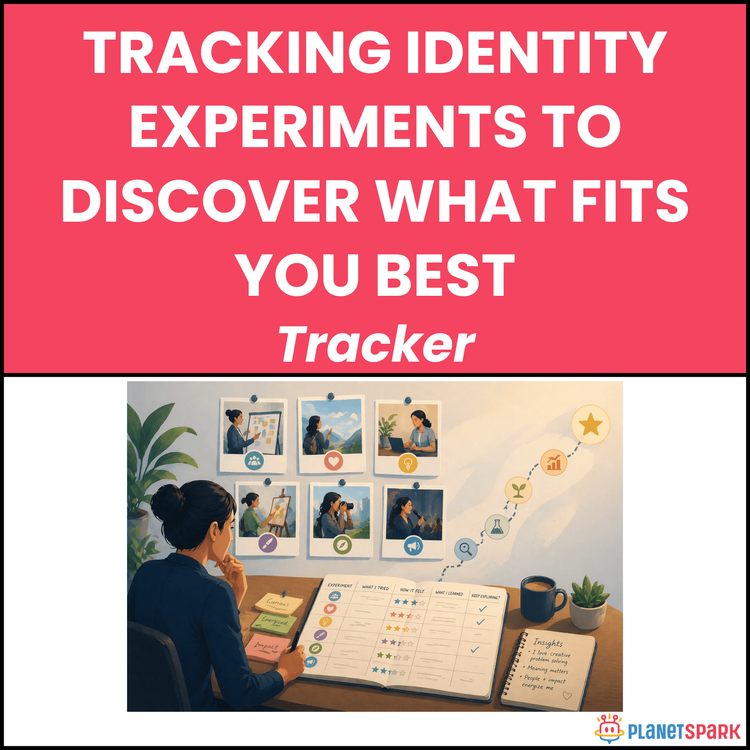
Tracking Identity Experiments to Discover What Fits You Best
Recording Identity Experiment Activities: A Practical System to Discover What Truly Fits Your Career
If you’ve ever felt stuck in your career—not unhappy enough to quit, but not fulfilled enough to feel confident about your next move—you’re not alone. Many working professionals operate on assumptions: what they think they’ll enjoy, what they believe they’re good at, or what they’ve been told they “should” pursue.
The problem? Most career decisions are made without real evidence.
That’s exactly why the resource “Tracking Identity Experiments to Discover What Fits You Best” exists. Instead of guessing your next move, this practical tracker helps you test, observe, and validate what actually energises and fulfils you—using your own real-world experiences as data.
This isn’t about overthinking your career. It’s about running small, structured experiments that lead to big clarity over time.
Who Is This Resource For?
This resource is especially useful if you are:
- A working professional (0–15 years of experience) feeling uncertain about your career direction
- Someone experiencing vague dissatisfaction but unable to pinpoint why
- A career switcher trying to explore new paths without taking big risks
- A professional considering role transitions, promotions, or internal moves
- A high-performer who feels competent—but not necessarily fulfilled
- Someone who wants clarity based on evidence, not assumptions
If you’re tired of guessing and want a structured way to understand what truly fits you, this tracker is built for you.
What Does This Resource Contain?
This is not a theoretical career guide—it’s a hands-on system designed for immediate application.
Inside the resource, you’ll find:
- A clear explanation of identity experiments and why they matter in modern careers
- A 4-phase Identity Experiment System: Design, Act, Observe, Reflect
- Step-by-step guidance to create your own identity experiments
- A structured method to define hypotheses about your career preferences
- A weekly experiment log to track key signals like energy, engagement, meaning, and growth
- A detailed reflection protocol to interpret your data effectively
- A framework to identify patterns across multiple experiences
- The Identity Map system to build a long-term evidence-based career profile
- A real-world case study showing how structured experiments lead to confident career moves
- Ready-to-use worksheets, checklists, and reflection prompts
- A self-evaluation tool to help you understand where you are in your career exploration journey
Everything is designed to be lightweight, practical, and repeatable—even for busy professionals.
Summary of the Resource
“Tracking Identity Experiments to Discover What Fits You Best” is a structured, evidence-based system that helps you make better career decisions by testing—not guessing.
Instead of relying on intuition alone, you’ll run small, time-bound experiments, track your real experiences, and build a clear understanding of what energises, drains, and motivates you.
In just a few weeks, you begin to see patterns. In a few months, you build undeniable clarity.
How Will This Resource Be Useful?
This resource helps you move from confusion to clarity—with real data to back your decisions.
You’ll gain:
- A clear understanding of what types of work energise vs. drain you
- Confidence in making career decisions backed by evidence
- A structured way to test new roles, skills, or responsibilities safely
- Reduced risk when considering career transitions or pivots
- Better self-awareness about your strengths, values, and motivations
- A repeatable system you can use throughout your career
Most importantly, it helps you stop relying on guesswork—and start making decisions based on lived experience.
How Should You Use This Resource?
To get the most value, follow a simple, phased approach:
Start by reading through the entire guide once. This gives you a clear understanding of how identity experiments work and how each step connects.
Next, design your first experiment. Define a specific hypothesis about yourself—for example, whether you enjoy leadership, independent work, or creative problem-solving.
Then, run the experiment in a real-world setting. Choose a small, low-risk activity within your current role that allows you to test your hypothesis over 2–4 weeks.
As you go, use the weekly log to track your experience. Focus on internal signals like energy, engagement, meaning, and growth—not just external success.
At the end of the experiment, reflect on your data. Identify patterns, insights, and surprises. Write a short evidence statement about what you’ve learned.
Finally, add your insights to your Identity Map. Over time, this becomes a powerful, evidence-based guide for your career decisions.
Repeat this cycle with new experiments to build deeper clarity.
Action Steps
After accessing this resource, take these steps immediately:
1. Write one clear identity hypothesis you want to test
2. Define a small, real-world experiment you can run within the next 2–4 weeks
3. Block a recurring 10-minute weekly slot in your calendar for tracking
4. Start logging your energy, engagement, and feedback each week
5. Complete your first reflection at the end of the experiment
6. Document your insights in an Identity Map
7. Plan your next experiment based on what you’ve learned
Consistency—not intensity—is what creates clarity here.
Your career isn’t something you figure out once and get right forever. It’s something you build, refine, and evolve over time. The professionals who move forward with confidence aren’t the ones who guess correctly—they’re the ones who test, learn, and adapt quickly.
This resource gives you a system to do exactly that. One experiment at a time, you replace uncertainty with evidence, hesitation with clarity, and confusion with direction.