
Tracking Patterns Of Trust And Distrust In Workplace Relationships

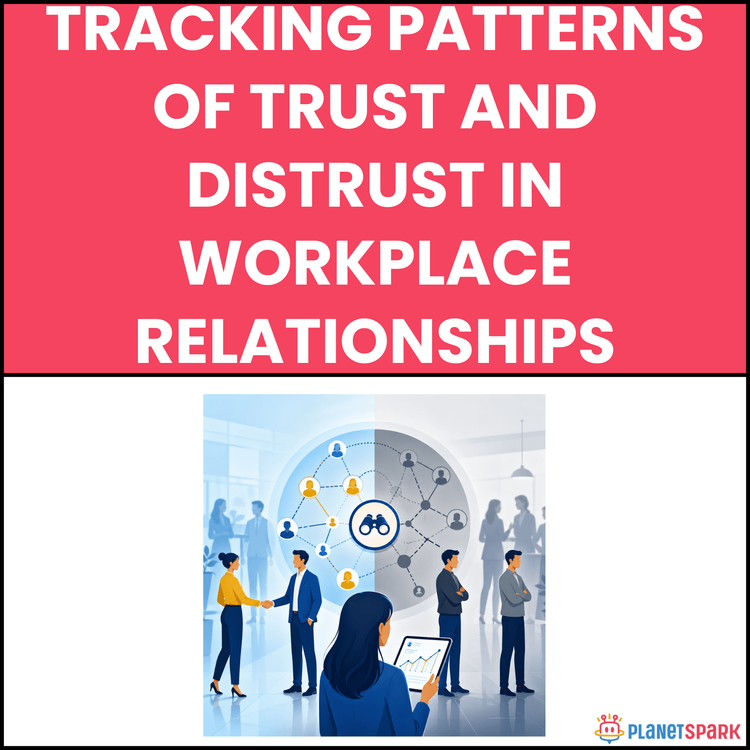
Tracking Patterns Of Trust And Distrust In Workplace Relationships
A Practical System to Track and Improve Workplace Relationships
Most professionals don’t struggle because they lack skills.
They struggle because they don’t fully understand the relationships around them.
You’ve probably felt it before—being left out of key conversations, not getting credit for your work, or sensing that something is “off” with a colleague or manager. But without clear evidence, you either overthink it or ignore it.
That’s where most careers quietly stall.
The resource “Tracking Patterns of Trust & Distrust in Workplace Relationships” solves this exact problem by giving you a structured, practical system to observe, track, and respond to trust dynamics—so you can act with clarity instead of guesswork.
Who Is This Resource For?
This resource is highly relevant if you are:
- A working professional trying to navigate workplace dynamics more effectively
- A manager looking to build or repair trust within your team
- A consultant managing multiple stakeholders and client relationships
- A career switcher trying to “read the room” in a new environment
- An early to mid-career professional who wants more visibility, influence, and growth
If your success depends on people (and it always does), this tracker is for you.
What Does This Resource Contain?
This is not a generic guide on “building trust.” It is a structured tracking system designed for real-world use.
Here’s what’s inside:
- A clear framework explaining how trust actually shows up at work
(based on communication, inclusion, reciprocity, and psychological safety — explained on page 3) - Visual breakdown of:
- Trust builders (consistent communication, inclusion, follow-through)
- Distrust signals (exclusion, broken commitments, withheld information)
- Ambiguous signals and relationship anchors (page 3 diagram)
- Relationship Mapping Worksheet
Helps you identify 5–7 high-impact relationships to track - Daily Signal Log Template
A structured way to record factual observations (not assumptions) - Weekly Pattern Review System
Includes 4 key questions to identify trends and relationship direction (page 6) - Categorisation Framework:
- Ascending trust
- Stable neutral
- Declining trust
- Strategic Response Playbook:
- What to do when trust is declining
- How to deepen high-trust relationships
- How to avoid reactive mistakes
- Real-world case study (Meera’s story)
Shows how pattern tracking leads to confident, non-confrontational action - Weekly checklist and monthly review templates
For ongoing relationship management
Everything is designed to move you from intuition → data → action.
Summary of the Resource
In simple terms:
This resource helps you stop guessing about workplace relationships and start managing them strategically.
Instead of reacting to isolated incidents, you learn to:
- Track patterns over time
- Identify whether trust is growing or declining
- Take informed, professional action
How Will This Resource Be Useful?
Most professionals rely on instinct when it comes to relationships—and instinct is often unreliable under pressure.
This resource helps you:
- Gain clarity on confusing workplace dynamics
- Reduce overthinking and emotional reactions
- Identify hidden trust issues early
- Improve visibility, credibility, and influence
- Build stronger, more reliable professional relationships
- Navigate conflicts with confidence and data
- Make smarter career decisions based on real patterns
As highlighted in the guide, trust is not a single moment—it’s a pattern of behaviour over time. This shift alone can completely change how you operate at work.
How Should You Use This Resource?
To get results, consistency matters more than intensity.
Here’s the best way to use it:
Step 1: Identify Key Relationships
Use the mapping worksheet to select 5–7 people who impact your work most.
Step 2: Start Daily Observation
Log simple, factual interactions:
- What happened
- Who was involved
- What type of signal it was
Keep it objective—not emotional.
Step 3: Review Weekly
Spend 10–15 minutes answering:
- How often signals appeared
- Trust vs distrust balance
- Context patterns
- Your own contribution
Step 4: Identify Patterns
After 2–3 weeks, classify relationships as:
- Growing (ascending trust)
- Stable
- Declining
Step 5: Act Strategically
Use the response framework:
- Address issues calmly using pattern data
- Increase visibility where needed
- Invest more in high-trust relationships
Step 6: Repeat and Refine
Use the weekly checklist and monthly review to continuously improve.
Action Steps
Start immediately with this simple plan:
- List your top 5 workplace relationships
- Create a basic daily log (notes app or notebook)
- Record at least 3 observations this week
- Schedule a 10-minute weekly review (Friday)
- Identify one relationship where trust feels unclear
- Commit to tracking it for 2–3 weeks before reacting
This small system can change how you navigate your entire workplace.
The professionals who grow fastest are not always the most talented.
They are the ones who understand relationships clearly—and act on that understanding.
This resource gives you that advantage.
Instead of reacting emotionally, you start operating strategically. Instead of guessing, you rely on patterns. Instead of feeling stuck, you take control.
You don’t need better instincts. You need a better system.
Now you have one.