
Transition Narrative Storytelling Examples

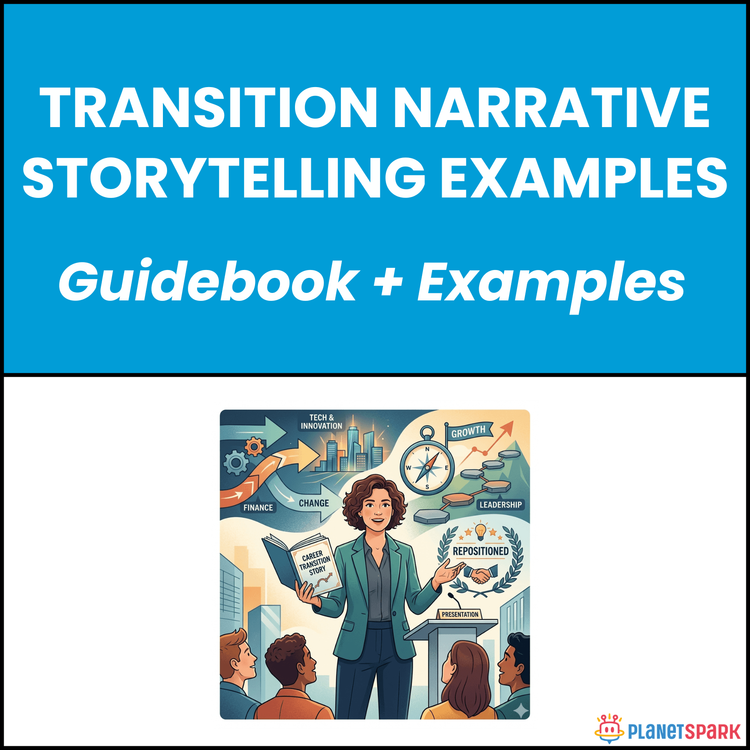
Transition Narrative Storytelling Examples
How to Craft a Powerful Career Transition Story
Most professionals going through a career transition make one critical mistake: they focus on listing what they’ve done instead of explaining why it all makes sense for where they’re going.
The result? Confused recruiters, weak interview answers, and missed opportunities—not because of lack of capability, but because of poor storytelling.
The Transition Narrative Storytelling guidebook exists to solve this exact problem. It gives you a structured, repeatable system to turn your career history into a clear, compelling story that builds trust, reduces doubt, and positions you as the right fit—even when your background is non-traditional.
Who Is This Resource For?
This guidebook is designed for:
- Career switchers moving across industries or roles
- Early to mid-career professionals (0–15 years experience)
- Managers stepping into leadership or strategic roles
- Consultants repositioning their expertise
- Job seekers struggling with “Tell me about yourself”
- Professionals with non-linear career paths or multiple pivots
If you’ve ever struggled to explain your career transition clearly and confidently, this resource is built for you.
What Does This Resource Contain?
This guidebook is structured into a step-by-step storytelling system, combining proven frameworks, templates, and real-world examples:
1. Understanding Transition Narratives
Learn what a strong transition story actually is:
- Not a resume summary
- Not an apology
- A forward-facing, trust-building narrative
Introduces the core structure: Hook → Bridge → Forward Direction
2. Experience Audit Framework
A structured method to extract your strongest material:
- Identify peak moments
- Translate experience into transferable skills
- Spot patterns across roles
- Define your “Through-Line” (your core professional identity)
3. Through-Line Builder
The most critical part of your story:
- A single sentence that connects your past to your future
- A formula to define your core strength and direction
- Helps transform a “random career” into a coherent narrative
4. ABT Framework (And–But–Therefore)
A powerful storytelling structure:
- AND → Your background and strengths
- BUT → Your transition reason (the pivot)
- THEREFORE → Your forward direction
Helps you answer:
- “Tell me about yourself”
- “Why are you changing careers?”
5. STAR-T Method for Proof
A structured way to add credibility:
- Situation, Task, Action, Result, Transfer
- The “Transfer” step connects past experience to future roles
6. Multi-Context Narrative Versions
Learn how to adapt your story for:
- 30-second networking pitches
- 2-minute interview answers
- LinkedIn About sections
- Referral and consulting conversations
7. Plug-and-Play Templates
Ready-to-use formats for:
- Elevator pitch
- Interview responses
- LinkedIn summaries
- Referral conversations
8. Real-World Case Studies
Examples of successful transitions:
- Finance → UX Design
- Teacher → L&D Consultant
- Engineer → Product Manager
Shows exactly how strong narratives are built and delivered
9. Common Mistakes & Fixes
Avoid critical errors like:
- Apology-based storytelling
- Resume recitation
- Vague pivot reasons
- Skill dumping
10. LinkedIn Narrative Optimization
A complete structure to turn your LinkedIn About section into a compelling story that attracts opportunities
11. Self-Evaluation Checklist
A practical tool to test:
- Clarity
- Strength
- Relevance
- Delivery readiness
Summary of the Resource
In simple terms, this guide helps you do three powerful things:
- Turn your career history into a clear, logical story
- Explain your transition with confidence and credibility
- Position yourself as an opportunity—not a risk
It transforms storytelling from something vague and uncomfortable into a structured professional skill.
How Will This Resource Be Useful?
This guidebook delivers immediate, real-world impact:
- Stronger Interviews: You answer “Tell me about yourself” with clarity and confidence
- Better Positioning: You control how others perceive your transition
- Higher Credibility: You back your claims with structured proof (STAR-T)
- Clear Direction: You articulate exactly where you’re going and why
- More Opportunities: Recruiters and decision-makers understand your value faster
- Consistent Messaging: Your resume, LinkedIn, and conversations all align
Most importantly, it helps you shift from “hoping they understand your background” to making your story impossible to misunderstand.
How Should You Use This Resource?
To get the best results, follow this structured approach:
Step 1: Start With the Experience Audit
List your roles, identify peak moments, and extract transferable skills.
Step 2: Define Your Through-Line
Write and refine your core professional identity in one sentence.
Step 3: Build Your ABT Narrative
Structure your story into:
- Context (AND)
- Pivot (BUT)
- Direction (THEREFORE)
Step 4: Add Proof Using STAR-T
Prepare at least 3 stories:
- Leadership
- Problem-solving
- Adaptability
Step 5: Create Multiple Versions
Develop:
- 30-second pitch
- 2-minute interview answer
- Written LinkedIn version
Step 6: Tailor for Your Audience
Adjust your narrative depending on:
- Recruiters
- Hiring managers
- Networking conversations
Step 7: Validate and Practice
Use the checklist to refine your story and practice delivering it out loud.
Action Steps
If you want to start immediately, follow these steps:
1. Write one sentence: “The problem I have always been trusted to solve is…” (repeat 3–5 times)
2. Identify your top 3 transferable skills
3. Draft your Through-Line using the formula
4. Build your first ABT story (keep it under 2 minutes)
5. Create one STAR-T story with a clear “Transfer” line
6. Record yourself explaining your story once
7. Refine based on clarity and confidence
8. Update your LinkedIn About section using your narrative
These actions will immediately improve how you communicate your career story.
Your career transition is not something you need to justify—it is something you need to position.
When you learn how to tell your story with structure, clarity, and confidence, everything changes. Interviews feel easier. Networking becomes more natural. Opportunities become more accessible.
Because people don’t just respond to experience—they respond to clarity.
And clarity is a skill you can build.
Book your free session today!
https://www.planetspark.in/parents/c/start_v235?lp_type=181&utm_source=resources&utm_source_info=ps_resources/working-professionals/guidebook-example-on-transition-narrative-storytelling-examples&utm_medium=ps_resources_tanvi_sharma_tas#card1