
Transition Narrative Storytelling Worksheet

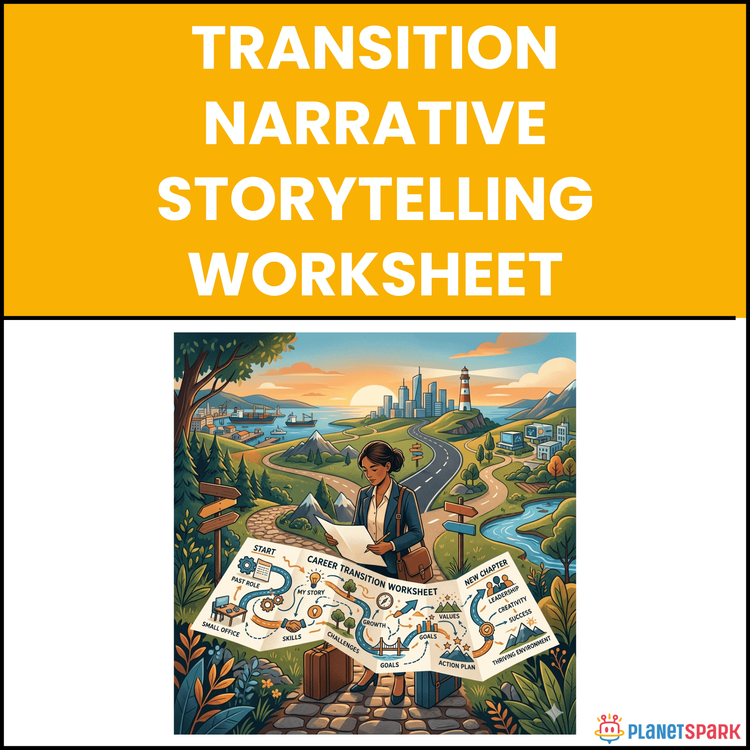
Transition Narrative Storytelling Worksheet
How to Craft a Career Transition Story That Makes Employers Say “This Makes Sense”
Let’s address the real problem—your resume is not the issue.
Your story is.
Most professionals can list their experience. Very few can explain it.
So when someone asks, “Walk me through your background,” what happens? Rambling. Over-explaining. Or worse—apologising for a non-linear career.
That’s not a confidence gap. It’s a structure gap.
The Transition Narrative Storytelling Worksheet exists to fix exactly that. It gives you a step-by-step system to turn your career journey into a clear, logical, and convincing story that hiring managers can actually trust. [oaicite:0]{=0}
Who Is This Resource For?
This resource is built for professionals navigating change—not just roles, but direction.
It’s especially valuable if you are:
- A career switcher moving into a new domain or function
- A professional with a non-linear or “messy” career path
- Someone struggling to answer “Tell me about yourself” clearly
- A job seeker failing to justify their transition convincingly
- A consultant or freelancer repositioning their expertise
- A mid-career professional aiming for strategic roles
If your experience is strong—but your story doesn’t land—this is exactly what you need.
What Does This Resource Contain?
This is not theory. It’s a structured narrative-building system.
Here’s what you get inside:
1. The Anatomy of a Strong Transition Narrative
- Hook (clear, confident opening)
- Bridge (logical connection between past and future)
- Destination (clear direction and intent)
As explained on page 3, strong narratives are honest, relevant, and forward-looking—not chronological summaries. [oaicite:1]{=1}
2. Career Capital Inventory
- Identify transferable skills, knowledge, and relationships
- Map how your past experience applies to your future role
3. “Why Now” Framework
- Define your transition trigger with clarity
- Replace vague reasoning with credible, professional intent
4. Narrative Bridge Framework
- Structured formula: Past → Transfer → Future value
- Turns your experience into a logical business case
5. 60-Second Transition Pitch
- Setup → Pivot → Bridge → Forward
- A ready-to-use answer for interviews and networking
6. Context Switching Strategy
- Adapt your story for recruiters, hiring managers, and networking conversations
7. Real-World Case Study
- Example showing how a weak narrative becomes a compelling one
8. 30-Day Narrative Action Plan
- Step-by-step execution from drafting to testing to refining
9. Narrative Readiness Assessment
- Score your clarity, logic, and delivery before real conversations
Summary of the Resource
The Transition Narrative Storytelling Worksheet is a practical system that helps you move from:
“My background is a bit different…”
to
“Here’s exactly why my experience makes me the right fit.”
It transforms your career story from a justification into a strategy.
How Will This Resource Be Useful?
This is where the real ROI shows up.
After using this resource:
- You stop sounding uncertain or defensive
- You explain your career transition with clarity and logic
- You handle interviews with structured, confident answers
- You align your resume, LinkedIn, and conversations into one narrative
- You reduce hiring risk perception instantly
Because here’s the truth:
Employers don’t reject “non-linear careers.”
They reject unclear stories.
Fix the story—and you fix the perception.
How Should You Use This Resource?
Don’t treat this like reading material. Treat it like a working system.
Step 1: Read once for structure
Understand how Hook, Bridge, and Destination work together.
Step 2: Complete the Career Capital Inventory
List what you actually bring—skills, knowledge, relationships.
Step 3: Define your “Why Now”
Make it specific, professional, and forward-looking.
Step 4: Build your Narrative Bridge
Connect your past to your future logically—not emotionally.
Step 5: Draft your 60-second pitch
Use Setup → Pivot → Bridge → Forward.
Step 6: Practice and refine
Speak it out loud. If it sounds scripted, fix it.
Step 7: Test in real conversations
Networking calls > theory.
This is iterative. Your narrative improves with use.
Action Steps
If you want immediate clarity, do this today:
1. Block 45–60 minutes of focused time
2. Write down 5 transferable skills from your past roles
3. Define your “Why Now” in 2–3 clear sentences
4. Draft your Bridge statement (Past → Future value)
5. Build your 60-second transition pitch
6. Practice it out loud at least 3 times
Execution beats perfection here.
Most professionals are not confused about their career.
They’re confused about how to explain it.
This worksheet fixes that by forcing structure, clarity, and logic into your story.
Because in the end, hiring decisions are not just about what you’ve done.
They’re about whether your journey makes sense.
Make it make sense—and opportunities follow.
Book your free session today!