
Understanding the Psychology Behind Workplace Silence and Withholding

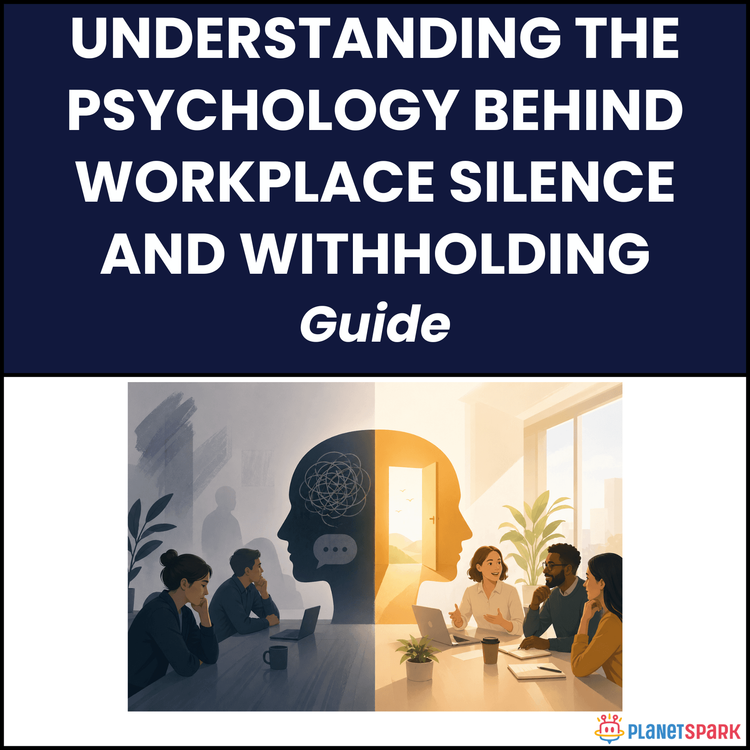
Understanding the Psychology Behind Workplace Silence and Withholding
Understanding Workplace Silence and Withholding: A Practical Guide to Building Open, High-Trust Teams
If you’ve ever sat in a meeting where everyone agreed too quickly—or worse, said nothing at all—you’ve already experienced one of the most invisible risks in professional life: workplace silence.
Projects fail, opportunities are missed, and teams underperform not because people lack ideas—but because those ideas never get voiced. For many working professionals, the challenge isn’t just communication skills. It’s understanding when, why, and how silence happens in the first place.
That’s exactly why the resource “Understanding the Psychology Behind Workplace Silence and Withholding” exists. It helps professionals decode what’s not being said, understand the hidden dynamics behind silence, and take practical steps to build environments where honest communication becomes the norm—not the exception.
Who Is This Resource For?
This resource is especially valuable if you are:
- A working professional navigating team dynamics and communication challenges
- A manager or team leader trying to encourage honest feedback
- A consultant diagnosing organisational or team performance issues
- A mid-career professional aiming to build influence and visibility
- An individual contributor who struggles with when and how to speak up
- Someone working in environments where important conversations are often avoided
If you’ve ever felt that critical information is being held back—or that you’re holding back yourself—this guide is built for you.
What Does This Resource Contain?
This is not a surface-level communication guide. It’s a deep, structured exploration of the psychology behind silence, combined with actionable frameworks.
Inside the resource, you’ll find:
- A breakdown of why workplace silence is never accidental—but a psychological decision
- The four types of silence: acquiescent, defensive, pro-social, and opportunistic
- A neuroscience-backed explanation of why people default to staying quiet
- Key drivers of information withholding, including fear, power dynamics, and perceived futility
- The Silence Cost Equation framework to understand decision-making behind speaking up
- The Silence Gradient model explaining how hierarchy filters information
- A diagnostic checklist to identify silence patterns within teams
- A clear explanation of psychological safety and what it truly means (and doesn’t mean)
- The four stages of psychological safety to assess team maturity
- A practical Speak-Up Decision Framework for individuals
- A manager playbook with behaviours that reduce or amplify silence
- A self-audit worksheet for leaders to assess their impact on team communication
- A real-world case study illustrating the cost of silence in action
- Common leadership mistakes that unintentionally reinforce silence
- A personal voice strategy framework for professionals
- A reusable Voice Strategy Planner worksheet
- A 30-day action plan to turn insights into behavioural change
Everything is designed to help you move from awareness to action—quickly and practically.
Summary of the Resource
“Understanding the Psychology Behind Workplace Silence and Withholding” is a comprehensive, action-oriented guide that helps professionals recognise, diagnose, and address silence in the workplace.
It goes beyond theory to show you exactly how silence forms, why it persists, and what you can do—whether you’re an individual contributor or a leader—to create more open, effective communication environments.
If you want to improve team performance, decision-making, and trust, this resource gives you the clarity and tools to start immediately.
How Will This Resource Be Useful?
This resource helps you shift from confusion to clarity when it comes to workplace communication.
You’ll gain:
- A clear understanding of why people stay silent—even when it’s costly
- The ability to identify different types of silence and respond appropriately
- Practical frameworks to encourage more honest, productive conversations
- Improved decision-making through better information flow
- Stronger leadership capability by creating psychologically safe environments
- Increased personal confidence in speaking up strategically
- Better team performance, trust, and collaboration
Most importantly, it helps you stop misinterpreting silence—and start addressing the real issues behind it.
How Should You Use This Resource?
To get the most value, approach this guide in phases:
Start by reading through the entire resource once. This gives you a complete mental model of how workplace silence works.
Next, focus on diagnosis. Use the silence checklist and frameworks to observe patterns in your team or organisation. Pay attention to where, when, and why silence occurs.
Then, move into application. If you’re a manager, start implementing silence-reducing behaviours and use the self-audit to guide improvement. If you’re an individual contributor, apply the Speak-Up Decision Framework and build your personal voice strategy.
After that, use the worksheets—especially the Voice Strategy Planner—to prepare for real conversations where speaking up matters.
Finally, follow the 30-day action plan to build consistent habits and create lasting change in how you and your team communicate.
This resource is not meant to be read once—it’s designed to be revisited as your role, environment, and challenges evolve.
Action Steps
After accessing this resource, take these steps immediately:
1. Reflect on the last 2–3 situations where silence affected outcomes in your work
2. Identify the type of silence involved (defensive, acquiescent, pro-social, or opportunistic)
3. Use the diagnostic checklist to assess your team’s communication patterns
4. Choose one silence-reducing behaviour to practice this week
5. Prepare for one important conversation using the Voice Strategy Planner
6. Commit to the 30-day action plan to build long-term communication habits
Small, intentional actions here can significantly improve trust, clarity, and performance.
Workplace silence is not a personality problem—it’s a system problem. And once you understand the system, you can start changing it.
Whether you’re leading a team or contributing within one, your ability to recognise and navigate silence is a powerful professional advantage. It shapes not just how you communicate—but how you influence, lead, and grow.
Use this resource to build that advantage. Because the most successful professionals aren’t just those who have great ideas—they’re the ones who know how to ensure those ideas are heard.