
Understanding Why People Behave Differently At Work Vs Outside

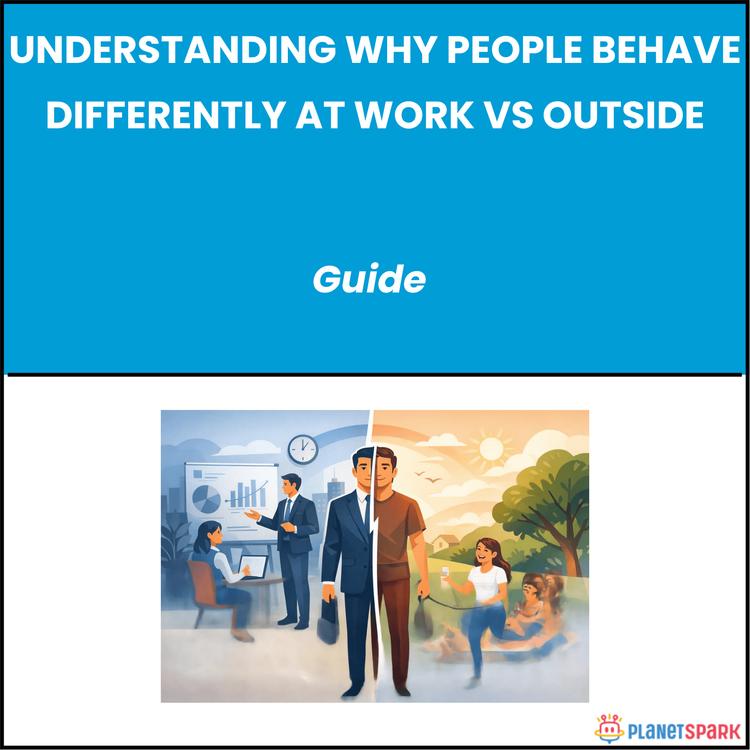
Understanding Why People Behave Differently At Work Vs Outside
Understanding Why People Behave Differently at Work vs. Outside: A Practical Guide
People don’t change who they are—they adapt how they show up. The “Behavioural Context Guide” helps professionals decode why colleagues act differently in formal work settings compared to informal ones, and how to use that insight to build stronger connections.
Who Is This Resource For?
This guide is designed for:
- Career switchers navigating new environments
- Early-to-mid career professionals (0–15 years experience)
- Consultants working across diverse teams
- Managers leading through complex dynamics
- Anyone curious about workplace behaviour shifts
If you want to understand and respond to behavioural differences strategically, this resource is built for you.
What Does This Resource Contain?
Inside the guide, you’ll find:
- Introduction: Why colleagues seem different at work vs. outside
- The Science Behind the Shift (role-bound identity, evaluation anxiety, power distance, norms, stakes)
- Module 1: The Five Forces shaping workplace behaviour
- Module 2: The Context-Behaviour Matrix (communication, emotion, risk, feedback, relationships)
- Module 3: Behavioural Personas (armoured professional, stage manager, compliance adapter)
- Module 4: Self-awareness worksheet for mapping your own behavioural gap
- Module 5: Decoding framework for reading others
- Module 6: Psychological safety as the key to authentic behaviour
- Deep dive: Introverts vs. extroverts across contexts
- Module 7: Cultural conditioning and workplace masks
- Case study showing hidden talent revealed outside formal settings
- Common mistakes and fixes
- 30-day practice plan for building contextual intelligence
Summary of the Resource
The “Behavioural Context Guide” is a structured toolkit that reframes workplace behaviour as context-driven adaptation. It ensures professionals can decode shifts, avoid misjudgments, and create conditions where colleagues bring their best selves to work.
How Will This Resource Be Useful?
By applying this guide, you’ll gain:
- Clarity on why behaviour shifts across contexts
- Confidence in interpreting colleagues’ actions
- Awareness of cultural and personality influences
- Tools to create psychological safety
- Strategies to unlock authentic contributions
- Long-term resilience through contextual intelligence
How Should You Use This Resource?
Follow a phased approach:
1. Audit your own behavioural shifts with the self-awareness worksheet.
2. Use the Context-Behaviour Matrix to map colleagues’ differences.
3. Apply the decoding framework in real-time interactions.
4. Build psychological safety in your team.
5. Adjust for introvert/extrovert dynamics.
6. Factor in cultural conditioning.
7. Practise contextual intelligence daily with the 30-day plan.
Action Steps
After accessing this resource, take these immediate steps:
1. Write down three ways you behave differently at work vs. outside.
2. Map one colleague’s behaviour using the Context-Behaviour Matrix.
3. Identify one trigger that shifts their behaviour.
4. Adjust your approach in your next interaction to reduce evaluation anxiety.
5. Ask one curiosity-driven check-in question this week.
6. Reflect on whether you created psychological safety in your last meeting.
Behavioural shifts aren’t inauthentic—they’re adaptive. With this guide, you can move from misreading colleagues to decoding them, ensuring your workplace relationships are stronger, more empathetic, and more effective.
Book your free session today!